The illustrated growing guide

Bee Balm

Monarda didyma

Family Lamiaceae

Est. zones 4-9

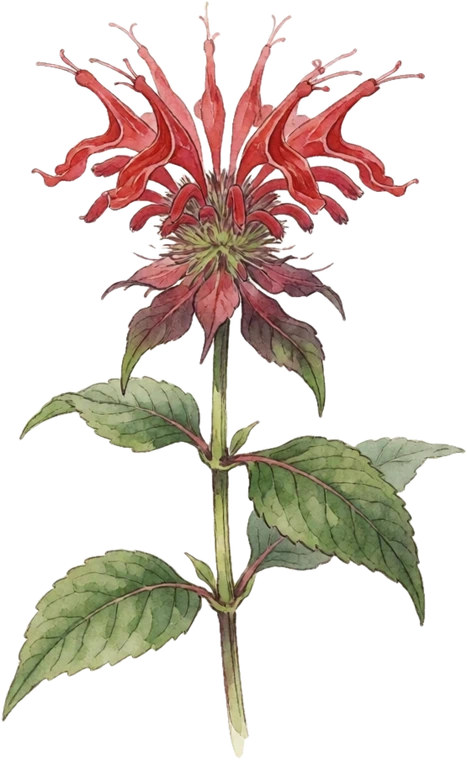
Botanical illustration of Bee Balm
Perennial · Monarda didyma

Nothing in the yard outdraws it for hummingbirds in July — a patch hums audibly. Buy mildew-resistant names only and give it elbow room to breathe.

Perennial · NativeFull Sun to Light ShadeModerate waterFast growthNative to North AmericaAttracts hummingbirdsAttracts bees

⚠ Spreads aggressivelyBee Balm spreads aggressively — mints and their kin send out underground runners and are extremely hard to get rid of once they're in the ground. Grow it in a sunken pot or a fully contained bed, never loose in open soil.

Where to buy the plant — 2 nurseries

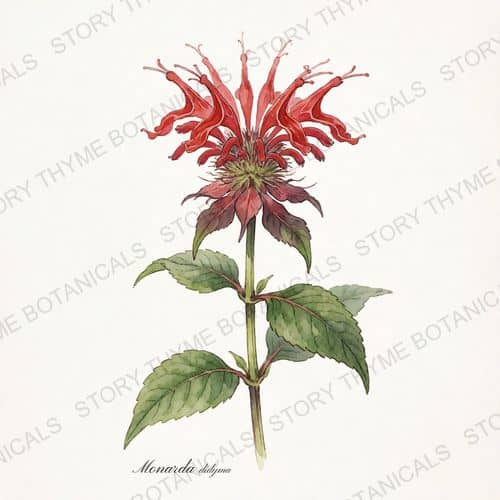
Bee Balm — a print from the Tea Herbs collection

From the print shop

Growing bee balm? Hang it.

Our Tea Herbs collection carries bee balmMonarda didyma, print Nº 5, “Bee Balm.”

16 designsfrom $21.99white or black groundmatte poster, unframed

Shop Tea Herbs botanical prints →

I

Overview

Will bee balm suit your garden, and what goes wrong.

Will it fruit where you are?

Enter your ZIP — we look up your USDA hardiness zone (2023 map) and check it against what bee balm actually needs.

Hardy inZones 4-9

Bee Balm at a glance

HardinessUSDA 4–9
Mature size2-4 ft, spreading patch
PollinationHummingbird + bumblebee riot
Chill requirementNot yet established
Bloom seasonJuly - August
Harvest seasonLeaves for bergamot tea (it's the Oswego tea plant)
Growth rateFast (runs like mint's polite cousin)

Common bee balm problems

II

Growing

Light, water, soil, propagation and the season’s jobs.

How to grow bee balm: light, water & soil

LightFull Sun to Light Shade
WaterModerate — mildews worst when drought-stressed
SoilRich, moist · pH 6.0 - 7.0
FertilizerSpring compost
PruningSpring — Thin stems by a third in May for airflow (mildew defense); deadhead for a second flush; edge the patch yearly.
Spacing18-24 in

How to plant & propagate bee balm

PropagateDivision or seed

When to spray bee balm

Growing season. Choose resistant cultivars + thin stems; or accept gray August leaves after bloom.

The bee balm growing playbook

Field-tested instructions for every job bee balm asks of you, compiled from university extension guidance — in the order the season brings them.

Planting out

Plant in full sun and give it room to breathe

Set bee balm in full sun and space plants 2 to 2 and a half feet apart. Skip the partly shaded, crowded corner even though it will survive there. Powdery mildew intensifies on overcrowded plants and on plants in partial to heavy shade, so spacing and sun are the cheapest disease control you will ever apply - they dry the leaf surface the fungus needs.

Watering

Water at the base, never over the leaves

Keep the soil lightly moist through summer, but deliver water to the ground at the crown rather than sprinkling the foliage. Avoid overwatering, which raises humidity in the canopy. Bee balm wants moisture at the root but wet foliage and humid air are what let powdery mildew and rust take hold, so the delivery method matters as much as the amount.

Dividing

Divide the clump every 2 to 3 years as growth appears

As soon as new growth shows in spring, dig the clump and cut it into sections with a sharp knife, keeping several shoots and a good root system on each. Replant the divisions immediately. Bee balm travels on underground rhizomes and the center of an old clump dies out while the edges crowd themselves - dividing rejuvenates the plant, checks its spread, and reopens the airflow that keeps mildew down.

Pruning

Clear the diseased leaf litter, but leave the stems standing

Rake up and destroy the fallen mildewed foliage and any infected debris rather than composting it cold. Cut the dead stems back to 12 to 24 inches and leave those stubs standing through winter. Iowa State advises removing and destroying disease-infested debris in fall, because the litter carries the spores that start next season's epidemic. NC State adds the reason the stubs stay: native bees nest in the dead hollow stems, so cut back to 12 to 24 inches and let them stand until they disintegrate on their own.

What to watch for

Watch for the grayish-white powder, on both leaf faces

Through warm humid weather, check leaves low and inside the clump where air moves least, turning them to look at both the upper and lower surfaces. You are looking for a grayish white powdery film, and for leaves dropping early. Powdery mildew produces its spores on both upper and lower leaf surfaces and infected leaves die and drop early. Once mildew growth is extensive, control with any fungicide becomes much more difficult - catching the first colonies is the point at which a spray decision is still worth making.

Spraying

Sulfur for powdery mildew, only on plants you will not drink

On a mildew-prone planting, apply wettable sulfur as a protectant before the disease shows, repeating on the label interval while warm humid weather lasts. Once the powder is widespread, stop spraying and plan on a resistant cultivar instead. Sulfur is a protectant that coats the leaf before the spores germinate - UC IPM notes it is effective only when applied before the disease appears, and that once mildew growth is extensive, control with any fungicide becomes more difficult.

Do not apply sulfur when temperatures are near or above 90F, and never apply an oil within 2 weeks of a sulfur application or either one may burn the plant. Fungicides labeled only for ornamentals are not cleared for leaves you will harvest for tea - if the label does not list the herb use, do not harvest from treated plants. Bee balm is in bloom through this window and heavily worked by bees and hummingbirds; follow the label and treat the planting you drink from culturally, not chemically.

Harvesting

Cut leaves for tea as the buds form, before they open

Take leafy stems early in the morning, after the dew dries but before the heat of the day, once flower buds have appeared but before they open. Up to 75 percent of the current season's growth can be taken at one time. Hang small bundles upside down in a warm, dry, airy place out of sun until the leaves are brittle. Oil concentration and flavor peak after the flower buds appear but before they open, and once flowering runs on, leaf production declines - the morning cut catches the oils before the sun volatilizes them.

III

The year

What bee balm asks for, month by month.

The bee balm year, month by month

MonthJanFebMarAprMayJunJulAugSepOctNovDec
Bloom
Prune

What each band means

  • Bloomflowers open — pollinators working, frost on blossoms is the danger.
  • Pruneshape it now — cuts heal cleanly and structure is visible.

The bee balm year as text

  • Jan quiet month
  • Feb quiet month
  • Mar pruning
  • Apr pruning
  • May pruning
  • Jun quiet month
  • Jul bloom
  • Aug bloom
  • Sep quiet month
  • Oct quiet month
  • Nov quiet month
  • Dec quiet month

These are the species' typical months — expect them a few weeks earlier in warm zones and later in cold ones. Watch the plant, not just the calendar.

IV

Ecology & uses

What it does for the garden, and what it is grown for.

Bee Balm in the garden system

  • Herbaceous layer perennial
  • Nectary/insectary
  • Hosts Hummingbird clearwing & snowberry clearwing moths
AttractsHummingbirds, Bees
HabitatPrairie/meadow
MoistureFacultative / average
DeerBrowsed — protect young plants
OriginNative to North America

What bee balm is grown for

✓ Commonly eaten

UseHummingbirds
UseTea
UseNative meadows
Edible value3/5
Traditional use rating3/5 in herbal tradition

Harvesting & storing bee balm

Leaves for bergamot tea (it's the Oswego tea plant).

Edibility, identification, and traditional-use notes here are general reference — not medical or veterinary advice, and not a claim that any plant treats or prevents anything. Medicinal ratings record how strongly a plant features in herbal tradition, nothing more. Never eat or dose a plant you have not positively identified. More on how to use this library.

V

Cultivars

Named varieties of bee balm, ruled as a catalogue.

Best bee balm varieties & cultivars

8 on file

Named varieties of bee balm differ in winter-chill needs, ripening time, hardiness, and whether they set fruit on their own — pick one that fits your climate.

Marshall's Delight

Zones4-9DiseasePowdery mildew: most resistant (rated 1.3 on a 0-5 scale in the UVM cultivar trial)Size2.5-4 ft

Bright pink flowers on a 2.5 to 4 foot plant. The most consistently mildew-resistant bee balm across independent trials, averaging under 20 percent of leaves infected.

Where to buy ‘Marshall's Delight

Story Thyme Farms may earn a small commission from these links, at no cost to you — it never changes what we recommend.

Violet Queen

Zones4-9DiseasePowdery mildew: most resistant (rated 1.2 on a 0-5 scale in the UVM cultivar trial, the best score in that trial)Size3-4 ft

Deep purple 2 inch flower heads on a 3 to 4 foot plant, blooming mid-July to mid-August. Scored the lowest mildew of the 17 cultivars in the UVM trial.

Where to buy ‘Violet Queen

Story Thyme Farms may earn a small commission from these links, at no cost to you — it never changes what we recommend.

Blue Stocking · Blaustrumpf

Zones4-9DiseasePowdery mildew: most resistant (rated 1.3 on a 0-5 scale in the UVM cultivar trial)Size3-4 ft

Purple flowers. One of the three top-rated cultivars for mildew resistance in the University of Vermont trial.

Where to buy ‘Blue Stocking

Story Thyme Farms may earn a small commission from these links, at no cost to you — it never changes what we recommend.

Raspberry Wine

Zones4-9DiseasePowdery mildew: better resistance than most MonardaSize3-4 ft

Wine-red globular mop-head flowers in July and August on a 3 to 4 foot plant. Listed among the mildew-resistant cultivars by Iowa State and rated a strong performer in the UGA beebalm evaluation.

Where to buy ‘Raspberry Wine

Story Thyme Farms may earn a small commission from these links, at no cost to you — it never changes what we recommend.

Jacob Cline

Zones4-9DiseaseDowny mildew: fair resistance (NC State). Powdery mildew: only moderate - UGA's 10-taxon beebalm evaluation rated it moderately susceptible despite strong overall performanceSize3-4 ft

Large red flowers and the standard red for the hummingbird draw. A top performer for flowering in UGA's beebalm evaluation, but do not buy it as a mildew-proof plant: UGA rated it moderately susceptible to powdery mildew. NC State credits it with a fair amount of resistance to downy mildew, which is a different disease. Give it full sun and wide spacing, or choose Marshall's Delight, Violet Queen or Blue Stocking if powdery mildew is your problem.

Where to buy ‘Jacob Cline

Story Thyme Farms may earn a small commission from these links, at no cost to you — it never changes what we recommend.

Gardenview Scarlet

Zones4-9DiseasePowdery mildew: moderate (rated 2.5 on a 0-5 scale in the UVM trial); listed as mildew-resistant by Iowa StateSize3-4 ft

Scarlet-red flower heads 3 to 3.5 inches across on a 3 to 4 foot plant. Trials disagree on how resistant it is - Iowa State lists it as resistant while UVM scored it only moderate, so give it the best air circulation you have.

Where to buy ‘Gardenview Scarlet

Story Thyme Farms may earn a small commission from these links, at no cost to you — it never changes what we recommend.

Colrain Red

Zones4-9DiseasePowdery mildew: listed among the mildew-resistant cultivars by Iowa StateSize3-4 ft

Purplish-red flowers on a 3 to 4 foot plant.

Where to buy ‘Colrain Red

Story Thyme Farms may earn a small commission from these links, at no cost to you — it never changes what we recommend.

Petite Delight

Zones4-9DiseasePowdery mildew: fair resistance only (Iowa State)Size12-18 in

A dwarf at 12 to 18 inches with lavender-rose flowers, for the front of a border or a container where a 4 foot bee balm will not fit. Iowa State rates its powdery mildew resistance as fair only, so it earns its place on size rather than health - give it the best air circulation you have.

Where to buy ‘Petite Delight

Story Thyme Farms may earn a small commission from these links, at no cost to you — it never changes what we recommend.

VI

Sources & plant ID

Where the care distinctions come from, and how the plant is filed.

Research basis

Sources behind this profile

No extension citations are attached to bee balmyet. The care figures below come from the library's own catalogue rather than a traced primary source.

Plant ID

BinomialMonarda didyma
FamilyLamiaceae
TypePerennial
USDA symbolMODI
OriginNative to North America
Invasive riskLow

VII

Where to buy

Third-party nurseries — not Story Thyme Farms.

Third-party nurseries, not Story Thyme Farms. Prices are theirs.

Story Thyme Farms may earn a small commission from these links, at no cost to you — it never changes what we recommend.

VIII

Questions

Bee Balm questions, answered straight.

Is bee balm safe for kids and pets?

Bee Balm is commonly eaten and isn't considered toxic, but "commonly eaten" isn't a guarantee for any particular person or animal — allergies, quantity, and which part you eat all matter. Never eat a plant you haven't positively identified, and check with a vet before letting pets or livestock graze anything new.

When do you harvest bee balm?

Leaves for bergamot tea (it's the Oswego tea plant).

How do you propagate bee balm?

Division or seed.

IX

Elsewhere

Where bee balm sits in the library.

Where bee balm sits in the library

Grows in the same world