Kentucky Coffeetree
Gymnocladus dioicus
Family Fabaceae
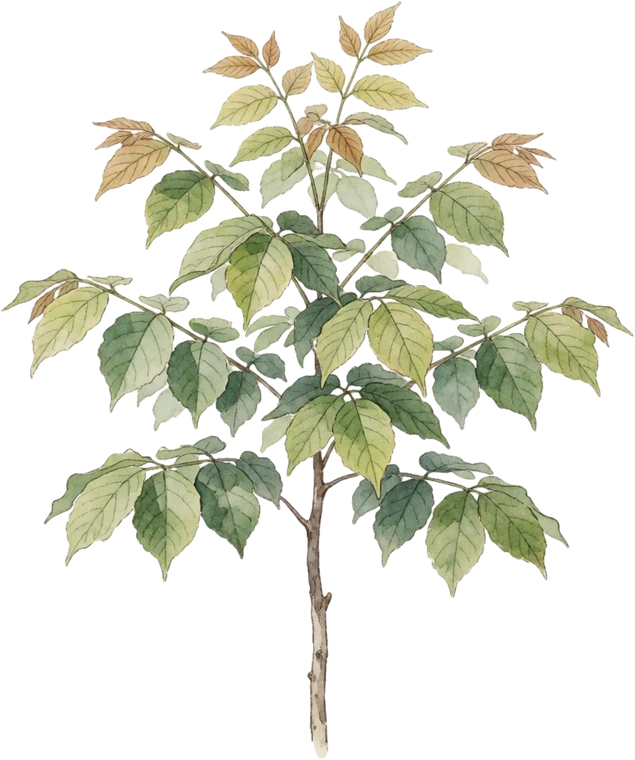
Kentucky coffeetree shrugs at impossible sites — drought, road salt, pollution, wretched soil, none of it registers. In return you get big, almost tropical compound leaves, a bold open crown, and one of the most dramatic bare-branch silhouettes any native tree throws against a winter sky.
The name records a settler experiment — roasted seeds once stood in for coffee, though raw they're toxic, so enjoy this one as shade, not harvest. A male cultivar like Espresso skips the heavy pods entirely and stays pest-free. Underused, undemanding, and overdue for more front yards.
 Full Sun
 Low water
 Slow-Moderate growth
 Native to North America
 Needs a pollination partner
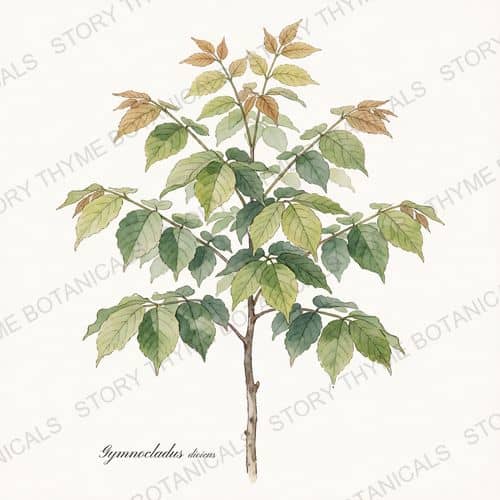
From the print shop
Growing kentucky coffeetree? Hang it.
Our Plant Library collection carries kentucky coffeetree — Gymnocladus dioicus, print Nº 261, “Kentucky Coffeetree.”
526 designsfrom $12.99white or black backgroundmatte poster, unframed
Will it fruit where you are?
Enter your ZIP — we look up your USDA hardiness zone (2023 map) and check it against what kentucky coffeetree actually needs.
 Hardy inZones 3-8PollinationPartner needed
Kentucky Coffeetree · Common problems
Common kentucky coffeetree problems

Pests
1 problem on file
- Almost none — remarkably pest-free

Diseases
1 problem on file
- Almost none
Pollination
Poor pollination → low fruit set (plant a partner)
Kentucky Coffeetree · Growing & propagation
Growing kentucky coffeetree
- Light
- Full Sun
- Water
- Low
Extremely tough: drought, salt, pollution, poor soil
 Soil
Soil- Any
A legume (light nitrogen contribution) · pH 6.0 - 8.0
 Fertilizer
- None
 Pruning
- Winter
A tough, underused native shade tree with a bold open branch structure, huge tropical-looking compound leaves, and remarkable adaptability to drought, salt, pollution, and poor soil. Late to leaf out and early to drop, it casts light shade and has a striking bare-winter silhouette. Plant a MALE cultivar to skip the messy, toxic pods. The name comes from settlers roasting the seeds as a coffee substitute — but raw seeds and pods are poisonous.
 Spacing
- 40+ ft
How to plant & propagate kentucky coffeetree
- Propagate
- Seed (stratify), cuttings, or layering
Kentucky Coffeetree · Calculators & field guides
A little help in the garden.
Kentucky Coffeetree · Yearly calendar
The kentucky coffeetree year, month by month
Jan
PruneDecember to February
 BloomPrune
BloomMay
PruneDecember to February
What each band means
- Bloom — flowers open — pollinators working, frost on blossoms is the danger.
- Prune — shape it now — cuts heal cleanly and structure is visible.
These are the species' typical months — expect them a few weeks earlier in warm zones and later in cold ones. Watch the plant, not just the calendar.
Kentucky Coffeetree · Ecology & uses
Ecology & uses
Gymnocladus dioicus
Kentucky Coffeetree in the garden system
- Canopy layer tree
- N-fixer
 Moisture
- Upland / dry
 Deer
Deer- Browsed
Protect young plants
- Origin
- Native to North America
What kentucky coffeetree is grown for
! Some parts toxic — see notesRAW seeds/pods TOXIC; roasted seeds were a historical coffee substitute — treat as a shade tree, not a food
 Use
Use- Tough urban shade
- Use
- Bold structure
- Use
- Native
- Use
- Pest-free
Harvesting & storing kentucky coffeetree
Large woody seed pods on females (ROASTED seeds were a coffee substitute — but raw are TOXIC).
Edibility, identification, and traditional-use notes here are general reference — not medical or veterinary advice, and not a claim that any plant treats or prevents anything. Medicinal ratings record how strongly a plant features in herbal tradition, nothing more. Never eat or dose a plant you have not positively identified. More on how to use this library.
Kentucky Coffeetree · Varieties & cultivars
Choosing a kentucky coffeetree variety
'Espresso' and 'Stately Manor' (male, seedless/podless cultivars)
Sources & plant identity
Know what you’re growing.
See where the knowledge comes from.
Kentucky Coffeetree
Gymnocladus dioicus
The plant, at a glance.
- Botanical name
- Gymnocladus dioicus
- Plant family
- Fabaceae
- Growth habit
- Tree · Perennial
- Origin
- Native to North America
- USDA plant symbol
- GYDI
- Invasive risk
- Low
Hardiness, size and timing vary with your cultivar, soil and climate.
Rooted in research.
University extension research, brought together with hands-on growing experience at Story Thyme Farms.
Questions
Kentucky Coffeetree questions, answered straight.
Why isn't my kentucky coffeetree fruiting?
Most often: it has no genetically distinct partner nearby. Kentucky Coffeetree can't pollinate itself — dioecious; wind/insect; late to leaf out, early to drop (open winter silhouette). Plant a second, unrelated one nearby; two different cultivars, or a cultivar plus a seedling, is the classic pairing.
Is kentucky coffeetree safe for kids and pets?
With care. RAW seeds/pods TOXIC; roasted seeds were a historical coffee substitute — treat as a shade tree, not a food Site it accordingly if children or pets roam the garden. This is general reference, not medical or veterinary advice — call a vet or poison control if something has actually been eaten.
When do you harvest kentucky coffeetree?
Large woody seed pods on females (ROASTED seeds were a coffee substitute — but raw are TOXIC).
How do you propagate kentucky coffeetree?
Seed (stratify), cuttings, or layering.
Elsewhere
Where kentucky coffeetree sits in the library.
 Black Locust
 Sassafras
 Eastern Hemlock
 Northern Catalpa