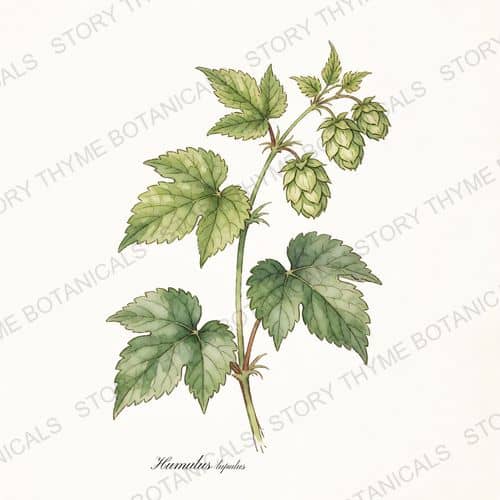
Hops

Humulus lupulus

Family Cannabaceae

VineNative & introducedZones 3-8

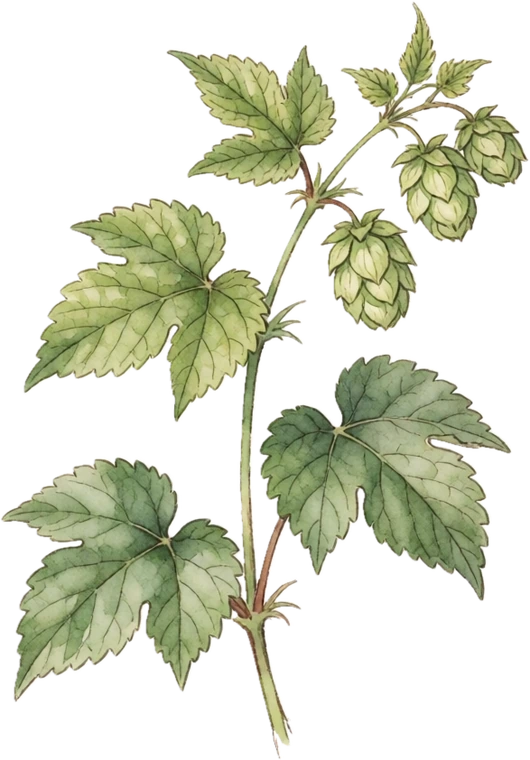
Botanical illustration of Hops

Hops grow a foot a day in June — a bine that hits twenty feet by midsummer, then hands the homebrewer papery cones dusted inside with golden lupulin, the exact aroma engine of every IPA. Brew them fresh off the vine and you've made a beer no store sells.

In the landscape it's the perfect seasonal screen — total summer privacy, gone by Thanksgiving, no permanent shadow — with butterflies visiting and leftover cones stuffing the classic sleep pillow. Dog households compost spent hops out of reach. String a tall wire somewhere sunny and watch it climb.

⚠ Spreads aggressivelyHops spreads vigorously and regrows from bits of root, so it's very hard to fully remove once established — give it a contained bed or a spot where it can roam freely, and edge it every year.

Where to buy hops — 5 nurseries compared

  • Full Sun
  • High water
  • EXPLOSIVE growth
  • Attracts butterflies
  • Needs a pollination partner
Hops — a print from the Plant Library collection

From the print shop

Growing hops? Hang it.

Our Plant Library collection carries hops — Humulus lupulus, print Nº 236, “Hops.”

526 designsfrom $12.99white or black backgroundmatte poster, unframed

Shop Plant Library botanical prints →

✓

Will it fruit where you are?

Enter your ZIP — we look up your USDA hardiness zone (2023 map) and check it against what hops actually needs.

Hardy inZones 3-8
PollinationPartner needed

Hops · Common problems

Common hops problems

Pests, diseases and weather to keep an eye on.

Pests

5 problems on file

Diseases

2 problems on file

Pollination

Poor pollination → low fruit set (plant a partner)

Hops · Growing & propagation

Growing hops

Light, water, soil, propagation and the season’s jobs.
What it needsThe details
Light
Full Sun
Water
High June-August

Bine growth is prodigious

Soil
Deep, rich, drained · pH 6.0 - 7.5
Fertilizer
Heavy spring nitrogen + compost
Pruning
Cut all bines to the crown after harvest

Train 2-3 bines per string clockwise in May, remove the rest; strip lower 3 ft of leaves for airflow.

Spacing
3 ft between crowns

12-18 FT of vertical string

Hops · Seasonal care & spray guidance

The hops growing playbook

Field-tested instructions for every job hops asks of you, compiled from university extension guidance — in the order the season brings them.

When to spray hops

Dormant season. Dormant copper where mildew was bad.

Growing season. Strip lower leaves; resistant cultivars ('Cascade' is forgiving); soap for aphids.

As growth begins

early spring

4 jobs
FeedingIn spring

Split the nitrogen across three feedings, front-loaded before burr

Feed established plants in at least three split applications, aiming for the equivalent of 120 to 150 pounds of actual nitrogen per acre across the season (about 0.33 pounds of actual N per 100 square feet). MSU runs the splits from April to the beginning of July in Michigan, which in practice means from shoot emergence to about the time burrs form — use the burr stage, not the calendar, to know when to stop. Give first-year plants only one-half to two-thirds of that. Hops want little phosphorus; target potassium around 100 ppm. A bine puts on 20 feet in a single season and cannot do it on one spring dose. Nitrogen arriving late pushes soft leafy growth instead of cones and thickens the canopy that mildew wants, which is why MSU's window closes in early summer rather than running to harvest.

PruningIn spring

Spring crowning: cut the first flush of shoots back to the crown

On plants two years and older, let the first shoots come up and cut them off at the crown once that secondary growth reaches about two feet. Never do this to a first-year plant. If a cold spring has pushed you past the point where there is still time for a full regrowth cycle before your training date, skip pruning entirely that year rather than pruning late and losing the crop. The downy mildew pathogen overwinters in the crown and buds, and the first flush of shoots carries that inoculum up into the plant as infected basal spikes. Removing that flush throws the spores away and forces a clean, uniform second flush. In a Washington commercial trial reported by MSU Extension, a four-week pruning delay dropped powdery mildew on leaves from 46 percent to 10 percent and on cones from 9 percent to 1 percent.

PruningIn spring

Train two to four bines clockwise up each string

Once the regrowth is long enough to handle, pick the strongest bines and wrap them clockwise around the support string, then rub off the surplus shoots at the base. MSU guidance ranges from two or three bines per plant up to three or four per string, so err toward the lower end on young or weak crowns. Hops twine clockwise on their own; a bine wrapped the wrong way will unwind itself and fall. Check back every few days and re-wrap any that have slipped. Err toward training earlier rather than later. Hops set cones on the laterals of bines that reach the top wire, so the plant needs its whole season on the string. Training too late costs real yield: a Czech study cited by MSU found bines trained too late gave nearly 40 percent less. Limiting the bine count puts the crown's energy into cone-bearing growth instead of a thicket.

SprayingAt green tip

Downy mildew: start protectant copper as the basal foliage appears

If downy mildew showed up last year, begin a copper fungicide as soon as basal foliage emerges in spring and repeat on a seven to ten day schedule, stretching to 14 days in hot dry spells. Actinovate AG, Regalia and Sonata are also labeled for hop and are the other options open to organic growers. Pseudoperonospora humuli overwinters in the crown and sporulates from the first infected shoots, so the spores are already flying before you can see a lesion. Copper is a protectant film on the leaf surface; it has to be there before the spore lands.

Through summer

the growing season

3 jobs
WateringThrough summer

Water hard through the peak growth and cone-set weeks

Through the fastest growth and into cone set, give a mature plant at least six gallons a day — that is MSU's floor for the peak weeks, not a ceiling, so water more in heat or sandy ground. Water at the base and keep it off the foliage where you can. First-year plants have almost no root system yet and need consistently moist, never waterlogged, soil to build one. This is the stretch when the bine is building its whole frame and then filling cones, and the crop is set by what the plant can draw in those weeks. Overhead water also wets foliage, and downy mildew spores develop in wet or foggy conditions at 60 to 70 degrees.

PruningThrough summer

Strip the basal foliage and suckers from the bottom four feet

Starting as soon as there is foliage to take and continuing as the bines climb, strip the leaves, side suckers and stray ground shoots from the bottom four feet of every bine, and pull the weeds out of that zone too. Carry the stripped material out of the yard and destroy it rather than dropping it at the base of the plant. Downy mildew spores splash up from the soil and infect the lowest leaves first, and they develop in wet or foggy weather at 60 to 70 degrees. Opening the bottom of the canopy improves air circulation, dries those leaves faster and cuts off the ladder the disease climbs.

What to watch forThrough summer

Scout the leaf undersides regularly for twospotted spider mite

Scout season-long, from the time bines are climbing until harvest, sampling two leaves from about 20 plants across the yard at several heights and examining the underside with a hand lens. More than two adult mites per leaf in June is the point to act on; by mid-July the threshold rises to five to 10 mites per leaf. Twospotted spider mite development accelerates with heat right up to an upper threshold around 100 degrees, so a population invisible in June becomes a bronzed, cone-ruining infestation in weeks; cold wet weather holds it back. Mites that reach the cones are effectively unmanageable, which is why the scouting has to start before damage is visible.

Harvest time

as it ripens, and picking

1 job
HarvestingAt harvest

Pick when a squeezed cone stays compressed and the lupulin is dark yellow

Start checking cones as they lose their soft green feel. Ripe cones are papery, springy and dry to the touch, and a cone crushed in your hand stays compressed rather than springing back, leaves a sticky residue and smells strongly. Tear one open: the lupulin should be dark golden yellow. Soft cones are early; orange lupulin and a rancid, cheesy smell mean you are late. The whole planting comes ripe inside a window of about seven to ten days, and the alpha acids and aromatic oils that make the cone worth growing peak and then degrade fast. There is no second pass.

After harvest

autumn, and putting it to bed

1 job
PruningAfter harvest

Cut the spent bines down and get them out of the planting

After picking, cut the bines down and take the vegetation out of the planting. Burn it, or compost it well away from the soil near the crowns rather than at their base. Any unharvested bines still standing, including on first-year plants, should come down and be destroyed after a hard frost. Downy mildew overwinters in the crown and on plant debris, and a pile of old bines at the base of the plant is next spring's inoculum sitting exactly where the new shoots will emerge through it.

Hops · Calculators & field guides

A little help in the garden.

Calculators for the figures. Field guides for the hands-on work.

Hops · Yearly calendar

The hops year, month by month

What hops asks for, month by month.

Jan

No calendar activity is listed for this month.

MonthJanFebMarAprMayJunJulAugSepOctNovDec
Bloom
Prune
Harvest

BloomJuly

PruneJuly to August

HarvestAugust to September

What each band means

  • Bloom — flowers open — pollinators working, frost on blossoms is the danger.
  • Prune — shape it now — cuts heal cleanly and structure is visible.
  • Harvest — picking time — check ripeness every few days.

These are the species' typical months — expect them a few weeks earlier in warm zones and later in cold ones. Watch the plant, not just the calendar.

Hops · Ecology & uses

Ecology & uses

What it does for the garden, and what it is grown for.
Botanical illustration of Hops

Humulus lupulus

Hops in the garden system

  • Vine layer vine
  • Hosts Question mark & comma butterflies
Attracts
Butterflies
Habitat
Dry/rocky
Moisture
Facultative / average
Deer
Browsed

Protect young plants

Origin
Introduced

What hops is grown for

✓ Commonly eatenCones safe (they're in beer); DOGS must not eat spent hops — genuinely dangerous

Use
Homebrewing
Traditional use
Sleep sachets
Use
Summer screens
Edible value
3/5
Traditional use rating
3/5 in herbal tradition

Harvesting & storing hops

AUGUST - SEPTEMBER: cones when papery, springy, and yellow-dusty inside (lupulin) — brew fresh ('wet hop') or dry same-day.

Edibility, identification, and traditional-use notes here are general reference — not medical or veterinary advice, and not a claim that any plant treats or prevents anything. Medicinal ratings record how strongly a plant features in herbal tradition, nothing more. Never eat or dose a plant you have not positively identified. More on how to use this library.

Hops · Varieties & cultivars

Best hops varieties & cultivars

There are far more than these — the ones below are the named varieties of hops people actually plant.

Named varieties of hops differ in winter-chill needs, ripening time, hardiness, and whether they set fruit on their own — pick one that fits your climate.

11 varieties

Cascade

Ripens
early
Zones
3-8
Disease
Susceptible to downy mildew; only moderately resistant to powdery mildew and no longer reliably so

Citrus, grapefruit; aroma hop with low bittering value — The craft-beer standard and the hop most in demand from Michigan brewers, but it is a downy mildew magnet, so give it the spring crowning and basal stripping without fail. Do not count on its old powdery mildew resistance either: that resistance has been overcome as Cascade acreage expanded, and it now needs a powdery mildew program too. Sold as female clones; cones form without pollination and no male plant is needed.

Where to buy ‘Cascade’

Story Thyme Farms may earn a small commission from these links, at no cost to you — it never changes what we recommend.

Sources & plant identity

Know what you’re growing.
See where the knowledge comes from.

Botanical illustration of Hops

Hops

Humulus lupulus

The plant, at a glance.

Botanical name
Humulus lupulus
Plant family
Cannabaceae
Growth habit
Vine · Perennial
Origin
Introduced
USDA plant symbol
HULU
Invasive risk
Low
Every garden is different.

Hardiness, size and timing vary with your cultivar, soil and climate.

Rooted in research.

University extension research, brought together with hands-on growing experience at Story Thyme Farms.

Explore Hops’s sources2 reference links
for Hops

Research from these sources

Publisher marks identify sources, not sponsorship or endorsement.

Questions

Hops questions, answered straight.

Why isn't my hops fruiting?

Most often: it has no genetically distinct partner nearby. Hops can't pollinate itself — dioecious — unfertilized female cones are the crop (no male needed or wanted). Plant a second, unrelated one nearby; two different cultivars, or a cultivar plus a seedling, is the classic pairing.

Is hops safe for kids and pets?

Hops is commonly eaten and isn't considered toxic, but "commonly eaten" isn't a guarantee for any particular person or animal — allergies, quantity, and which part you eat all matter. One caveat on this one: Cones safe (they're in beer); DOGS must not eat spent hops — genuinely dangerous. Never eat a plant you haven't positively identified, and check with a vet before letting pets or livestock graze anything new.

When do you harvest hops?

AUGUST - SEPTEMBER: cones when papery, springy, and yellow-dusty inside (lupulin) — brew fresh ('wet hop') or dry same-day.

Elsewhere

Where hops sits in the library.

Where hops sits in the library

Grows in the same world