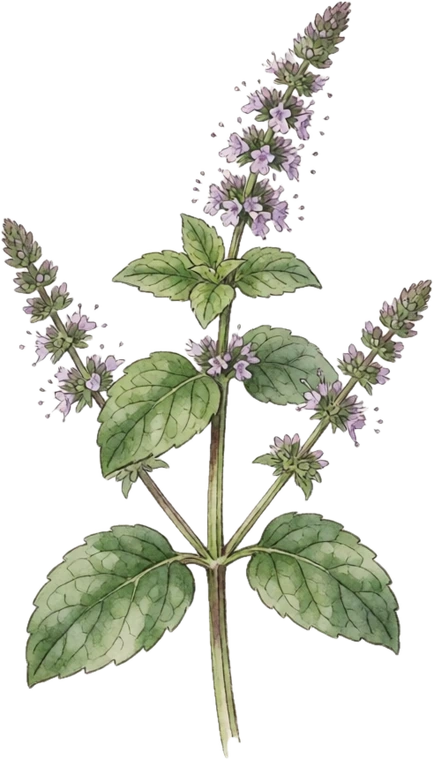
The illustrated growing guide
Mint
Mentha spp.
Family Lamiaceae
Est. zones 3-9

INVASIVE. Always plant in a pot or contained area. Will take over garden.
⚠ Spreads aggressivelyMint spreads aggressively — mints and their kin send out underground runners and are extremely hard to get rid of once they're in the ground. Grow it in a sunken pot or a fully contained bed, never loose in open soil.

From the print shop
The closest print we make
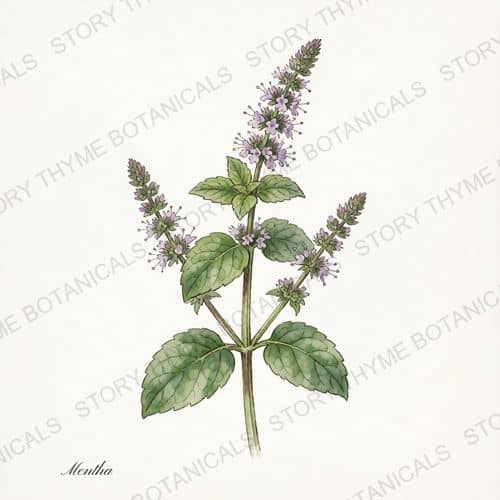
We don’t print Mentha spp. The closest we have is Mentha × piperita (“Peppermint”) in the Kitchen & Orchard collection — the same genus, Mentha, not the same species.
16 designsfrom $21.99white or black groundmatte poster, unframed
I
Overview
Will mint suit your garden, and what goes wrong.
Will it fruit where you are?
Enter your ZIP — we look up your USDA hardiness zone (2023 map) and check it against what mint actually needs.
Mint at a glance
Common mint problems
- None major
- Rust
- Wilt
II
Growing
Light, water, soil, propagation and the season’s jobs.
How to grow mint: light, water & soil
How to plant & propagate mint
The mint growing playbook
Field-tested instructions for every job mint asks of you, compiled from university extension guidance — in the order the season brings them.
Planting out
Plant mint inside a buried container, not loose in the bed
Plant early in the growing season, setting each plant into a bottomless container sunk so it extends 3-4 inches above and 10-15 inches below the soil surface. Space plants at least 2 feet apart. Buy plants or take cuttings and divisions rather than sowing seed if you want a named type, since seed rarely comes true. Mint travels by underground rhizomes that root as they go, and once it is loose in a bed it is nearly impossible to eradicate. The collar has to sit proud of the soil because the runners will also creep over a flush rim.
Watering
Water at the roots, and never leave leaves wet overnight
Give up to 1 to 2 inches per week depending on heat, exposure and soil. Use drip irrigation if you can; if you water overhead, do it before midday so the foliage dries. Do not overwater. Mint rust needs leaf wetness to infect, so foliage that stays damp through the night is what lets it in. Overwatering also dilutes the oil in the leaves along with encouraging the disease.
Feeding
One light feeding as growth resumes
As new growth pushes in spring, give each plant about one teaspoon of a balanced 16-16-16 fertilizer. That is the whole year's feeding. At soil prep, work in no more than 1 inch of well-composted organic matter per 100 square feet. Mint is vigorous enough without help, and pushing it harder backfires: over-fertilizing produces soft crowded growth that promotes rust and actually lowers the leaf oil that gives mint its flavor.
Dividing
Divide every 3-4 years to restore vigor
Every 3 to 4 years, lift and divide the clump and replant the vigorous pieces. Do this in spring before growth starts, or alternatively in early fall. Move the divisions to a fresh spot rather than back into the same soil. Dividing every 3 to 4 years is what keeps a mint planting vigorous. Rotating the planting to new ground at the same time is the recommended cultural control for the verticillium wilt and anthracnose that home growers cannot spray for.
Pruning
Cut the planting to the ground before winter
Before winter, cut each plant back to the ground. Pull out and dispose of any diseased plants entirely rather than replanting them, and rotate the planting area if anthracnose or verticillium showed up this season. Cutting mint to the ground before winter is the extension-recommended way to discourage overwintering pests and diseases, and pruning healthy plants to the ground in fall is listed as a control for anthracnose alongside removing diseased plants and rotating planting areas.
Harvesting
Cut hard as the first flower buds show
When flower spikes begin to appear, cut the stems back to within 1 inch of the soil. Leaves destined for drying are best taken right at this point. The plant will regrow and you can take about three such cuttings a season. Between cuttings, pinch off flower spikes as they form. It is very difficult to over-prune a mint plant. If mint is allowed to bloom, the oil content in the leaves decreases and the leaves are less flavorful, so the same leaf is worth less after bloom than before it. Removing flower spikes as they appear is what holds the flavor.
III
The year
What mint asks for, month by month.
The mint year, month by month
What each band means
- Bloom — flowers open — pollinators working, frost on blossoms is the danger.
- Prune — shape it now — cuts heal cleanly and structure is visible.
- Harvest — picking time — check ripeness every few days.
The mint year as text
- Jan pruning, harvest
- Feb pruning, harvest
- Mar pruning, harvest
- Apr pruning, harvest
- May pruning, harvest
- Jun bloom, pruning, harvest
- Jul bloom, pruning, harvest
- Aug bloom, pruning, harvest
- Sep pruning, harvest
- Oct pruning, harvest
- Nov pruning, harvest
- Dec pruning, harvest
These are the species' typical months — expect them a few weeks earlier in warm zones and later in cold ones. Watch the plant, not just the calendar.
IV
Ecology & uses
What it does for the garden, and what it is grown for.
Mint in the garden system
- Groundcover layer perennial
- Living mulch
What mint is grown for
! Some parts toxic — see notesToxic to dogs, cats and horses in quantity (ASPCA; essential oils) — vomiting and diarrhoea. Separately: PENNYROYAL (Mentha pulegium) is not culinary mint and is far more dangerous — its oil has killed a dog through skin application alone and causes liver failure and seizures in people. Never take pennyroyal internally or use its oil on pets.
Harvesting & storing mint
Anytime.
Edibility, identification, and traditional-use notes here are general reference — not medical or veterinary advice, and not a claim that any plant treats or prevents anything. Medicinal ratings record how strongly a plant features in herbal tradition, nothing more. Never eat or dose a plant you have not positively identified. More on how to use this library.
V
Cultivars
Named varieties of mint, ruled as a catalogue.
Best mint varieties & cultivars
Peppermint / Spearmint
VI
Sources & plant ID
Where the care distinctions come from, and how the plant is filed.
Research basis
Sources behind this profile
No extension citations are attached to mintyet. The care figures below come from the library's own catalogue rather than a traced primary source.
Plant ID
VII
Where to buy
Third-party nurseries — not Story Thyme Farms.
Third-party nurseries, not Story Thyme Farms. Prices are theirs.
Story Thyme Farms may earn a small commission from these links, at no cost to you — it never changes what we recommend.
VIII
Questions
Mint questions, answered straight.
Is mint safe for kids and pets?
With care. Toxic to dogs, cats and horses in quantity (ASPCA; essential oils) — vomiting and diarrhoea. Separately: PENNYROYAL (Mentha pulegium) is not culinary mint and is far more dangerous — its oil has killed a dog through skin application alone and causes liver failure and seizures in people. Never take pennyroyal internally or use its oil on pets. Site it accordingly if children or pets roam the garden. This is general reference, not medical or veterinary advice — call a vet or poison control if something has actually been eaten.
When do you harvest mint?
Anytime.
How do you propagate mint?
Division or seed.
Is mint invasive?
It can be an aggressive spreader — give it room or a barrier, and check your state's invasive-species list before planting.
IX
Elsewhere
Where mint sits in the library.
Thyme
Lemon Thyme
Roman Chamomile
Comfrey