The illustrated growing guide
Mullein
Verbascum thapsus
Family Scrophulariaceae
Est. zones 3-9

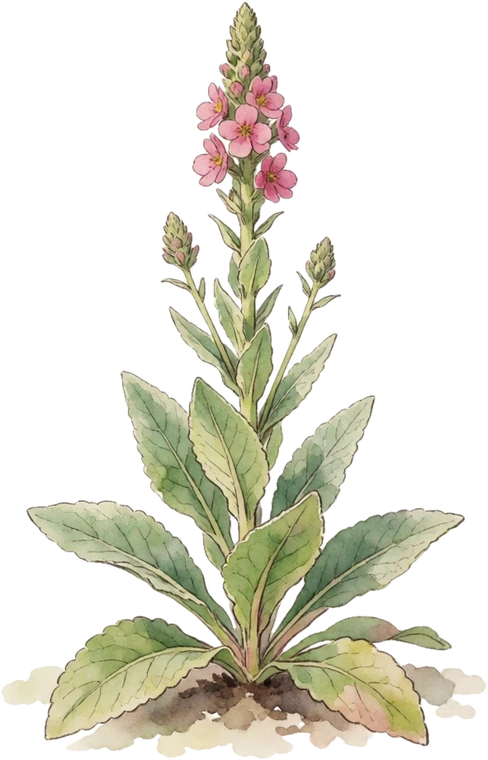
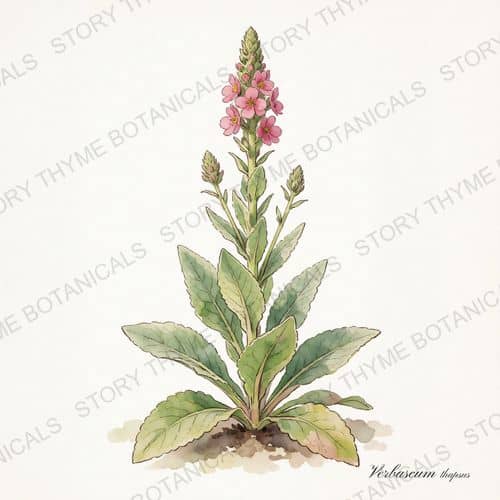
Velvet-flannel rosettes the first year, a candelabra tower the second — the roadside plant that IS the classic lung-and-cough tea. Give it your worst soil and it thanks you; every herbalist's food forest keeps a corner of it.

From the print shop
Growing mullein? Hang it.
Our Medicinal Herbs collection carries mullein — Verbascum thapsus, print Nº 8, “Mullein.”
16 designsfrom $21.99white or black groundmatte poster, unframed
I
Overview
Will mullein suit your garden, and what goes wrong.
Will it fruit where you are?
Enter your ZIP — we look up your USDA hardiness zone (2023 map) and check it against what mullein actually needs.
Mullein at a glance
Common mullein problems
- Almost none
- Few
II
Growing
Light, water, soil, propagation and the season’s jobs.
How to grow mullein: light, water & soil
The mullein growing playbook
Field-tested instructions for every job mullein asks of you, compiled from university extension guidance — in the order the season brings them.
Sowing
Surface sow the seed, and do not bury it
Scatter seed on bare, well drained soil in late spring to early summer and press it against the surface without covering it. Do not rake soil over the top. Expect only a flat rosette this year, the flower stalk comes the season after. Mullein seed will not germinate in the dark, so only seed lying at or near the soil surface ever sprouts, and burying it wastes the sowing. The rosette also needs a winter of cold to trigger flowering the following spring, which is why year one is leaves only.
⚠ Common mullein is listed as a noxious weed in Colorado and Hawaii (NC State Extension Gardener Plant Toolbox, https://plants.ces.ncsu.edu/plants/verbascum-thapsus/). In Colorado it is a List C species, which means local jurisdictions decide whether to require eradication, containment or suppression - check your county weed authority before sowing, in those states and anywhere else.
Pruning
Cut the spent tower before the capsules ripen
Once flowering finishes, cut the whole stalk off at its base and bag it or burn it. Do not leave it standing to dry, and do not compost it in place. Skip this only if you deliberately want volunteers. One plant carries 200 to 300 capsules holding 500 to 800 seeds each, well over 100,000 seeds in total, and that seed stays viable in the soil for decades - seeds in the Beal longevity experiment still germinated after 100 years. Cutting the stalk while the capsules are green is the one moment you control the seed bank.
What to watch for
Pull volunteer rosettes while the soil is moist
Walk the patch in spring and pull, hoe or dig unwanted rosettes as soon as they are big enough to hold onto, working when the soil is moist so the taproot lifts whole. Do not reach for the mower or the sprayer. Mowing backfires - the rosettes simply widen and then bolt as soon as mowing stops - and herbicide is a poor tool on this plant because the dense woolly leaf hairs block absorption of the chemical. Hand removal at the rosette stage, before any stalk rises, is what actually works.
Harvesting
Take the flannel leaves in year one
Harvest the big basal leaves from the first year rosette across its first summer, cutting outer leaves and leaving the center of the rosette intact to keep feeding the taproot. Mullein is a biennial that dies once it flowers. The rosette leaves are largest and the plant is still alive in year one, while year two pours everything into a flower stalk of roughly 3 to 10 feet and then the plant is gone for good.
⚠ The leaf hairs irritate the throat - strain any leaf tea through cloth before drinking.
Pick the flowers in the morning, before they close
Work the spike in the morning and take only the open yellow flowers. Come back every few days all summer rather than waiting for one big pick. Each mullein flower opens before dawn and closes by mid afternoon, and the spike opens only a few flowers at a time in spirals from the bottom upward, so an afternoon pass finds almost nothing open.
III
The year
What mullein asks for, month by month.
The mullein year, month by month
What each band means
- Bloom — flowers open — pollinators working, frost on blossoms is the danger.
The mullein year as text
- Jan quiet month
- Feb quiet month
- Mar quiet month
- Apr quiet month
- May quiet month
- Jun bloom
- Jul bloom
- Aug bloom
- Sep bloom
- Oct quiet month
- Nov quiet month
- Dec quiet month
These are the species' typical months — expect them a few weeks earlier in warm zones and later in cold ones. Watch the plant, not just the calendar.
IV
Ecology & uses
What it does for the garden, and what it is grown for.
Mullein in the garden system
- Herbaceous layer biennial
- Nectary/insectary
What mullein is grown for
✓ Commonly eatenSafe as strained tea
Harvesting & storing mullein
Leaves (year one) + flowers: THE traditional respiratory tea (strain through cloth — the hairs itch).
Edibility, identification, and traditional-use notes here are general reference — not medical or veterinary advice, and not a claim that any plant treats or prevents anything. Medicinal ratings record how strongly a plant features in herbal tradition, nothing more. Never eat or dose a plant you have not positively identified. More on how to use this library.
V
Cultivars
Named varieties of mullein, ruled as a catalogue.
Best mullein varieties & cultivars
Common thapsus; 'Southern Charm' (ornamental hybrid)
VI
Sources & plant ID
Where the care distinctions come from, and how the plant is filed.
Research basis
Sources behind this profile
No extension citations are attached to mulleinyet. The care figures below come from the library's own catalogue rather than a traced primary source.
Plant ID
VII
Where to buy
Third-party nurseries — not Story Thyme Farms.
Third-party nurseries, not Story Thyme Farms. Prices are theirs.
Story Thyme Farms may earn a small commission from these links, at no cost to you — it never changes what we recommend.
VIII
Questions
Mullein questions, answered straight.
Is mullein safe for kids and pets?
Mullein is commonly eaten and isn't considered toxic, but "commonly eaten" isn't a guarantee for any particular person or animal — allergies, quantity, and which part you eat all matter. One caveat on this one: Safe as strained tea. Never eat a plant you haven't positively identified, and check with a vet before letting pets or livestock graze anything new.
When do you harvest mullein?
Leaves (year one) + flowers: THE traditional respiratory tea (strain through cloth — the hairs itch).
IX
Elsewhere
Where mullein sits in the library.
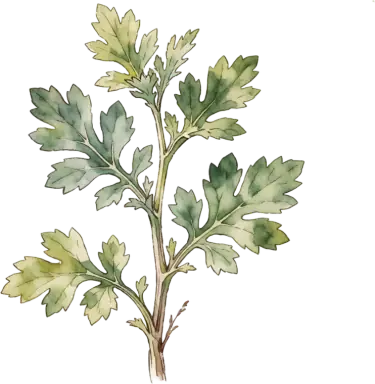
Feverfew
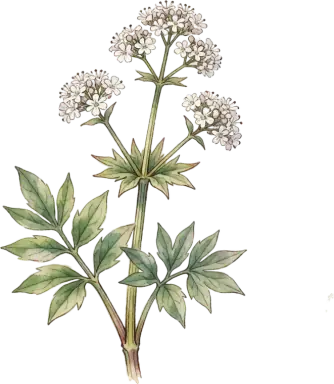
Valerian
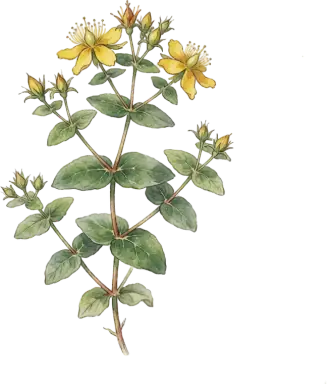
St. John's Wort
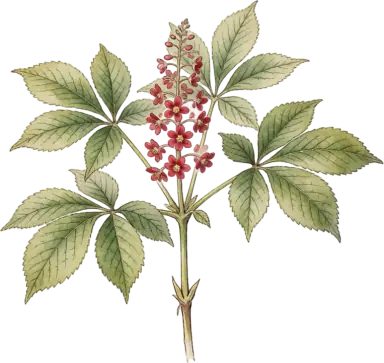
American Ginseng