Cold-Hardy Kiwi Varieties: Hardy Kiwi and Arctic Beauty
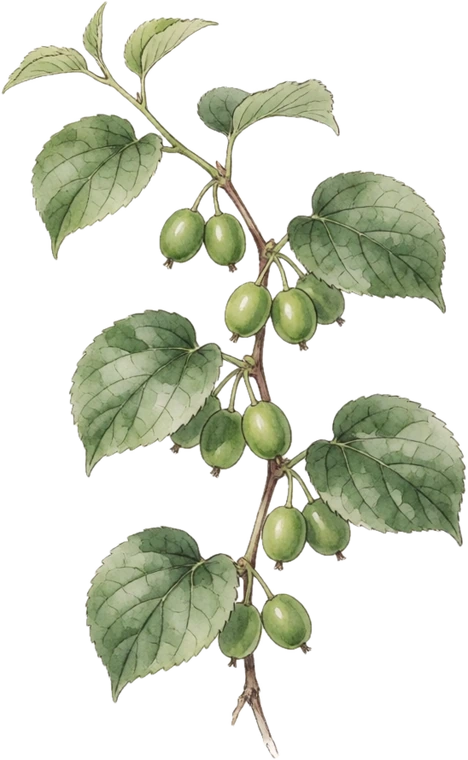
The hardy kiwi is a different species from the fuzzy supermarket fruit: a vigorous vine hardy to zone 4 that bears grape-sized, smooth-skinned fruit you eat whole, sweeter than a fuzzy kiwi and needing no peeling. Arctic Beauty, a third species, goes a zone colder still. What limits them is not winter but spring: hardy kiwis break bud early and a late frost burns the new growth, so the site matters more than the hardiness number, and a frost pocket at the bottom of a slope is the wrong place.
The self-fertile column is the one to read. Kiwis are dioecious, so a female vine fruits only with a male within range, roughly one male for every six to eight females; Meader is the male on this table and produces nothing itself. Prolific is the partly self-fertile exception for a one-vine garden. Ananasnaya is the reliable standard, Geneva and Dumbarton Oaks ripen earlier for short seasons, Michigan State is the heavy cropper. Give any of the 7 a structure built for a vine that can put on twenty feet in a season, and expect the first real crop in year three to five. Sorted hardiest first.
Story Thyme Farms may earn a small commission from these links, at no cost to you — it never changes what we recommend.
| Variety | Zones | Ripens | Self-fertile | Notes | Where to buy |
|---|---|---|---|---|---|
| Arctic Beauty | 3-7 | Aug (very early) | No | small, very sweet, tender-skinned fruit with high vitamin CThis is A. kolomikta, sold under the common name 'Arctic Beauty' rather than a single defined cultivar; it is the hardiest kiwi (survives to around -40F), making it the pick for zones 3-4 where A. arguta won't survive. Chill hours for kolomikta are poorly documented — the value here is a rough estimate; its defining trait is very early budbreak (low heat requirement), not a proven low chill requirement. | Browse growers |
| Ananasnaya | 4-8 | Late Sept-Oct | No | sweet with a pineapple-like aroma, eaten skin-and-allThe most widely planted, reliable hardy kiwi for home gardens; you must add a male vine (e.g. Meader) to get fruit. Chill figure is a species-level approximation — extension sources do not publish cultivar-specific chill hours for hardy kiwi. | Browse growers |
| Dumbarton Oaks | 4-8 | Sept (early; about three weeks before Anna) | No | sweet, light green, flattish ribbed fruit resembling miniature pumpkins; good flavorNamed by Penn State extension among the hardy kiwi varieties worth growing; PSU records only that it was propagated from an old vine at the Dumbarton Oaks public garden and that it 'has good flavor.' The early-ripening trait is nursery-sourced, not extension-sourced: One Green World and Edible Landscaping both put it about three weeks ahead of Anna, which matters where the season is short. Extension sources do not publish a chill figure for any A. arguta cultivar, so chill is left blank rather than estimated. | Buy $24.99 |
| Geneva | 4-8 | Sept (early-mid) | No | very sweet, honeyed; among the earliest-ripeningChoose this for an earlier harvest in short-season areas, but it drops fruit as it ripens so pick promptly. Chill figure is an approximate species-level estimate. | Browse growers |
| Meader | 4-8 | n/a (male, non-fruiting) | No | non-fruiting; grown only for pollenA pollen source, not a fruit plant: one male pollinates roughly six to eight A. arguta females, so add one unless you grow only self-fertile types (Issai, Prolific). A distinct 'Meader Female' is occasionally sold, but 'Meader'/'Meader Male' is the standard male pollinizer. | Browse growers |
| Michigan State | 4-8 | Late Sept-Oct | No | sweet, good-sized fruit that stores relatively wellA dependable, heavy-cropping female valued for cold-climate reliability in the Midwest and Northeast. Chill figure is an approximate species-level estimate. | Browse growers |
| Prolific | 4-8 | Sept-Oct | Partial | sweet, larger fruit than Issai; good fresh eatingA hardier self-fertile alternative to Issai for one-plant gardens, with bigger fruit; a male still increases the crop, and it is not reliably a pollinizer for other females. Sometimes claimed to be USDA accession 119-40B, but I could not verify that accession link, so it is omitted. Chill figure is an approximate species-level estimate. | Buy $83.44 |