Hardy Kiwi
- Hardiness
- 4-8
- Growth rate
- Very Fast once started
- Chill requirement
- ~400
- Harvest season
- September - October
Family Actinidiaceae
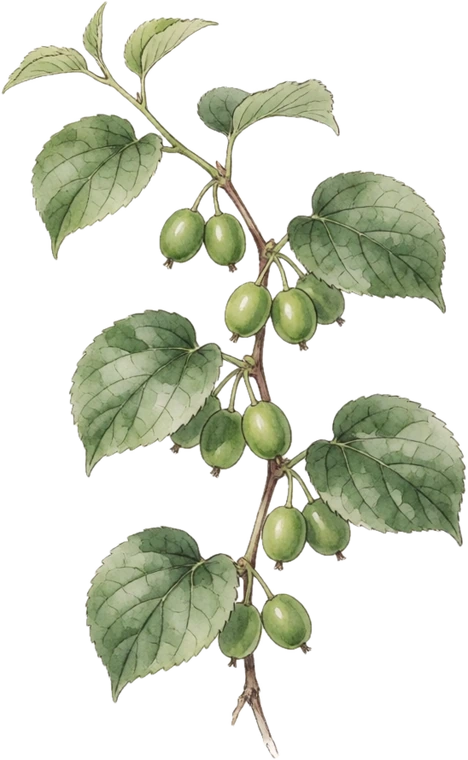
Kiwi on a backyard vine surprises everyone the first time — this entry covers the fuzzy market kind and the hardy kiwi, whose smooth, grape-sized fruit is eaten skin and all and never shows up in stores. Between the two types there's a kiwi for zones 4 through 9.
As vines go it is an enthusiastic climber that will cover any sturdy arbor, flowering in spring for the bees. Kiwis need a partner — plant a male alongside the fruiting females — so buy them in company and let the pair furnish shade and dessert together.
 Excellent edible
 Attracts beesNeeds a pollination partner
Hardiness differs across the 2 kiwis in this guide, so pick yours and this panel answers for that one.
Hardy Kiwi
Kiwi · Common problems
Poor pollination → low fruit set (plant a partner)
Kiwi · Which one do you have?
Where these differ, the key facts above give the span across all of them. Each type’s own figures, as the catalogue records them:
Kiwi · Growing & propagation
Kiwi merges several types whose light, water and soil needs differ — the care groups and the growing playbook carry what applies to each.
Kiwi · Seasonal care & spray guidance
winter, before growth starts
4 jobs PruningIn February, March and JulyHardy Kiwi
In winter shorten fruiting laterals and remove excess growth; in summer cut back vigorous shoots shading the canopy. Hardy kiwi is very vigorous and needs regular pruning to fruit within reach and keep vines on the trellis.
PruningIn January and DecemberKiwi (Fuzzy)In the depth of winter dormancy, remove roughly 70 percent of the wood that grew last season, most of it older wood that has already fruited. Leave 30 to 45 well-spaced fruiting canes on a mature vine, about 8 to 12 inches apart along the cordons, and head fruiting laterals back to 2 to 4 buds. Leave spurs alone, they are fruitful too. Prune male vines only lightly now, just enough to untangle them, since their real pruning comes after they finish flowering. Kiwi fruit only on current-season shoots growing from one-year-old canes, and the fruitful buds sit at nodes 6 to 12, so every cane you leave carries a crop's worth of buds. It is easy to prune a kiwivine too lightly, and leaving too many buds gives high yield of small fruit plus reduced growth and a lighter crop the next year.
 ProtectionIn January and FebruaryHardy Kiwi
Before the late-winter sun strengthens, shield the south and southwest side of the trunk with a plastic spiral wrap, a split grow tube set with the split facing north, or a full grow tube or tree shelter. Make the guard taller than your usual snow depth. In late winter the sun combined with glare off the snow heats the trunk's wood tissue out of dormancy on a mild afternoon, and the refreeze that night kills the bark. All young vines are susceptible, and dark-barked Arctic Beauty vines stay susceptible at every age.
ProtectionIn winterKiwi (Fuzzy)Put a trunk wrap on every fuzzy kiwi vine over winter — every vine, young or old, since the only age exemption in the source is for hardy kiwi (A. arguta) over 5 years old, not for fuzzy kiwi. Painting the trunk with a 1:1 mix of interior white latex paint and water helps prevent sunburn, and a milk carton or similar sleeve guards against both sunburn and rodent feeding. Hayward tops out at about 10 F for cold tolerance, and cold injury to it has occurred in some winters even in the mild Pacific Northwest. The damage typically comes when the temperature crashes at night after a warm spell while the vine is not fully dormant, which is why a wrap through the whole winter matters more than one applied at the coldest week.
early spring
5 jobs MulchingIn springHardy Kiwi
Spread roughly 4 inches of wood chips, leaf mulch, or corn stover over the root area, pulling it back a few inches from the trunk itself. Kiwi wants soil that holds moisture and is rich in organic matter, and a deep mulch both retains that moisture and regulates the soil temperature swings the shallow root system sits in.
 FeedingIn springHardy Kiwi
Starting the second year, spread 2 ounces of 10-10-10 per plant over the root zone after risk of frost is past, and add 2 more ounces each following year until you reach a maximum of 8 ounces per plant. Do not fertilize after July. Hardy kiwi roots burn rather easily, so a rate that would be trivial for an apple can scorch them, and fertilizer applied after July drives excessive late-season growth that will not harden off before the first hard freeze.
FeedingAt green tipKiwi (Fuzzy)As buds break, broadcast about two-thirds of the vine's yearly nitrogen under the canopy, and apply the remaining third roughly two months later. A mature vine of seven years or more uses about 1 pound of actual nitrogen per year. Hold first-year vines to no more than 0.4 ounce of actual nitrogen per month, spread in a circle 6 to 12 inches out from the trunk, and second-year vines to 0.8 ounce per month in a ring 12 to 36 inches out. Water first, wait a day or two, then fertilize. The bud-break dose feeds early shoot growth and the fruit set that follows about a month into summer. Kiwi roots burn very easily, so nitrogen concentrated near the trunk scorches roots instead of feeding the vine.
ProtectionAt green tipHardy KiwiOnce buds break and shoots begin extending, watch the forecast and protect the vine any night headed for about 30F or below - cover low or untied vines with leaves or fabric, wrap the trunk, or run sprinklers or heaters on a trained vine. A dormant hardy kiwi tolerates -30F, but it pushes shoots extremely early in spring and even brief exposure to 30F or lower damages them. The vine usually survives and regrows, but if the flowers are frosted no fruit will develop that year.
ProtectionAt green tipKiwi (Fuzzy)From bud break until the frost danger passes, protect the new shoots on any night forecast to reach freezing. In the home garden, lay spunbonded row cover over the vine before sunset and pull it off once temperatures climb back above freezing. With overhead sprinklers, start before the air drops below 31 to 32 F and keep running until the air is back above critical temperature and the ice has melted. A kiwi bud produces only one shoot, so a frosted shoot means no crop at that node and no second chance. Thirty minutes at 30 F can severely damage emerging shoots, and total crop loss has been recorded on vines left unprotected after bud break.
at bloom
1 job What to watch forAt bloomKiwi (Fuzzy)
Walk the vines at bloom and check that male flowers are open at the same time as the female's. One male serves six to ten females, but the two must overlap: male pollen stays viable only 2 to 3 days after a flower opens, though female flowers remain receptive for 7 to 9 days even as the petals start to drop. Males are less cold-hardy than females, so if a late-winter freeze killed the male's buds you may have no pollen at all this year. Kiwi are dioecious and insect-pollinated, and seed count sets fruit size: a large Hayward holds 1,000 to 1,400 seeds. Poorly pollinated fruit come out small and lopsided, with narrow dents down one side and no seeds behind them.
the growing season
2 jobs WateringIn summerHardy Kiwi
Keep the soil evenly moist while the vine is carrying and sizing fruit, and let the surface dry between waterings. Do not over-water, and do not plant or irrigate kiwi in ground that holds standing water. Phytophthora crown and root rot is one of the most serious diseases of hardy kiwi, and the way to prevent it is to plant in well-drained soil and avoid over-watering. The vine is thirsty and drown-prone at the same time, so drainage plus restraint is the whole control strategy.
WateringIn summerKiwi (Fuzzy)Irrigate once or twice a week through the growing season, and size the system to deliver up to 35 gallons per mature vine per day in hot weather. A mature, full-canopy vine transpires 25 to 35 gallons a day at 70 to 80 F. Keep the emitters back from the trunk, about 12 to 18 inches out, so the crown stays relatively dry. Surface mulch helps hold soil moisture between waterings. Water stress shrinks fruit, cuts the number of flower buds initiated for next year's crop, and drops fruit early. Watering by eye does not work here: by the time the foliage looks off-color and blue-green, the damage is already done, and severe drought can even trigger fall flowering that costs you the following season.
as it ripens, and picking
3 jobsWhat to watch forAs fruit ripensHardy KiwiInsect damage on kiwiberry is usually rare, so the one thing worth checking is spotted wing drosophila around ripening and overripe fruit. Pick all the fruit at harvest time and clear away any berries that fall to the ground. Spotted wing drosophila lays eggs into sound, softening fruit rather than waiting for a wound, and dropped or overlooked berries on the ground breed the generation that infests the rest of your crop.
HarvestingAt harvestHardy KiwiSqueeze-test the berries: immature fruit is glossy, opaque and hard, while mature fruit is dull, translucent and soft to a gentle squeeze. Once the berries start to ripen, pick all of them, then sort the firm from the soft and refrigerate the firm ones. Hardy kiwi after-ripens, so fruit picked firm still climbs toward the 18 to 25 percent sugar of vine ripeness and will keep in a cooler for up to 2 months, whereas fruit left to soften on the vine ripens unevenly, drops, and then lasts only days.
HarvestingAt harvestKiwi (Fuzzy)Test with a hand-held refractometer: cut a wedge from stem to blossom end and squeeze out the juice, straining it through a couple of layers of facial tissue since starch clouds the reading. At 6.5 percent soluble solids the fruit is mature, so pick the entire vine in one pass. Kiwi show almost no visual change as they mature and fruit size does not track maturity, so repeat picking gains nothing. Wear soft cotton gloves and handle gently, the fruit bruises even though it feels rock hard. Kiwi are picked hard and starchy and finish ripening off the vine. 6.5 Brix is the California maturity standard for Hayward and the point from which fruit still reaches good eating quality after storage. Picked below it, the fruit never develops proper flavor.
autumn, and putting it to bed
1 jobProtectionAfter harvestKiwi (Fuzzy)Keep picked fruit in the shade and pull the field heat out of it quickly. Store as close to 32 F as you can at 90 to 95 percent relative humidity, where Hayward holds for 3 to 6 months. When you want a batch to eat, put the fruit in a loosely vented plastic bag with a fresh apple; at about 77 F it will be ripe in 4 to 5 days. Kiwi are still loaded with starch at harvest and convert it to sugar afterward, and the apple supplies the ethylene that sets that off. Cold only slows the process down: fruit at 41 F softens three times faster than fruit at 32 F, and losing just 3 to 4 percent of its water leaves it shrivelled at the stem end.
Kiwi · Calculators & field guides
Kiwi · Yearly calendar
No calendar activity is listed for this month.
 Bloom
BloomBloomMay
These are the species' typical months — expect them a few weeks earlier in warm zones and later in cold ones. Watch the plant, not just the calendar.
Kiwi · Ecology & uses
 AttractsMoisture
 Deer
DeerProtect young plants
✓ Commonly eaten
Edible valueEdibility, identification, and traditional-use notes here are general reference — not medical or veterinary advice, and not a claim that any plant treats or prevents anything. Medicinal ratings record how strongly a plant features in herbal tradition, nothing more. Never eat or dose a plant you have not positively identified. More on how to use this library.
Kiwi · Varieties & cultivars
Compare hardiness, mature size, growth habit, days to maturity and intended use in the seller’s variety description. Where this guide covers several plant types, start with the type you want to grow, then choose a variety for your season and space.
Sources & plant identity
Hardiness, size and timing vary with your cultivar, soil and climate.
University extension research, brought together with hands-on growing experience at Story Thyme Farms.
 Ohio State University
 Oregon State University
 Penn State
 University of Minnesota
 Auburn University
 LSU AgCenter
Publisher marks identify sources, not sponsorship or endorsement.
Kiwi questions, answered straight.
Most often: it has no genetically distinct partner nearby. Kiwi can't pollinate itself. Plant a second, unrelated one nearby; two different cultivars, or a cultivar plus a seedling, is the classic pairing.
Kiwi is commonly eaten and isn't considered toxic, but "commonly eaten" isn't a guarantee for any particular person or animal — allergies, quantity, and which part you eat all matter. Never eat a plant you haven't positively identified, and check with a vet before letting pets or livestock graze anything new.
Where kiwi sits in the library.
 Boysenberry
 Grape
Grape Cantaloupe
 Watermelon