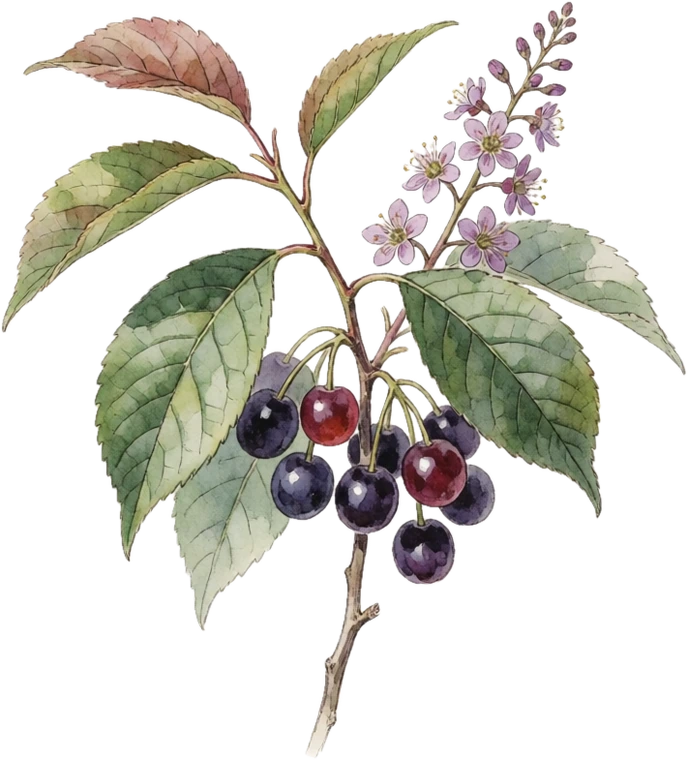
The illustrated growing guide
Black Cherry
Prunus serotina
Family Rosaceae
Est. zones 3-9

Wildlife magnet. Leaves (wilted) are toxic to livestock. Fruit is small/bitter but makes great jelly/wine.

From the print shop
The closest print we make
We don’t print Prunus serotina. The closest we have is Prunus serrulata (“Japanese Cherry”) in the Flowering Trees collection — the same genus, Prunus, not the same species.
16 designsfrom $21.99white or black groundmatte poster, unframed
I
Overview
Will black cherry suit your garden, and what goes wrong.
Will it fruit where you are?
Enter your ZIP — we look up your USDA hardiness zone (2023 map) and check it against what black cherry actually needs.
Black Cherry at a glance
Common black cherry problems
- Eastern Tent Caterpillar
- Cherry Scallop Shell Moth
- Black Knot
- Leaf Spot
II
Growing
Light, water, soil, propagation and the season’s jobs.
How to grow black cherry: light, water & soil
How to plant & propagate black cherry
The black cherry growing playbook
Field-tested instructions for every job black cherry asks of you, compiled from university extension guidance — in the order the season brings them.
Pruning
Black knot: cut out every gall while the tree is dormant
With the leaves gone you can finally see them: hard, black, cracked swellings wrapped around twigs and branches. Cut at least 4 inches below each gall, into clean wood, and take the prunings out of the planting to burn or bury them. Disinfect your blades between cuts. Prune on a cold, dry stretch rather than a mild wet one. Apiosporina morbosa overwinters alive inside the galls, and those galls are what fire spores at your new shoots during spring rains. A gall left on the tree is not a scar, it is next year's inoculum, and the fungus grows inside a shoot for months before the swelling ever shows.
⚠ The prunings are the hazard here: cut cherry foliage and twigs wilt into hydrogen cyanide, and 1.2 to 4.8 pounds of wilted black cherry leaves can kill a 1,200-pound cow. Never toss prunings over the fence into a pasture or paddock.
What to watch for
Rub out eastern tent caterpillar egg masses on bare twigs
Look along pencil-thin twigs for a shiny black band that looks like it was dipped in varnish, wrapped right around the wood. Prune the twig off or crush the mass with your thumb. On a big tree carrying many masses, a dormant oil spray smothers the eggs instead. Each of those bands holds 150 to 400 eggs, so a handful of masses you can reach in January is an entire tent you never have to deal with in spring. They are only findable now, because once the canopy fills in you will never spot them.
Pull tents out by hand as the buds break
Tents appear in branch crotches right as the tree leafs out. Wear gloves and pull small tents out by hand, or wind larger webs onto a stick or broom, and take the caterpillars with the web. Do it early morning or evening while the caterpillars are home inside, not midday when they are out feeding. The eggs hatch at bud break, timed to the first tender leaves, and the tent is their nightly shelter. Remove it while they are inside and you take the colony with it, otherwise they simply rebuild.
⚠ Never burn a tent that is still in the tree. The fire does far more damage to the branch than the caterpillars ever would.
After any storm, get downed cherry limbs away from livestock
Walk the tree line after every windstorm and drag any broken cherry branches out of reach of cattle, sheep, goats, or horses. Do the same with your own prunings and anything a mower has knocked down. Applies any time the tree is in leaf, not just in summer. Intact leaves on a standing tree are safe, but wilting ruptures the cells and lets the stored glycosides meet the enzyme that converts them to hydrogen cyanide. Wilted is the dangerous state, and stock will eat wilted cherry leaves readily.
⚠ As little as 1.2 to 4.8 pounds of wilted leaves can be a lethal dose for a 1,200-pound cow, and 0.18 to 0.72 pounds for a 180-pound sheep. Signs of cyanide poisoning can appear within 15 to 20 minutes of an animal eating them. Watch for drooling, labored breathing, weak pulse, bright red mucous membranes, and convulsions, and call a vet immediately.
Spraying
Btk for tent caterpillars, only while they are small
If the tents are out of reach to pull by hand, spot-spray the foliage around them with Bacillus thuringiensis kurstaki while the caterpillars are still under an inch long. They have to eat the treated leaf for it to work, so cover the foliage they are feeding on rather than drenching the web itself. Btk is a stomach poison that only affects caterpillars, and it only really kills young larvae. Once they pass an inch, sprays stop working and you are just spending money on a tree that will releaf anyway.
⚠ Btk kills the larvae of every butterfly and moth that eats treated leaves, so spot-treat infested branches only, never the whole canopy. This is a pre-bloom application while flower buds are still closed. Do not spray any insecticide once the racemes open, as black cherry bloom is heavily worked by pollinators.
Black knot fungicide on young trees, starting as buds open
Only worth doing on a young or small tree you can actually cover, and only alongside pruning, never instead of it. Starting when the flower buds just begin to open, spray captan, thiophanate-methyl, or lime sulfur, and repeat per the label while shoots are still expanding. Time applications ahead of a rain when temperatures are above 60F, and stop once the weather turns consistently warm and dry. The galls release spores during spring rains, and only young green shoots and fresh wounds can be infected. Protecting that narrow window of expanding tissue is the whole point, which is also why spraying a mature 70-foot black cherry is pointless.
⚠ If you intend to eat the fruit, read the label for the pre-harvest interval before choosing a product. Chlorothalonil is also labeled for black knot but on cherry it is barred after shuck split, so it is not an option for later cover sprays.
Harvesting
Pick the cherries once they go past red to near-black
The small 3/8-inch fruits hang in drooping clusters and turn from red to a deep purple-black as they ripen in late summer. Red is not ready. Take them at full black, and expect to share, since around 70 bird species strip these trees. Black cherry is bitter and astringent eaten out of hand even when ripe, which is why it goes to jelly, syrup, and wine rather than the fruit bowl. Colour is the only reliable ripeness cue.
⚠ The flesh is what is edible. Leaves and seeds carry cyanogenic glycosides, so do not crush, grind, or eat the pits, and keep them away from children and pets. Fruit dropping on a driveway or patio will stain it.
III
The year
What black cherry asks for, month by month.
The black cherry year, month by month
What each band means
- Bloom — flowers open — pollinators working, frost on blossoms is the danger.
- Prune — shape it now — cuts heal cleanly and structure is visible.
- Harvest — picking time — check ripeness every few days.
The black cherry year as text
- Jan pruning
- Feb pruning
- Mar quiet month
- Apr quiet month
- May bloom
- Jun harvest
- Jul harvest
- Aug harvest
- Sep quiet month
- Oct quiet month
- Nov quiet month
- Dec pruning
These are the species' typical months — expect them a few weeks earlier in warm zones and later in cold ones. Watch the plant, not just the calendar.
IV
Ecology & uses
What it does for the garden, and what it is grown for.
Black Cherry in the garden system
- Canopy layer tree
- Hosts 450+ Lepidoptera incl. tiger swallowtail, cecropia moth
- Keystone: Keystone — hosts 340-450+ caterpillar species
What black cherry is grown for
! Some parts toxic — see notesWilted leaves toxic to livestock
Harvesting & storing black cherry
Summer.
Edibility, identification, and traditional-use notes here are general reference — not medical or veterinary advice, and not a claim that any plant treats or prevents anything. Medicinal ratings record how strongly a plant features in herbal tradition, nothing more. Never eat or dose a plant you have not positively identified. More on how to use this library.
V
Cultivars
Named varieties of black cherry, ruled as a catalogue.
Best black cherry varieties & cultivars
Native Missouri
VI
Sources & plant ID
Where the care distinctions come from, and how the plant is filed.
Research basis
Sources behind this profile
No extension citations are attached to black cherryyet. The care figures below come from the library's own catalogue rather than a traced primary source.
Plant ID
VII
Where to buy
Third-party nurseries — not Story Thyme Farms.
Third-party nurseries, not Story Thyme Farms. Prices are theirs.
Story Thyme Farms may earn a small commission from these links, at no cost to you — it never changes what we recommend.
VIII
Questions
Black Cherry questions, answered straight.
Do I need two black cherry plants to get fruit?
No — black cherry is self-fertile, so a single plant will set a crop. A second one usually improves yields, but it isn't required.
Is black cherry safe for kids and pets?
With care. Wilted leaves toxic to livestock Site it accordingly if children or pets roam the garden. This is general reference, not medical or veterinary advice — call a vet or poison control if something has actually been eaten.
When do you harvest black cherry?
Summer.
How do you propagate black cherry?
Grafted, or from cuttings/layering (seed won't come true).
IX
Elsewhere
Where black cherry sits in the library.
Mulberry
Avocado
Persimmon
Orange