Asian Persimmon
- Hardiness
- 7-10
- Mature size
- 15-30 ft
- Growth rate
- Moderate
- Chill requirement
- 100-200
- Pollination
- Usually self-fertile/parthenocarpic; pollination can add seeds and improve set
Family Ebenaceae
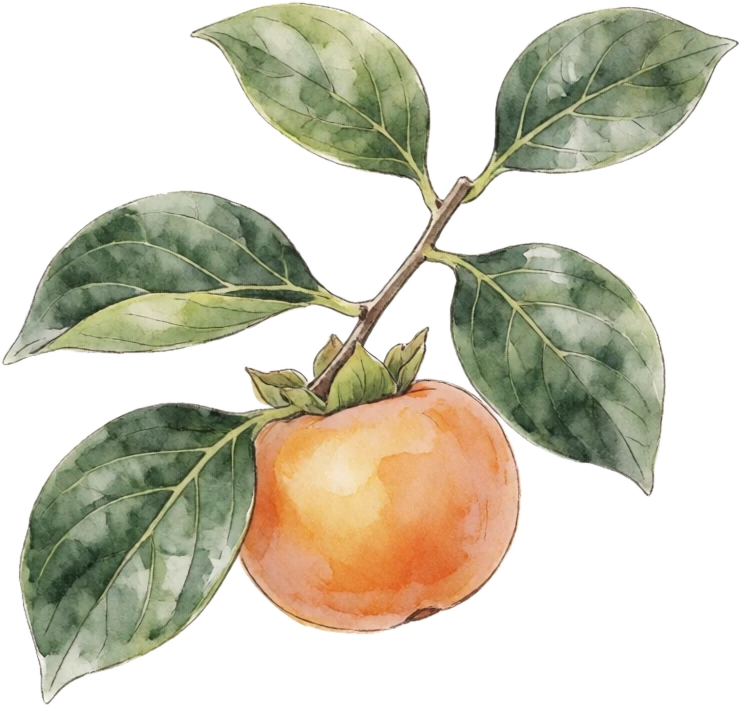
Wait for a persimmon to turn fully soft and it repays you with spoon-sweet, honeyed flesh — one of autumn's great rewards, and one the impatient never meet, since only dead-ripe fruit loses its pucker. This entry covers both the Asian persimmon and the native American type.
Across the two types hardiness spans zones 4-10, so one persimmon or another suits almost any yard, in full sun or part shade. The fruit hangs on like ornaments after leaf drop, feeding whoever waits longest — pick your type, plant it, and learn patience deliciously.
 Full Sun to Part Shade
 Excellent edible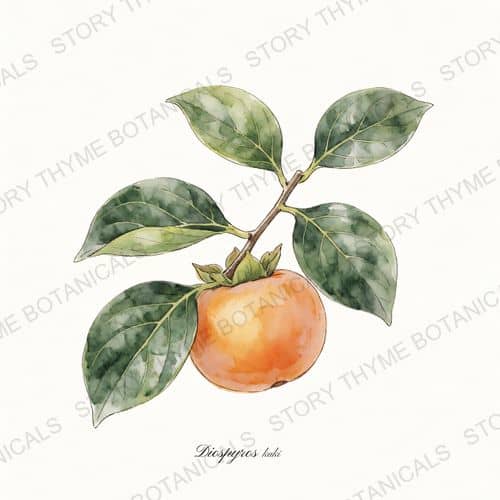
From the print shop
Our Plant Library collection carries persimmon — Diospyros kaki, print Nº 363, “Asian Persimmon.”
526 designsfrom $12.99white or black backgroundmatte poster, unframed
Hardiness differs across the 2 persimmons in this guide, so pick yours and this panel answers for that one.
Asian Persimmon
Persimmon · Common problems
Nothing common enough to list for persimmon. Watch it like anything else in the garden, and check the plants growing next to it.
Persimmon · Which one do you have?
Where these differ, the key facts above give the span across all of them. Each type’s own figures, as the catalogue records them:
Persimmon · Growing & propagation
Light Pruning
 Propagate
Seed won't come true
Persimmon · Harvest & keeping
 Years to first harvestTypical yieldWhat you eat
 How to tell it is ready
Asian types firm-ripe or soft depending on cultivar
 How long it keeps
Persimmon · Seasonal care & spray guidance
winter, before growth starts
3 jobsPruningIn winterAsian PersimmonPrune while the tree is dormant. Take out dead, diseased, and crossing limbs, branches bent to the ground, and spindly wood that would snap under a load of fruit. Open the canopy by removing a few whole old branches and heading the tallest ones, rather than shearing every branch back to the same length. Prune what remains lightly. Persimmon fruits on new wood and on one-year-old wood, and the buds nearest the branch tips are the most productive, so uniform heading cuts remove next season's crop and provoke a thicket of regrowth at every cut.
PruningIn February and MarchAmerican Persimmon (Native)While the tree is fully dormant in late winter, take out dead, broken, and crossing wood and train to a modified central leader, which also keeps the tree from getting too tall. Cut back to the branch collar with a clean, smooth cut and leave no stubs. This tree needs little pruning once it reaches bearing size if you set the form early, so resist the urge to cut more. Persimmon wilt spores are wind-borne and a wound is what lets them in — the Forest Service tells you to cover bruises on healthy trees to keep spores out, so every cut is a door. Cutting while the tree is dormant means fewer open wounds standing through the season when the fungus is active.
 SprayingIn winterAsian Persimmon
If scale showed up last season, spray horticultural dormant oil over the trunk, scaffolds, and twigs in late winter, shortly before the buds swell. Cover the bark thoroughly; the oil only works where it lands. Scale overwinters on the bark as immobile, armored insects, and the oil kills by smothering them, which is why it must go on before growth starts and while the insects are still exposed and stationary.
early spring
2 jobs FeedingIn springAsian Persimmon
In late winter or very early spring, apply about three-quarters of a pound (roughly 1.5 cups) of 13-13-13 per inch of trunk diameter measured at the soil line, spread under the canopy. Judge whether the tree needs it at all first: if the leaves were not dark green last year and the tree put on less than 10 to 12 inches of shoot growth, it needs feeding. If it is dark green and grew more than that, skip it. Persimmon is a light feeder, and excess nitrogen pushes leafy growth at the expense of fruit and triggers premature fruit drop, so overfeeding costs you the crop you were trying to grow.
FeedingIn springAmerican Persimmon (Native)If growth is weak, broadcast a balanced 10-10-10 evenly on the ground beneath the canopy at about a half to one pound per year of the tree's age, capping out around eight to ten pounds on an old tree. Skip the spiked fertilizer stakes. Give a newly planted tree nothing until it has leafed out and is growing. A persimmon pushed too hard drops its fruit, so this is a tree where restraint outyields generosity. Most trees in decent soil, especially ones surrounded by fed lawn, need nothing at all.
as the fruit sets
1 jobThinningAt petal fallAsian PersimmonIn a year when the tree sets heavily, thin the young fruit to about 6 inches apart, breaking up any clusters. Do it within a month after bloom, while the fruit is still small. A heavy set makes small, clustered fruit, and it exhausts the tree into alternate bearing, where this year's glut buys next year's blank. Thinning early, while the fruit is still cheap for the tree to drop, is what resets that cycle.
the growing season
4 jobsPruningIn summerAmerican Persimmon (Native)Native persimmon throws suckers from its roots, sometimes well out from the trunk. Cut them off at ground level as they appear through the growing season, while they are still soft and small. This tree sprouts vigorously from roots and the stump, and left alone a mature tree turns its own dripline into a thicket that competes with the tree and with everything planted under it.
 What to watch forThrough summerAsian Persimmon
Through the growing season, look over twigs and leaf undersides for scale bumps and cottony mealybugs. The tell is honeydew: sticky leaves and trails of ants running the trunk. Banding material and an insect barrier on the trunk help keep ants from farming them. Note what you find so you know whether a dormant oil spray is warranted next winter. Persimmon has few serious pests, so scouting is mostly about catching the two that do turn up, and because scale is far easier to kill with dormant oil in winter than with anything sprayed in season.
What to watch forIn summerAmerican Persimmon (Native)Walk the tree and look for leaves wilting and dropping while the branches die back from the top down. Cut into a suspect branch and look for dark streaking in the wood. There is no cure, so remove and burn a confirmed infected tree rather than leaving it standing as a spore source. Cephalosporium diospyri plugs the water-conducting wood, and an infected tree lives only one or two years after wilting starts. It is the one disease with real potential to kill a native persimmon.
What to watch forIn summerAmerican Persimmon (Native)Look for silk webs enclosing the leaves at branch ends. Where you can reach them, prune the webbed tips out and drown or bury them. If webs are too many to prune on a small tree, spray Bacillus thuringiensis while the caterpillars are still small, wetting the foliage next to the web rather than the web itself. Webworms colonize branch ends and can genuinely set back a small young tree. On a big established persimmon the feeding lands so close to natural leaf drop that it does not hurt the tree, and the webs are mostly an eyesore.
as it ripens, and picking
2 jobsHarvestingAt harvestAsian PersimmonPick by color, not by the calendar. Harvest astringent types like Hachiya and Tanenashi once the color has fully developed but while the fruit is still hard, then ripen them soft indoors. Non-astringent types like Fuyu and Jiro are ready to eat firm, once they color up. Cut the fruit from the tree with shears, taking the calyx and a small portion of stem with it, rather than pulling the fruit off. Waiting for frost is folk advice that backfires: frost will ruin immature fruit on the tree, and persimmons lose astringency as they ripen rather than because of a freeze. Pulling fruit tears it loose at the calyx and opens the wound that rots it in storage.
HarvestingAt harvestAmerican Persimmon (Native)Test by feel, not by date. Take fruit only when it has gone deep orange and squishy-soft, so soft it feels overripe and pulls free with no resistance. The tree ripens unevenly, so pick it over every few days for weeks rather than stripping it once. The fruit is loaded with soluble tannins until it is thoroughly ripe, and it is softening, not frost, that finally binds those tannins up. Ripe fruit often arrives around your first frost, which is how the frost story got started, but a hard persimmon is astringent in any weather.
autumn, and putting it to bed
2 jobsWhat to watch forIn autumnAmerican Persimmon (Native)Once twigs the thickness of a pencil start dropping with a neat, chewed-through cut at one end, rake them up and destroy them by burning, burying, or bagging. Get the ones still hung up in the canopy too. Do this through fall and winter and finish before spring. The female twig girdler girdles the twig on purpose and lays her egg in the part beyond the cut, because her larva cannot develop in healthy sapwood. The grub overwinters in that fallen twig, so hauling the twigs away is what actually breaks the cycle.
HarvestingAfter harvestAsian PersimmonAstringent persimmons picked hard need to soften before they are edible. Left on the counter they will ripen on their own. To hurry it, bury the fruit in uncooked dry rice for 3 to 5 days, or freeze it for 24 hours and then thaw. The pucker is soluble tannin, and it does not wash out or cook out. It only becomes insoluble as the fruit softens, which is why an astringent persimmon eaten firm is inedible and the same fruit eaten soft is not.
Persimmon · Calculators & field guides
Persimmon · Yearly calendar
No calendar activity is listed for this month.
 BloomPruneHarvest
BloomMay
PruneFebruary to March
HarvestOctober to November
These are the species' typical months — expect them a few weeks earlier in warm zones and later in cold ones. Watch the plant, not just the calendar.
Persimmon · Ecology & uses
 Deer
DeerProtect young plants
✓ Commonly eatenSafe when ripe; unripe astringent fruit is unpleasant · Safe RIPE; unripe = mouth-puckering astringent (never eat firm)
Edible valueEdibility, identification, and traditional-use notes here are general reference — not medical or veterinary advice, and not a claim that any plant treats or prevents anything. Medicinal ratings record how strongly a plant features in herbal tradition, nothing more. Never eat or dose a plant you have not positively identified. More on how to use this library.
Persimmon · Varieties & cultivars
Named varieties of persimmon differ in winter-chill needs, ripening time, hardiness, and whether they set fruit on their own — pick one that fits your climate.
20 varieties
Also known as Fuyugaki; note Jiro is often sold under the Fuyu name
Self-fertile
sweet, mild; eaten firm and crisp like an apple — The classic non-astringent (PCNA) persimmon eaten while still hard. Self-fruitful and sets seedless fruit without a pollinizer; the best all-around choice for most home growers.
Story Thyme Farms may earn a small commission from these links, at no cost to you — it never changes what we recommend.
Also known as Maekawa Jiro; often marketed alongside or as Fuyu
Self-fertile
sweet, crunchy when ripe; eat firm — A flatter, blockier non-astringent (PCNA) cousin of Fuyu that ripens slightly earlier. Self-fruitful; a distinct cultivar from Fuyu despite shared marketing.
Story Thyme Farms may earn a small commission from these links, at no cost to you — it never changes what we recommend.
Also known as Ichikikei Jiro, Early Jiro
Self-fertile
sweet, crisp non-astringent (PCNA); eat firm — A compact, cold-hardy non-astringent sport of Jiro, widely sold as one of the hardiest PCNA kaki and a good pick for smaller yards and colder sites (protect young trees). Zone 6 is the tested edge.
Story Thyme Farms may earn a small commission from these links, at no cost to you — it never changes what we recommend.
Self-fertile
sweet, mild non-astringent (PCNA); eat firm — One of the earliest-ripening non-astringent varieties on a naturally small tree; good where the season is short or space is tight.
Story Thyme Farms may earn a small commission from these links, at no cost to you — it never changes what we recommend.
Self-fertile
rich, sweet, custardy; only edible when fully soft-ripe — The classic acorn-shaped astringent (PCA) persimmon prized for baking and drying. Sets seedless parthenocarpic fruit without a pollinizer, but must be fully soft or it is intensely astringent.
Story Thyme Farms may earn a small commission from these links, at no cost to you — it never changes what we recommend.
Self-fertile
exceptionally sweet, jelly-like; astringent (PCA) until soft — One of the sweetest persimmons and among the hardier astringent kaki. Some sources rate it to zone 6, but it performs best in zone 6b or warmer; wait for soft fruit.
Story Thyme Farms may earn a small commission from these links, at no cost to you — it never changes what we recommend.
Also known as Gionbo
Self-fertile
sweet, juicy, jelly flesh; astringent until soft; excellent dried — A large-fruited astringent variety with Saijo-quality flavor on much bigger fruit; one of the best for drying. Classed as a pollination-variant astringent, so unlike PVNA types it stays astringent even when seeded — eat only when fully soft.
Story Thyme Farms may earn a small commission from these links, at no cost to you — it never changes what we recommend.
Self-fertile
sweet when soft-ripe; astringent (PCA) when firm; seedless — A popular Southeast astringent persimmon (the name means 'seedless') that reliably sets heavy crops of large seedless fruit with no pollinizer. Flavor is good but not top-tier among astringents.
Story Thyme Farms may earn a small commission from these links, at no cost to you — it never changes what we recommend.
Also known as Tsurunoko
Partly self-fertile
spicy, rich; cinnamon-brown flesh when seeded — A pollination-variant type whose signature spice-brown, non-astringent flesh develops only when the fruit is seeded. It bears many male flowers so it can partly pollinate itself; grown truly alone the fruit tends to stay astringent.
Story Thyme Farms may earn a small commission from these links, at no cost to you — it never changes what we recommend.
Also known as Nishimura Wase
Partly self-fertile
sweet, brown-sugar/spice; crunchy brown flesh only when fully seeded — An early-ripening (about a month ahead of Fuyu types) pollination-variant (PVNA) persimmon. It must be fully seeded by a pollinizer to lose astringency — unpollinated fruit behaves like an astringent type — so plant a pollen source such as Chocolate alongside it.
Story Thyme Farms may earn a small commission from these links, at no cost to you — it never changes what we recommend.
Self-fertile
Astringent until soft, very high quality, red-orange — Heavy producer on a relatively small, self-fruitful tree, which suits a home yard. Unusual among Oriental persimmons in that its fruit is seeded rather than seedless. Long regarded as the best commercial variety in Texas.
Story Thyme Farms may earn a small commission from these links, at no cost to you — it never changes what we recommend.
Astringent, must be soft to eat; juicy, watery and stringy, with a thick peel — Distinctive ring constriction around the top third of the fruit, nearest the stem. The most vigorous and upright of the varieties grown in the South, so give it room and prune for structure early.
Story Thyme Farms may earn a small commission from these links, at no cost to you — it never changes what we recommend.
Astringent, bright orange, high jelly content — A well-spreading tree. The fruit is large with lobed sections that look somewhat like a four- or six-leaf clover viewed from the top. It will set many seeds when pollinated.
Story Thyme Farms may earn a small commission from these links, at no cost to you — it never changes what we recommend.
Astringent, must soften; dry flesh similar to Tanenashi but of excellent quality — A strong, upright tree carrying small four-sided fruit. The flesh is dry in the manner of Tanenashi, which suits it to drying, but quality is excellent.
Story Thyme Farms may earn a small commission from these links, at no cost to you — it never changes what we recommend.
Also known as Giant Fuyu
Non-astringent, sweet, eaten firm — but may be slow to lose astringency — A large-fruited non-astringent type in the Fuyu group, of medium vigor, that regulates its own crop load well — a good homeowner cultivar. Fruit are slightly larger than most and generally free of imperfections, but can be slow to lose astringency, so give them time to colour fully before eating firm.
Story Thyme Farms may earn a small commission from these links, at no cost to you — it never changes what we recommend.
Non-astringent, sweet, eaten firm; seeded fruit has better flavor — Non-astringent type adapted to the Southeast. Unseeded fruit may still reach good size, but seeded fruit has better flavor — and seeded fruit requires a pollinator, so plant a pollinizer such as Gailey if flavor is the goal.
Story Thyme Farms may earn a small commission from these links, at no cost to you — it never changes what we recommend.
Non-astringent, very sweet — A late non-astringent type, which means it needs a long enough autumn to color up before hard freezes.
Story Thyme Farms may earn a small commission from these links, at no cost to you — it never changes what we recommend.
Non-astringent, sweet, eaten firm — An earlier-ripening Fuyu sport. Recommended as the midseason non-astringent choice for Florida, bridging the gap between Izu and Fuyu.
Story Thyme Farms may earn a small commission from these links, at no cost to you — it never changes what we recommend.
Also known as Christmas persimmon
Astringent, must be soft to eat; juicy, with large seeds — A late astringent cultivar for Florida, sometimes called the Christmas persimmon because fruit are often harvested in January. Persimmons grow and fruit best in central and northern Florida. Caution: the tree begins growing early in spring, which increases its chances of freeze injury — a poor choice for a site prone to late frosts.
Story Thyme Farms may earn a small commission from these links, at no cost to you — it never changes what we recommend.
Astringent; very dark flesh, even with few seeds — Grown as a pollinizer rather than for its own fruit — extension names Fuyu or Gailey as the pollen sources for Oriental persimmons. Concentric ring cracking of the fruit is common. Note that native American persimmon will not cross-pollinate Oriental types, so it cannot substitute.
Story Thyme Farms may earn a small commission from these links, at no cost to you — it never changes what we recommend.
Sources & plant identity
Hardiness, size and timing vary with your cultivar, soil and climate.
University extension research, brought together with hands-on growing experience at Story Thyme Farms.
 Clemson University
 Mississippi State University
 NC State Extension
 University of California ANR
 University of Florida
 USDA PLANTS Database
 University of Georgia
 University of Wisconsin-Madison
 Texas A&M AgriLife
 Alabama Cooperative Extension
 Purdue UniversityVirginia Cooperative Extension / Virginia Tech (Publication 354-313), with USDA Forest Service National Agroforestry Center
 University of Missouri
 Stark Bro?s
Publisher marks identify sources, not sponsorship or endorsement.
Persimmon questions, answered straight.
Persimmon is commonly eaten and isn't considered toxic, but "commonly eaten" isn't a guarantee for any particular person or animal — allergies, quantity, and which part you eat all matter. One caveat on this one: Safe when ripe; unripe astringent fruit is unpleasant · Safe RIPE; unripe = mouth-puckering astringent (never eat firm. Never eat a plant you haven't positively identified, and check with a vet before letting pets or livestock graze anything new.
Grafted, or from cuttings/layering (seed won't come true).
Where persimmon sits in the library.
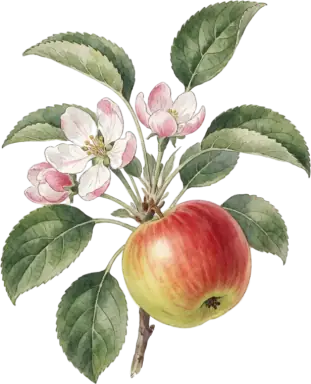 Apple
Apple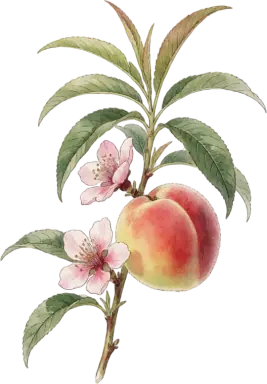 Peach
Peach Plum
Plum Pluot
Pluot