The illustrated growing guide

Pluot

Prunus salicina × armeniaca

Family Rosaceae

Est. zones 6-9

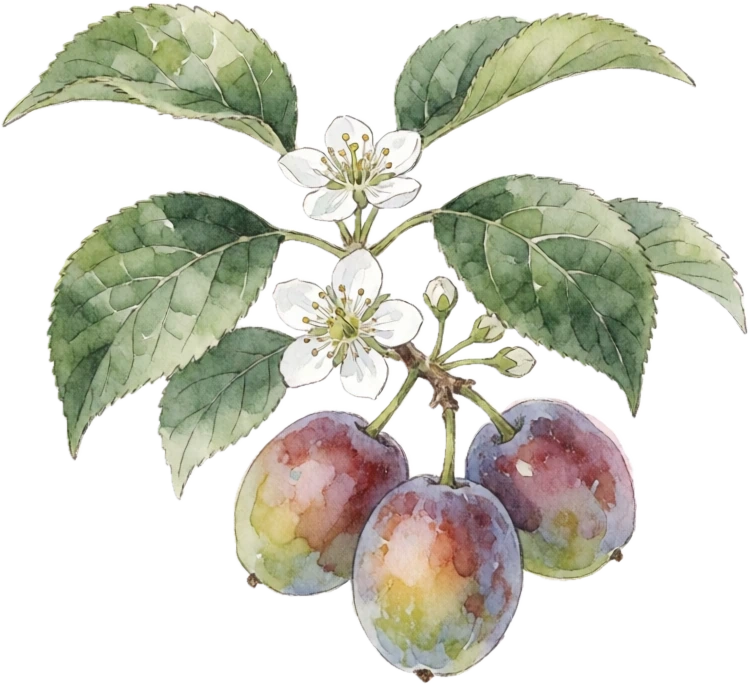
Botanical illustration of Pluot
Tree · Prunus salicina × armeniaca

Very sweet fruit. High sugar content creates higher Brown Rot risk.

TreeFull SunModerate waterFast growthExcellent edibleAttracts bees400-600 winter chill (unconfirmed)Needs a pollination partner

Where to buy the plant — 1 nursery

Japanese Cherry — a print from the Flowering Trees collection

From the print shop

The closest print we make

We don’t print Prunus salicina × armeniaca. The closest we have is Prunus serrulata (“Japanese Cherry”) in the Flowering Trees collection — the same genus, Prunus, not the same species.

16 designsfrom $21.99white or black groundmatte poster, unframed

Shop Flowering Trees botanical prints →

I

Overview

Will pluot suit your garden, and what goes wrong.

Will it fruit where you are?

Enter your ZIP — we look up your USDA hardiness zone (2023 map) and check it against what pluot actually needs.

Hardy inZones 6-9
Winter chill400-600
Unconfirmed

Commonly quoted, but we have not traced this range to a university extension trial or another primary source, and published figures for the same plant often disagree. Chill-hour requirements were only ever established by trial for a handful of commercial fruit crops; for most species the work was never funded. Treat it as a starting point and check your local extension office before you plant on it.

PollinationPartner needed

Pluot at a glance

HardinessUSDA 6–9
Mature size12-15 ft
PollinationNeeds Pollinator (Japanese Plum usually required, e.g., Santa Rosa)
Chill requirement400-600
Unconfirmed

Commonly quoted, but we have not traced this range to a university extension trial or another primary source, and published figures for the same plant often disagree. Chill-hour requirements were only ever established by trial for a handful of commercial fruit crops; for most species the work was never funded. Treat it as a starting point and check your local extension office before you plant on it.

Bloom seasonEarly Spring
Harvest seasonJuly - August
Growth rateFast

Common pluot problems

  • Same as Plums (Curculio, etc.)
  • Bacterial Spot
  • Brown Rot
  • Poor pollination → low fruit set (plant a partner)

II

Growing

Light, water, soil, propagation and the season’s jobs.

How to grow pluot: light, water & soil

LightFull Sun
WaterModerate
SoilWell-drained Loam · pH 6.0 - 7.0
FertilizerEarly Spring
PruningLate Winter or Summer — Open Center (Vase)
Spacing15-20 ft

How to plant & propagate pluot

PropagateGrafted, or from cuttings/layering (seed won't come true)

When to spray pluot

Dormant season. Copper / Oil: Treat exactly like Plum/Apricot. Late winter application.

Growing season. Petal Fall: Insecticide essential. Brown Rot sprays crucial as high-sugar fruit ripens.

The pluot growing playbook

Field-tested instructions for every job pluot asks of you, compiled from university extension guidance — in the order the season brings them.

Thinning

Thin the young fruit to 4 to 6 inches apart

Once frost danger has passed and the fruit has set, pull fruit by hand until what remains stands 4 to 6 inches apart along each branch. Waiting until frost risk is over keeps you from thinning a crop the weather was going to thin for you. Pluots set far heavier than the tree can finish. Left alone, the fruit stays small, the sugars spread thin across too many, and limbs loaded to the tip break or fall into alternate bearing.

Pruning

Dormant-prune your pluot to an open centerFeb – Mar

In late winter, before buds swell, train the tree the way a Japanese plum is trained: an open vase of 3 to 4 main scaffolds starting 24 to 30 inches off the ground, with the central stem removed entirely. On a bearing tree take out roughly 25 percent of the wood, favoring crossing limbs, inward growth and anything dead. Pluots inherit the Japanese plum habit of throwing dense upright growth that shades out its own fruiting wood, and light reaching the interior is what colors and sizes the crop.

Prune in dry weather. Cytospora and bacterial canker enter through fresh cuts made while the wood is wet.

What to watch for

Strip every mummy before the tree goes dormant

After the last pick, walk the tree and pull off every shriveled, hardened fruit still hanging, and rake up what fell during the summer. Get it done before spring bud break, and cut out dead and cankered twigs while you are there. Brown rot overwinters inside those mummies and in infected twigs. They are the spore source that fires at bloom next spring, so the fruit you leave hanging in October is the blossom blight you fight in April.

Do not compost mummified fruit near the orchard. Bag it or bury it.

Spraying

Dormant horticultural oil for San Jose scaleFeb – Mar

While the tree is still dormant or at delayed dormant, from silver tip up to about half-inch green and before any flowers open, cover the trunk, scaffolds and twigs to the drip point with horticultural oil. Pick a dry day above 40F with no freeze in the forecast. San Jose scale spends the winter as an immature nymph sealed under a waxy armor on the bark, and a smothering oil film is what gets through it. This is the moment it works: the scale is resuming development so it is breathing hardest, and there is no foliage yet to shadow the spray and shelter the bark. Aphid and mite eggs on the bark go with it.

Do not apply oil in freezing weather or to a tree that is already leafed out. Read the label for the dormant versus delayed-dormant rate. This spray does not end the scale season: crawlers emerge about four to six weeks after bloom, so check the bark and any sticky tape then and treat again if you find them.

Brown rot: protect the blossoms as they open

When the first blossoms crack open, spray myclobutanil, propiconazole, captan or sulfur, and repeat on the label interval until petal fall. If the bloom period stays wet, hold the 7 to 10 day interval. Monilinia spores land on open flowers and need only a few hours of wetness to infect, three hours at 70F. Blossoms lost now become the twig cankers that seed the fruit rot in summer, so this is the spray that decides the season.

This is a fungicide window, not an insecticide one. Never tank-mix or apply an insecticide while the tree is in bloom, and spray at dusk when bees have left the flowers.

Plum curculio: first spray at shuck split

As the dried shucks split away from the young fruit, spray esfenvalerate, lambda-cyhalothrin or carbaryl, or azadirachtin for an organic program. Repeat at 7 to 10 day intervals, up to three applications, while the beetles keep coming. Overwintered adults move up into the tree once it hits 70F and cut crescent-shaped scars to lay eggs in fruit barely past the shuck. Each female lays 150 to 200 eggs, and the larvae tunnel the flesh and drop the crop early.

Wait until petals have fallen and the shucks are splitting. Never apply these insecticides during bloom. Check the label for the pre-harvest interval before every application.

Brown rot: cover the fruit as it ripens

Start spraying myclobutanil, propiconazole or captan 2 to 3 weeks before you expect to pick, and repeat through harvest as the fruit softens. Keep it up on the label interval while the weather stays wet. Ripening fruit turns susceptible as its sugars climb, and a single infected fruit can rot the ones touching it in the cluster and then in the picking basket.

Do not reach for chlorothalonil here. It is cleared only for the blossom blight window on stone fruit, not for fruit rot. Observe the pre-harvest interval on whichever product you use.

Harvesting

Pick pluots by feel, not by the calendar

Pick when the ground color has changed and the fruit gives slightly to gentle pressure. Pluots ripen unevenly, so go over the tree several times across a couple of weeks rather than stripping it once. Pluot flavor is built on sugar that only accumulates on the tree, and a fruit picked hard never gets there. Colour change and a slight give are what tell you it is done, not a date. Ripe fruit keeps about three weeks refrigerated, so pick in passes rather than all at once.

III

The year

What pluot asks for, month by month.

The pluot year, month by month

MonthJanFebMarAprMayJunJulAugSepOctNovDec
Bloom
Prune
Harvest

What each band means

  • Bloomflowers open — pollinators working, frost on blossoms is the danger.
  • Pruneshape it now — cuts heal cleanly and structure is visible.
  • Harvestpicking time — check ripeness every few days.

The pluot year as text

  • Jan quiet month
  • Feb pruning
  • Mar bloom, pruning
  • Apr bloom
  • May quiet month
  • Jun pruning
  • Jul pruning, harvest
  • Aug pruning, harvest
  • Sep quiet month
  • Oct quiet month
  • Nov quiet month
  • Dec quiet month

These are the species' typical months — expect them a few weeks earlier in warm zones and later in cold ones. Watch the plant, not just the calendar.

IV

Ecology & uses

What it does for the garden, and what it is grown for.

Pluot in the garden system

  • Understory layer tree
  • Keystone: Keystone — hosts 340-450+ caterpillar species
AttractsBees
MoistureFacultative / average
DeerBrowsed — protect young plants
OriginIntroduced

What pluot is grown for

! Some parts toxic — see notesPits toxic if crushed

UseFresh eating (Dessert quality)
Edible value4/5

Harvesting & storing pluot

July - August.

Edibility, identification, and traditional-use notes here are general reference — not medical or veterinary advice, and not a claim that any plant treats or prevents anything. Medicinal ratings record how strongly a plant features in herbal tradition, nothing more. Never eat or dose a plant you have not positively identified. More on how to use this library.

V

Cultivars

Named varieties of pluot, ruled as a catalogue.

Best pluot varieties & cultivars

8 on file

Named varieties of pluot differ in winter-chill needs, ripening time, hardiness, and whether they set fruit on their own — pick one that fits your climate.

Flavor King

Needs a pollinizer
Chill–400 hrsRipensmid-August to early SeptemberZones6-10Sizenaturally compact tree
Pollinationpollenized by Flavor Supreme or Dapple Dandy pluot, or Santa Rosa / Late Santa Rosa plum

sweet, spicy, aromatic — Reddish-purple skin over crimson flesh and a repeat taste-test winner. Low chill, so it flowers early and is a frost gamble in a late-spring climate.

Where to buy ‘Flavor King

Story Thyme Farms may earn a small commission from these links, at no cost to you — it never changes what we recommend.

Dapple Dandy · Dinosaur Egg

Needs a pollinizer
Chill400–500 hrsRipensearly to late AugustZones5-10Sizestandard
Pollinationpollenized by Flavor Supreme or Flavor King pluot, or Santa Rosa, Catalina or Burgundy plum

rich plum-apricot — Freestone, with creamy white and red flesh under skin that dapples maroon and yellow as it ripens. Sold in supermarkets as the Dinosaur Egg. The widest zone range of the common pluots.

Where to buy ‘Dapple Dandy

Story Thyme Farms may earn a small commission from these links, at no cost to you — it never changes what we recommend.

Flavor Supreme

Needs a pollinizer
Chill700–800 hrsRipenslate June to early JulyZones5-9Sizestandard
Pollinationpollenized by Santa Rosa or Late Santa Rosa plum, or Flavorosa, Flavor Queen or Geo Pride pluot

sweet, rich, firm red flesh — Greenish-maroon mottled skin. At 700 to 800 hours it is by far the highest-chill pluot commonly sold, which makes it the one that actually works in a colder zone where the low-chill varieties bloom too early.

Where to buy ‘Flavor Supreme

Story Thyme Farms may earn a small commission from these links, at no cost to you — it never changes what we recommend.

Flavor Grenade

Needs a pollinizer
Chill300–400 hrsRipensSeptember to early OctoberZones6-10Sizestandard
Pollinationpollenized by Flavor King, Dapple Dandy or Emerald Drop pluot, or Santa Rosa plum

explosive sweet, crisp — Elongated green fruit with a red blush that stays crisp rather than soft. Hangs in good condition on the tree for four to six weeks, which turns one tree into a long picking season. Lowest chill of the group.

Where to buy ‘Flavor Grenade

Story Thyme Farms may earn a small commission from these links, at no cost to you — it never changes what we recommend.

Flavor Queen

Needs a pollinizer
Chill400–500 hrsRipenslate July to late AugustSizestandard
Pollinationpollenized by Dapple Dandy or Flavor Supreme pluot, or Burgundy plum. NOT pollenized by Flavor King

candy-like sweet — Greenish-yellow skin over amber-orange flesh, with a prolonged harvest spanning several weeks. Note the pollination trap: Flavor King will not set this one, despite being the obvious neighbor to plant.

Where to buy ‘Flavor Queen

Story Thyme Farms may earn a small commission from these links, at no cost to you — it never changes what we recommend.

Splash

Needs a pollinizer
Chill–400 hrsRipensmid to late JulyZones6-10Sizesmall to medium fruit on an upright tree
Pollinationpollenized by Santa Rosa plum or Flavor Grenade pluot

very sweet orange flesh — Small round to heart-shaped red-orange fruit that scores consistently near the top of Dave Wilson's formal tastings. Good fresh, dried, or in dessert.

Where to buy ‘Splash

Story Thyme Farms may earn a small commission from these links, at no cost to you — it never changes what we recommend.

Emerald Drop

Needs a pollinizer
Chill–400 hrsRipenslate July to AugustZones5-10Sizemedium to large fruit
Pollinationpollenized by Flavor Grenade pluot or Santa Rosa plum

sweet, honey-like when hung — Green-skinned with yellow-orange flesh. Picked early it is firm, juicy and sweet. Left to hang the skin turns greenish-yellow and the flesh goes honeyed, so the picking date is a real choice, not a deadline.

Where to buy ‘Emerald Drop

Story Thyme Farms may earn a small commission from these links, at no cost to you — it never changes what we recommend.

Geo Pride

Needs a pollinizer
Chill–400 hrsRipensmid to late JulyZones6-10Sizemedium fruit, heavy bearing
Pollinationpollenized by Flavor Supreme or Dapple Dandy pluot, or Santa Rosa plum. Itself a good pollinizer for other pluots and plums

balanced sweet-tart plum-apricot — Red skin over yellow flesh, with more acid behind the sugar than most pluots. Heavy producer, so thin it hard. Doubles as the pollinizer for its neighbors.

Where to buy ‘Geo Pride

Story Thyme Farms may earn a small commission from these links, at no cost to you — it never changes what we recommend.

VI

Sources & plant ID

Where the care distinctions come from, and how the plant is filed.

Research basis

Sources behind this profile

No extension citations are attached to pluotyet. The care figures below come from the library's own catalogue rather than a traced primary source.

Plant ID

BinomialPrunus salicina × armeniaca
FamilyRosaceae
TypeTree · Perennial
OriginIntroduced
Invasive riskLow

VII

Where to buy

Third-party nurseries — not Story Thyme Farms.

Third-party nurseries, not Story Thyme Farms. Prices are theirs.

Story Thyme Farms may earn a small commission from these links, at no cost to you — it never changes what we recommend.

Pluot needs a pollination partner — plant two genetically distinct trees (two different cultivars, or a cultivar plus a seedling).

VIII

Questions

Pluot questions, answered straight.

Why isn't my pluot fruiting?

Most often: it has no genetically distinct partner nearby. Pluot can't pollinate itself — needs pollinator (japanese plum usually required, e.g., santa rosa). Plant a second, unrelated one nearby; two different cultivars, or a cultivar plus a seedling, is the classic pairing.

Will pluot fruit in a warm-winter climate?

Pluot needs roughly 400-600 hours of winter chill (hours between 32–45°F) to break dormancy and set fruit. That range is commonly quoted but we have not traced it to a university extension trial, and published figures for this plant disagree — treat it as a starting point and check your local extension office. Mild-winter growers should count their chill hours before planting.

Is pluot safe for kids and pets?

With care. Pits toxic if crushed Site it accordingly if children or pets roam the garden. This is general reference, not medical or veterinary advice — call a vet or poison control if something has actually been eaten.

When do you harvest pluot?

July - August.

IX

Elsewhere

Where pluot sits in the library.