 SprayingIn February and November
Peach dormant fungicide
Apply a copper or chlorothalonil spray at leaf drop and again at bud swell. Times the two windows that stop peach leaf curl.
Prunus persica
Family Rosaceae
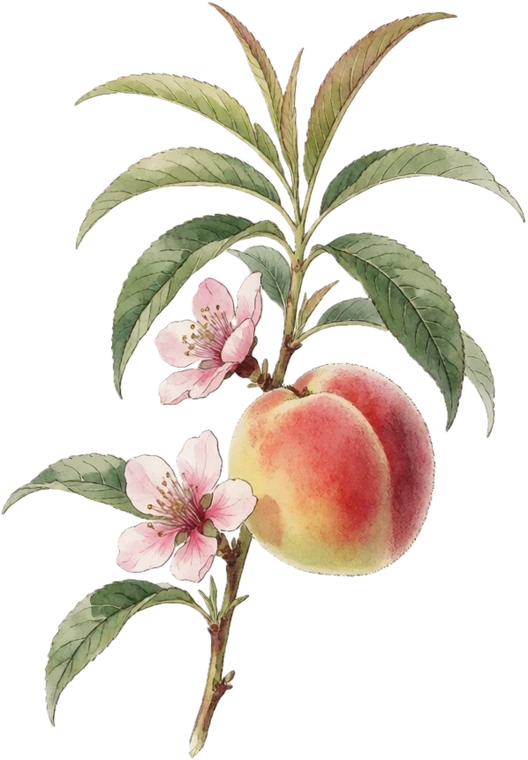
There is a reason peach juice running down your wrist is shorthand for summer. A tree-ripened peach in July is soft, perfumed, and impossible to ship, which is why the ones you grow taste like a different species from the ones you buy.
Fast to grow and quick to bear, a peach stays a manageable 12-15 feet and covers itself in pink spring bloom that bees and butterflies work hard. It is self-fertile, so a single tree earns its keep — one sunny spot is all the invitation it needs.
 Full Sun
 Moderate water
 Fast growth
 Excellent edible
 Attracts bees
 Attracts butterflies
 250-900 winter chill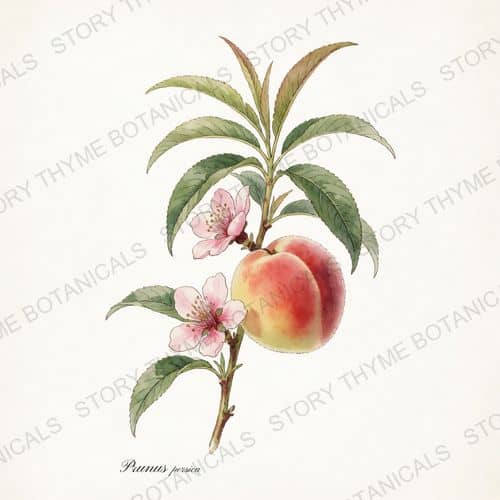
From the print shop
Our Plant Library collection carries peach — Prunus persica, print Nº 353, “Peach.”
526 designsfrom $12.99white or black backgroundmatte poster, unframed
Will it fruit where you are?
Enter your ZIP — we look up your USDA hardiness zone (2023 map) and check it against what peach actually needs.
 Hardy inZones 4-8PollinationSelf-fertile
Peach · Common problems

9 problems on file
7 problems on file
1 problem on file
Peach · Growing & propagation
LightWater Soil
Soil Fertilizer
Nitrogen heavy if growth is poor.
 Pruning
Open Center (Vase). Remove central leader to allow light into center.
 SpacingPropagate
Seed won't come true
Peach · Harvest & keeping
 Years to first harvestTypical yieldWhat you eat
 How to tell it is readyHow long it keeps
Peach · Seasonal care & spray guidance
Dormant season. Leaf Curl (Copper/Lime Sulfur): CRITICAL spray. Apply late autumn after leaf drop OR early spring BEFORE bud swell. Must cover every twig.
Growing season. Petal Fall (Shuck Split): Insecticide (Curculio/OFM) + Fungicide (Brown Rot). Cover sprays every 10-14 days. Pre-Harvest: Fungicide 2 weeks before picking.
winter, before growth starts
1 jobSprayingIn February and NovemberApply a copper or chlorothalonil spray at leaf drop and again at bud swell. Times the two windows that stop peach leaf curl.
early spring
1 jobPruningAt green tipPrune in the last stretch of dormancy, as the coldest weather breaks and the buds begin to swell but before they open - in the warm end of the range this is mid-February to early March, further north it is later, so watch the buds rather than the calendar. Keep three or four scaffold limbs with wide crotch angles above 45 degrees, the lowest about 15 inches off the ground and the highest about 30 inches, and cut out the center so the tree holds a vase shape that light can reach the bottom of. Do not prune between leaf drop and midwinter. Peaches fruit only on wood that grew the previous season, so a tree left unpruned walks its crop higher and further out every year until the fruiting wood is all out of reach. Holding the cuts until the end of dormancy also keeps open wounds from sitting through the cold, which is when winter injury and bacterial canker get in, and it lets you see which wood the winter already killed before you decide what to keep.
at bloom
2 jobsFeedingAt bloomMake the first application somewhere between bloom and petal fall using a complete fertilizer such as 16-4-8, 12-6-6, 12-4-8 or 10-10-10, then a second about two months later, and a third after harvest if the tree carried a crop. Young trees in their first three years need less than a mature bearing tree. Peaches pull more out of the soil than most tree fruit and respond to nitrogen more than to any other nutrient, and bearing trees ship nitrogen and potassium out of the orchard in every fruit picked. Splitting the dose feeds the tree when it is actually growing instead of dumping it all at once.
SprayingAt bloomAs the flowers open, spray captan or chlorothalonil to protect the blossoms from brown rot. Repeat if bloom stretches out over a long cool wet spell, since flowers that open later are unprotected by the earlier spray. Monilinia fructicola infects through the stigmas and anthers of open flowers, and a blighted blossom becomes the twig canker that seeds the fruit rot months later. Fungicides only prevent new infection, they cannot cure what has already gone in.
as the fruit sets
2 jobsThinningAt shuck splitAbout four weeks after full bloom, once the shucks have split and you can see which fruit has really set, pull fruit off by hand until the ones left are spaced about 6 inches apart along each limb. Take the small, damaged and doubled fruit first. A peach sets far more fruit than it can ever mature, and left alone it will ripen a heavy crop of small bland fruit and snap its own limbs under the weight. Thinning is what turns the same amount of sugar into fewer, larger, better-tasting peaches.
SprayingAt petal fallOnce the petals have dropped and the bees have left the tree, spray malathion for plum curculio, catfacing insects and oriental fruit moth, and repeat through shuck split into first cover. Plum curculio females cut crescent-shaped egg scars into the young fruit as soon as it sizes, and the overwintering generation of oriental fruit moth is bored into shoots at this same moment. Hitting this window is what stops both from establishing a population that runs all season.
the growing season
1 jobSprayingThrough summerHang a pheromone trap and spray permethrin or carbaryl on the lower trunk and the ground at the base of the tree once males start showing up, then again two to three weeks later if they are still flying. Wet the bark from the lower scaffolds down to the soil line until it puddles at the base. This is a trunk spray, not a canopy or fruit spray. Females lay on the lower trunk bark and in soil cracks near the base, the eggs hatch in about ten days, and the larvae tunnel straight into the sapwood below the soil line where nothing can reach them. The insecticide only works as a barrier on the bark during the ten days between laying and hatching, so it has to be there while moths are flying.
as it ripens, and picking
1 jobSprayingBefore harvestStart covering the fruit again in the last few weeks before picking, on a 10 to 14 day interval, and shorten the interval during frequent rain. Both propiconazole and captan carry a 0-day pre-harvest interval on peach, so either can legally be used right up to picking - read your own product's label, since the interval belongs to the label and not to the active ingredient in the abstract. Ripening fruit turns sharply susceptible to brown rot as its sugar climbs, and a gap in coverage now lets in latent infections that stay invisible until the fruit rots in the bowl days after you pick it. Sugar-rich fruit and warm wet weather are exactly what the fungus needs to sporulate.
autumn, and putting it to bed
1 jobPruningAfter harvestOnce the crop is off, go through the tree and pull down every shriveled mummified fruit still hanging, and rake up the ones on the ground. Get them out of the orchard rather than composting them at the base of the tree. Leave the twigs with sunken cankers for the dormant pruning pass at the end of winter - cut those out then, when the wounds will not be sitting open through the growing season, and burn or bin the prunings. Brown rot overwinters in exactly two places: mummified fruit on the tree and on the ground, and the cankers on twigs and branches. Those mummies are what produce next spring's spores during bloom, so pulling them now removes the inoculum before it can start the cycle over, and the cankers come out with the rest of the dormant cuts.
Peach · Calculators & field guides
Peach · Yearly calendar
No calendar activity is listed for this month.
 BloomPruneHarvest
BloomMarch to April
PruneFebruary to April
HarvestJuly to August
These are the species' typical months — expect them a few weeks earlier in warm zones and later in cold ones. Watch the plant, not just the calendar.
Peach · Ecology & uses
Prunus persica
AttractsMoisture Deer
DeerProtect young plants
 Origin
! Some parts toxic — see notesPits toxic — don't crack for kernels
UseUseUseUseEdible valueJuly - August.
Edibility, identification, and traditional-use notes here are general reference — not medical or veterinary advice, and not a claim that any plant treats or prevents anything. Medicinal ratings record how strongly a plant features in herbal tradition, nothing more. Never eat or dose a plant you have not positively identified. More on how to use this library.
Peach · Varieties & cultivars
Named varieties of peach differ in winter-chill needs, ripening time, hardiness, and whether they set fruit on their own — pick one that fits your climate.
12 varieties
Self-fertile
sweet — The cold-hardiest reliable peach
Story Thyme Farms may earn a small commission from these links, at no cost to you — it never changes what we recommend.
Self-fertile
classic freestone — Self-fertile heirloom
Story Thyme Farms may earn a small commission from these links, at no cost to you — it never changes what we recommend.
Also known as Red Haven
Self-fertile
rich, balanced yellow semi-freestone, excellent fresh and canned — The global benchmark peach (Michigan State, 1940) and the standard against which other varieties' ripening dates are recorded; reliable and widely adapted.
Story Thyme Farms may earn a small commission from these links, at no cost to you — it never changes what we recommend.
Self-fertile
sweet, firm yellow freestone, excellent fresh and for canning — Top pick for cold and late-frost climates: very bud-hardy with a late bloom and high fruit quality, often the best all-around choice for zone 5.
Story Thyme Farms may earn a small commission from these links, at no cost to you — it never changes what we recommend.
Also known as JH Hale, Hale
Needs a pollinizer
very large, firm, rich yellow freestone with nearly fuzzless skin — The rare peach that is NOT self-fruitful: it has sterile pollen and needs another mid-season peach nearby (avoid Elberta, which is a poor pollinizer for it) to set fruit.
Story Thyme Farms may earn a small commission from these links, at no cost to you — it never changes what we recommend.
Also known as Georgia Belle
Self-fertile
aromatic white freestone flesh, red-blushed, prized for fresh eating — Classic vigorous white-fleshed heirloom that is bud-hardy and well-suited to the home orchard.
Story Thyme Farms may earn a small commission from these links, at no cost to you — it never changes what we recommend.
Also known as OHenry
Self-fertile
firm, full-flavored yellow freestone; commercial fresh-market quality — A West Coast favorite delivering large, firm, richly flavored fruit on a self-fruitful tree; ripens roughly mid-to-late August.
Story Thyme Farms may earn a small commission from these links, at no cost to you — it never changes what we recommend.
Self-fertile
juicy, tangy-sweet yellow freestone, good fresh and canned — Best choice for the cool, wet Pacific Northwest thanks to outstanding peach-leaf-curl resistance (especially once established); about 700 chill hours.
Story Thyme Farms may earn a small commission from these links, at no cost to you — it never changes what we recommend.
Also known as Tropic Beauty
Self-fertile
firm, melting yellow semi-freestone, sweet for a low-chill peach — A UF/Texas A&M low-chill release (~150 hours, 1989) that fruits in central and lower Florida and the Gulf Coast where standard peaches never chill enough.
Story Thyme Farms may earn a small commission from these links, at no cost to you — it never changes what we recommend.
Also known as Florida King, Fla. King
Self-fertile
large, firm yellow clingstone-to-semi-freestone, good fresh — Vigorous, heavy-bearing low-chill standard (~400 hours) for the Gulf Coast and lower South.
Story Thyme Farms may earn a small commission from these links, at no cost to you — it never changes what we recommend.
Also known as Stark Saturn, donut peach, peento-type
Self-fertile
flat 'donut' white freestone, very sweet, low-acid, almond-honey notes — The popular flat donut peach: sweet and fuzz-light with a modest chill need (published estimates cluster around 200-400 hours).
Story Thyme Farms may earn a small commission from these links, at no cost to you — it never changes what we recommend.
Also known as Bonanza II, genetic dwarf peach
Self-fertile
sweet, juicy yellow semi-freestone on a compact tree — A true genetic dwarf that fruits in a large pot or small yard, the go-to peach for patios; not notably cold-hardy, so best from zone 6 up. Reported chill need varies (~250-450 hours).
Story Thyme Farms may earn a small commission from these links, at no cost to you — it never changes what we recommend.
Sources & plant identity
Prunus persica
Hardiness, size and timing vary with your cultivar, soil and climate.
University extension research, brought together with hands-on growing experience at Story Thyme Farms.
Publisher marks identify sources, not sponsorship or endorsement.
Peach questions, answered straight.
No — peach is self-fertile, so a single plant will set a crop. A second one usually improves yields, but it isn't required.
Peach needs roughly 250-900 hours of winter chill (hours between 32–45°F) to break dormancy and set fruit. Mild-winter growers should count their chill hours before planting.
With care. Pits toxic — don't crack for kernels Site it accordingly if children or pets roam the garden. This is general reference, not medical or veterinary advice — call a vet or poison control if something has actually been eaten.
July - August.
Where peach sits in the library.


 Apple
Apple Plum
Plum Pluot
Pluot Cocktail Tree