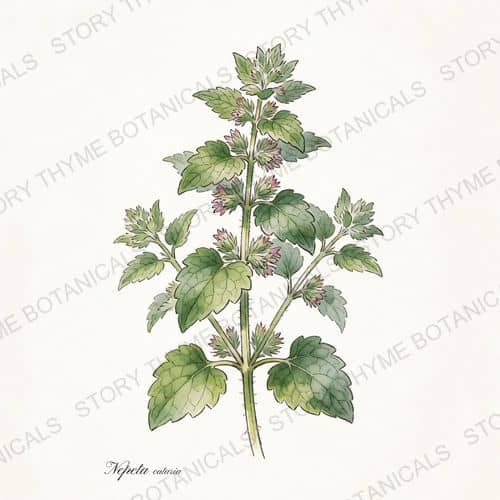
The illustrated growing guide
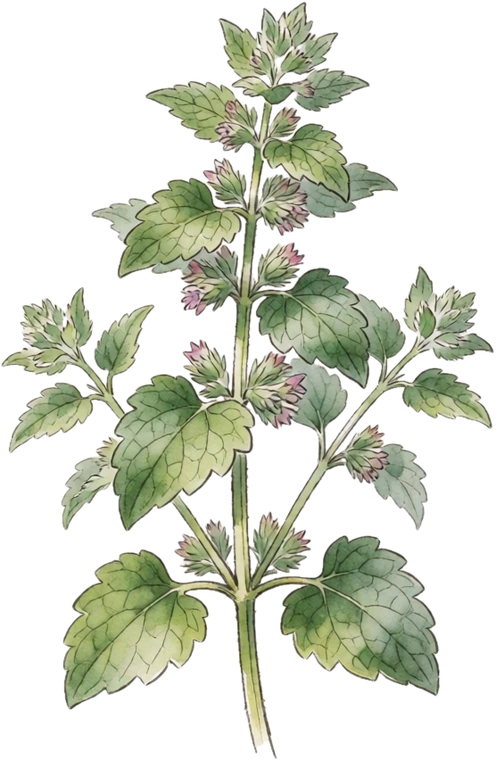
Catnip
Nepeta cataria
Family Lamiaceae
Est. zones 3-9

Plant it and the neighborhood cats will roll it flat — cage young plants. The tea (mild, minty, calming) is the forgotten half of this plant's résumé.

From the print shop
The closest print we make
We don’t print Nepeta cataria. The closest we have is Nepeta faassenii (“Catmint”) in the Cottage Garden Vol. 2 collection — the same genus, Nepeta, not the same species.
16 designsfrom $21.99white or black groundmatte poster, unframed
I
Overview
Will catnip suit your garden, and what goes wrong.
Will it fruit where you are?
Enter your ZIP — we look up your USDA hardiness zone (2023 map) and check it against what catnip actually needs.
Catnip at a glance
Common catnip problems
- Flea Beetles (ironically it repels some pests)
- None significant
II
Growing
Light, water, soil, propagation and the season’s jobs.
How to grow catnip: light, water & soil
How to plant & propagate catnip
The catnip growing playbook
Field-tested instructions for every job catnip asks of you, compiled from university extension guidance — in the order the season brings them.
Sowing
Start catnip seed indoors a few weeks before your last frost
Sow seed indoors a few weeks ahead of your last frost date and grow the seedlings on in a sunny window. Move them out after frost danger passes, giving each plant about 3 feet of room, since a mature clump can grow up to 3 feet tall and just as wide. An indoor start puts an established, rooted plant in the ground with enough of the season left to reach the full bloom the plant is harvested at. Catnip can also be propagated by division of established plants if you already have a clump.
Dividing
Divide the clump every few years as it ages out
Lift established clumps as growth resumes, shake the soil off, and cut the root mass into sections with a spade or sharp shears before replanting them at the depth they were growing. Catnip is a vigorous but short lived perennial that spreads by short rhizomes, and the center of an old clump thins and declines - dividing it restarts the planting from the young growth at the edges.
Pruning
Shear the spent flower spikes to bring on a second bloom
After the first flush of flowers fades, shear the flower spikes back over the whole plant. Pinching the plant back through the season as well keeps it compact instead of sprawling and weedy. Cutting the spikes before they set seed sends the plant back into growth rather than into seed production, which is what drives the repeat bloom and the second cutting of leaf.
Cut catnip to the ground in autumn to stop it reseeding
Cut the plant all the way to the ground in autumn once flowering is finished. It dies back to the ground over winter anyway and sends up fresh stems from the crown in early spring. Catnip reseeds readily and can become weedy, and taking the top growth off before the seed heads shatter is what keeps a planting from spreading into ground you did not intend to give it.
⚠ If catnip is already spreading where you do not want it, grow it in a container or in a bottomless bucket sunk in the bed rather than relying on the cutback alone.
Protection
Cage new catnip plants against roaming cats
Set an ornamental bird cage or a cage of wire mesh over young plants and leave it in place while the clump establishes. Where cats are persistent, growing catnip in a hanging basket keeps it out of reach altogether. Roaming cats damage catnip mainly by rolling on the plant and breaking the stems, and a young plant has little growth to spare.
Harvesting
Cut catnip for drying when it reaches full bloom
Cut whole stems once the plant is in full bloom and hang them to dry in a cool, well ventilated location. Once dry, strip the leaves off the coarse stems and store them in sealed containers. The flavor and aroma of catnip are at their peak when the plant is in full bloom, so a cutting taken then carries the most of what you are drying it for.
III
The year
What catnip asks for, month by month.
The catnip year, month by month
What each band means
- Bloom — flowers open — pollinators working, frost on blossoms is the danger.
- Prune — shape it now — cuts heal cleanly and structure is visible.
- Harvest — picking time — check ripeness every few days.
The catnip year as text
- Jan harvest
- Feb harvest
- Mar pruning, harvest
- Apr pruning, harvest
- May pruning, harvest
- Jun bloom, harvest
- Jul bloom, harvest
- Aug bloom, harvest
- Sep bloom, harvest
- Oct bloom, harvest
- Nov bloom, harvest
- Dec harvest
These are the species' typical months — expect them a few weeks earlier in warm zones and later in cold ones. Watch the plant, not just the calendar.
IV
Ecology & uses
What it does for the garden, and what it is grown for.
Catnip in the garden system
- Herbaceous layer perennial
- Nectary/insectary
What catnip is grown for
✓ Commonly eateneuphoric for ~70% of cats, mild sedative tea for humans
Harvesting & storing catnip
Leaves anytime; dry for cat toys and human tea.
Edibility, identification, and traditional-use notes here are general reference — not medical or veterinary advice, and not a claim that any plant treats or prevents anything. Medicinal ratings record how strongly a plant features in herbal tradition, nothing more. Never eat or dose a plant you have not positively identified. More on how to use this library.
V
Cultivars
Named varieties of catnip, ruled as a catalogue.
Best catnip varieties & cultivars
Standard; 'Citriodora' (lemon)
VI
Sources & plant ID
Where the care distinctions come from, and how the plant is filed.
Research basis
Sources behind this profile
No extension citations are attached to catnipyet. The care figures below come from the library's own catalogue rather than a traced primary source.
Plant ID
VII
Where to buy
Third-party nurseries — not Story Thyme Farms.
Third-party nurseries, not Story Thyme Farms. Prices are theirs.
Story Thyme Farms may earn a small commission from these links, at no cost to you — it never changes what we recommend.
VIII
Questions
Catnip questions, answered straight.
Is catnip safe for kids and pets?
Catnip is commonly eaten and isn't considered toxic, but "commonly eaten" isn't a guarantee for any particular person or animal — allergies, quantity, and which part you eat all matter. One caveat on this one: euphoric for ~70% of cats, mild sedative tea for humans. Never eat a plant you haven't positively identified, and check with a vet before letting pets or livestock graze anything new.
When do you harvest catnip?
Leaves anytime; dry for cat toys and human tea.
How do you propagate catnip?
Division or seed.
IX
Elsewhere
Where catnip sits in the library.
Comfrey
Lavender
Rosemary
Anise Hyssop