The illustrated growing guide

Chestnut

Castanea mollissima & hybrids

Family Fagaceae

Est. zones 4-8

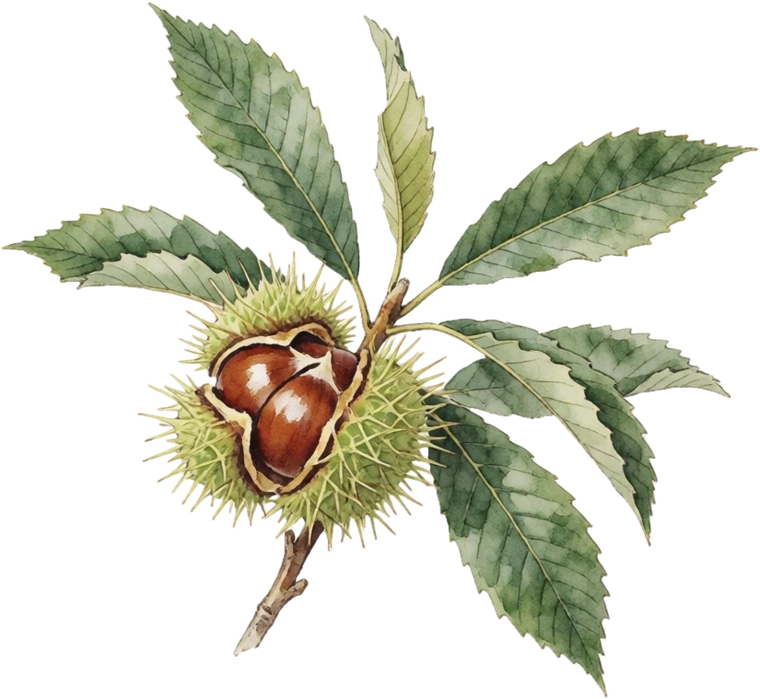
Botanical illustration of Chestnut
Tree · Castanea mollissima & hybrids

The American chestnut fed the East until blight erased 4 billion trees — resistant Chinese/hybrid types return the staple: fast-bearing, low-spray, carb-crop-off-a-tree. Two trees, deep acid soil, daily fall pickup: a food forest's grain replacement.

TreeFull SunLow waterFast for a nut tree growthExcellent edibleAttracts beesNeeds a pollination partner

Where to buy the plant — 3 nurseries

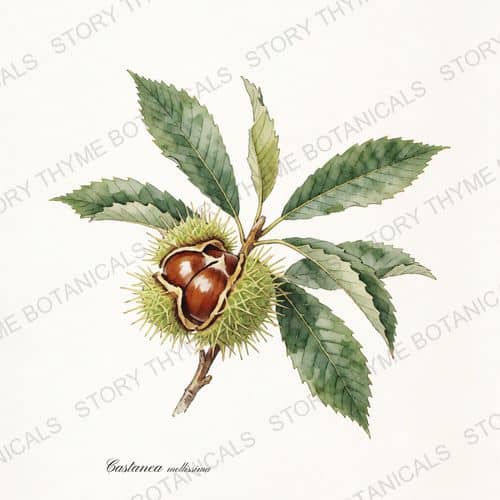
Chestnut — a print from the Nut Trees collection

From the print shop

The closest print we make

We don’t print Castanea mollissima & hybrids. The closest we have is Castanea sativa (“Chestnut”) in the Nut Trees collection — the same genus, Castanea, not the same species.

16 designsfrom $21.99white or black groundmatte poster, unframed

Shop Nut Trees botanical prints →

I

Overview

Will chestnut suit your garden, and what goes wrong.

Will it fruit where you are?

Enter your ZIP — we look up your USDA hardiness zone (2023 map) and check it against what chestnut actually needs.

Hardy inZones 4-8
PollinationPartner needed

Chestnut at a glance

HardinessUSDA 4–8
Mature size40-60 ft
PollinationTWO different trees required (self-sterile); wind + insect; bloom smell is... memorable
Chill requirementNot yet established
Bloom seasonJune (catkins)
Harvest seasonSeptember - October: spiny burs drop, nuts inside — gather DAILY (deer, squirrels, weevils know the schedule)
Growth rateFast for a nut tree (nuts in 4-7 yrs — vs 10+ for most)

Common chestnut problems

  • Chestnut Weevil (sanitation: pick up ALL nuts daily; hot-water dip stored nuts)
  • Deer
  • Chestnut Blight (Chinese types resistant — American parentage varies)
  • Root Rot on wet sites
  • Poor pollination → low fruit set (plant a partner)

II

Growing

Light, water, soil, propagation and the season’s jobs.

How to grow chestnut: light, water & soil

LightFull Sun
WaterLow-Moderate once established
SoilDEEP, acid, well-drained — no limestone flats, no wet feet · pH 5.0 - 6.5
FertilizerLight nitrogen young; little after
PruningLate Winter — Central leader young; wide crotch angles (nut loads are heavy).
Spacing30-40 ft; TWO trees minimum

How to plant & propagate chestnut

PropagateGrafted, or from cuttings/layering (seed won't come true)

When to spray chestnut

Growing season. Orchard sanitation IS the weevil program.

The chestnut growing playbook

Field-tested instructions for every job chestnut asks of you, compiled from university extension guidance — in the order the season brings them.

Watering

Keep water on the tree while nuts fill and burs mature

Water deeply through the nut-filling weeks and right up to bur split, ideally with drip or micro-sprinklers rather than overhead. Do not let the soil dry out in the final month before the burs open. Chestnut sizes its crop on late-season water: drought while kernels are filling gives you small nuts, and a dry spell as burs mature stops the burs from opening normally, so the nuts never release.

Chestnuts need well-drained soil - do not overwater or plant where water perches, because saturated soil is what lets Phytophthora root rot infect and kill the tree.

Feeding

Spring nitrogen, and nothing after early summer

Fertilize in spring so nitrogen is available as the tree wakes up, spreading it evenly over the whole vegetation-free circle around the trunk rather than in a ring at the drip line. Give a bearing tree no more than 1 pound of actual nitrogen per year, and much less on young trees - roughly 2 ounces in year two, working up to about 12 ounces by year five. Skip fertilizer entirely in the planting year and keep nothing amended in the planting hole. Target soil pH 5.5 to 6.5. Chestnut flowers in late spring or early summer, much later than most fruit trees, so spring nitrogen still reaches the developing flower buds, while nitrogen applied late in summer pushes growth that will not harden off and can delay fruit development and increase pre-harvest drop.

Do not fertilize after early summer - late nitrogen keeps trees growing too far into fall and they take winter injury. Fertilizer touching the roots of a first-year tree can kill it.

Pruning

Dormant pruning: one leader, no narrow crotchesJan – Dec

While the tree is leafless, pick one central leader and remove competing leaders and any branch thicker than half the diameter of the main stem. Cut out dead, broken, and narrow-angled limbs back to their origin or to a lateral at least a third the diameter of what you removed. Never take more than 30 percent of the foliage in one year, and on bearing trees remove only one or two low limbs a year until you have clearance to mow and harvest under it. Narrow crotch angles form bark inclusions that split under a heavy nut crop or an ice load, and pruning while dormant means lighter limbs, less bark tearing, a visible framework, and far less risk of chestnut blight entering the fresh wounds.

Heavy pruning exposes bare trunk to sunscald - paint an exposed trunk with 50 percent interior white latex. If you find blight cankers in the canopy, prune those limbs out to slow spread through the planting.

What to watch for

Jar the branches to count chestnut weevils

Once kernels reach the dough stage and before burs crack open, scout for adult chestnut weevils by jarring a branch over a sheet and counting the weevils that drop. Keep checking through harvest, since egg-laying peaks after the burs begin to open. Small chestnut weevil adults emerge from the soil from late spring into midsummer and feed on foliage until kernels fill, then a female drills through the shell and lays five to seven eggs inside a nut - so the weevils you can knock out of the canopy now are the grubs inside your nuts in six weeks.

A new planting can go 10 to 15 years before weevils find it, so scout before you spray - there may be nothing to treat.

Spraying

Chestnut weevil: spray only if scouting finds them

If jarring turns up weevils, treat during the weeks before harvest, when adults are active and laying. Carbaryl is the standard, applied up to three times at 10-day intervals starting as kernels reach the dough stage; phosmet, acetamiprid, and clothianidin are also registered. Rotate at least two modes of action across the season to keep resistance from building. Eggs laid in the five weeks before harvest are the ones that hatch into larvae still inside the nuts at pickup, which is why this narrow pre-harvest window is the only spray timing that changes what ends up in your basket.

Carbaryl is highly toxic to honeybees and other pollinators - never apply it while catkins are shedding pollen in late spring or early summer, only after bloom is finished. Observe the pre-harvest interval: carbaryl 14 days, acetamiprid 14 days, clothianidin 21 days, phosmet 28 days. Follow the label's maximum applications per season.

Protection

Hot-water treat the nuts and clear the fallen ones you did not keep

Right after harvest, dip nuts in 122 degree F water for 20 minutes, then cool them immediately to about 32 to 34 degrees F. Separately, collect and destroy the nuts on the ground that you are not keeping, and rake out burs and debris rather than leaving them under the tree. The hot-water dip kills weevil eggs before they hatch, and any infested nut left on the ground lets its larvae drop into the soil, where they wait two to three years before emerging as adults - so this year's sanitation is what sets next year's weevil pressure.

Cool the nuts immediately after the dip; leaving them warm and wet invites mold in storage. Burs and leaves raked out can be composted until fully broken down and returned to the soil.

Guard the trunks before bucks start rubbing

Have deer protection standing before late summer and early fall. A permanent 8-foot fence around the planting is the reliable answer; the next best is a woven-wire cage per tree, a cylinder of fencing anchored with two 4-foot pieces of rebar. Also press a tree guard into the soil at each trunk against voles and rabbits. Deer do not just browse chestnuts - bucks rub the bark clean off young trunks during the rut in late summer and early fall, which girdles and kills a tree you have waited years on. The protection has to be standing before the rubbing starts, not after.

Cages last about ten years but are usually unnecessary past year five as the tree outgrows the threat. Tree tubes can blow over or be knocked down and must be removed once trees are several years old so they do not choke growth.

Harvesting

Gather the drop every day, then get it cold

Once burs start dropping, pick nuts up at least every other day and ideally every day - an individual tree drops for only a week to ten days. Mow the ground short first so nuts do not tangle in grass. Roll spiny burs underfoot to pop the nuts free. Then refrigerate promptly at 32 degrees F in sealed or ventilated plastic bags. Unlike oily nuts, a ripe chestnut is 44 percent water and 49 percent carbohydrate, so it molds and rots within days on warm ground - and deer, turkey, opossums, and mice are working the same schedule you are.

Wear heavy leather gloves - a chestnut bur prick is very painful. Site home trees where children and pets can be kept away from falling burs. Do not seal large quantities airtight for long storage; without some air movement the nuts ferment and take on an off flavor.

III

The year

What chestnut asks for, month by month.

The chestnut year, month by month

MonthJanFebMarAprMayJunJulAugSepOctNovDec
Bloom
Prune
Harvest

What each band means

  • Bloomflowers open — pollinators working, frost on blossoms is the danger.
  • Pruneshape it now — cuts heal cleanly and structure is visible.
  • Harvestpicking time — check ripeness every few days.

The chestnut year as text

  • Jan quiet month
  • Feb pruning
  • Mar pruning
  • Apr quiet month
  • May quiet month
  • Jun bloom
  • Jul quiet month
  • Aug quiet month
  • Sep harvest
  • Oct harvest
  • Nov quiet month
  • Dec quiet month

These are the species' typical months — expect them a few weeks earlier in warm zones and later in cold ones. Watch the plant, not just the calendar.

IV

Ecology & uses

What it does for the garden, and what it is grown for.

Chestnut in the garden system

  • Canopy layer tree
AttractsBees
HabitatWoodland
MoistureUpland / dry
DeerBrowsed — protect young plants
OriginIntroduced

What chestnut is grown for

✓ Commonly eatenthe holiday roasting nut

UseRoasting nuts
UseFlour
UseStaple tree crop
Edible value5/5

Harvesting & storing chestnut

September - October: spiny burs drop, nuts inside — gather DAILY (deer, squirrels, weevils know the schedule).

Edibility, identification, and traditional-use notes here are general reference — not medical or veterinary advice, and not a claim that any plant treats or prevents anything. Medicinal ratings record how strongly a plant features in herbal tradition, nothing more. Never eat or dose a plant you have not positively identified. More on how to use this library.

V

Cultivars

Named varieties of chestnut, ruled as a catalogue.

Best chestnut varieties & cultivars

10 on file

Named varieties of chestnut differ in winter-chill needs, ripening time, hardiness, and whether they set fruit on their own — pick one that fits your climate.

Qing

Needs a pollinizer
Ripensearly to mid season, roughly the first days of October in mid-MissouriZones4-8DiseaseMinimal blossom end rot; best spring frost avoidance in University of Missouri trialsSizeSmaller tree with a compact, loose crown and good branch angles

Exceptionally sweet, sweeter than most Chinese chestnuts in the US; shiny dark mahogany nuts, 21-35 nuts per pound — Found as a yard tree in Hickory, Kentucky and named in 1998. A heavy producer that stores very well, with minimal or absent multiple embryos. One of four cultivars Missouri lists as recommended for the state. Chestnuts are self-incompatible, so plant it with a different cultivar within 200 feet for pollination. Grafts often show delayed failure or poor growth, so seedlings are frequently preferred.

Where to buy ‘Qing

Story Thyme Farms may earn a small commission from these links, at no cost to you — it never changes what we recommend.
Gideon · Miller 72-283

Needs a pollinizer
Ripensmid season, a few days after Peach; early October in mid-MissouriZones4-8SizeSpreading, semi-upright tree with an intermediate crown

Excellent flavor, uniform attractive nuts that peel easily, 28-38 nuts per pound — A Greg Miller selection from a 1972 Ohio planting, the same seedlot that gave Amy and Peach. More cold hardy than many Chinese chestnuts and a consistent bearer whose offspring have been consistently superior, which is why it is used as a seed orchard parent.

Where to buy ‘Gideon

Story Thyme Farms may earn a small commission from these links, at no cost to you — it never changes what we recommend.

Mossbarger

Needs a pollinizer
Ripensearly to mid season, late September into the first days of October in mid-MissouriZones4-8SizeSpreading, semi-upright with unusually thick stems and branches

Very good flavor raw or cooked; large dark brown nuts, 27-35 nuts per pound — A 1983 Kentucky selection, presumed pure Chinese chestnut though other species may be in its background. Nuts fall free from the bur, which speeds harvest a great deal, and they store well. Ramets are vigorous and precocious compared with most Chinese chestnut selections. One of four cultivars Missouri lists as recommended for the state, and a common partner for Qing - chestnuts are self-incompatible, so a second cultivar must stand within 200 feet for pollination.

Where to buy ‘Mossbarger

Story Thyme Farms may earn a small commission from these links, at no cost to you — it never changes what we recommend.

Peach

Needs a pollinizer
Ripensmid season, slightly earlier than GideonZones4-8DiseaseOffers some protection from long-term storage moldSizeSemi-upright with a tight canopy

Typical Chinese chestnut flavor; medium to large nuts with a distinct peach fuzz on the shell — A Greg Miller selection from the 1972 Ohio planting that also produced Amy and Gideon. Its draw is consistently large nuts, but Missouri warns it did not reach commercial production until age 15, far later than other recommended cultivars, and it tends to flower in fall, which cuts the following year's crop.

Where to buy ‘Peach

Story Thyme Farms may earn a small commission from these links, at no cost to you — it never changes what we recommend.

Amy · Miller 72-400

Needs a pollinizer
Ripensearly, matures ahead of Eaton and Sleeping GiantZones4-8DiseaseBlossom end rot observed in MissouriSizeSemi-upright with an intermediate crown

Excellent flavor, peels well; small to medium nuts, about 12 g in early years dropping to 10 g or less on a mature tree — Showed greater cold hardiness than most Chinese chestnut trialed in Carrollton, Ohio, and bears consistently high yields. DNA markers put it at roughly one-eighth Japanese, which likely explains its high yield and early phenology. It breaks bud relatively early, so it is exposed in late-frost sites.

Where to buy ‘Amy

Story Thyme Farms may earn a small commission from these links, at no cost to you — it never changes what we recommend.

Benton Harbor

Needs a pollinizer
Ripensearly ripening, earlier than most Chinese chestnut selectionsZones4-8DiseaseField observations note blight resistanceSizeUpright with a tight crown

Average taste; dark red to purple nuts that peel well, free of double embryos and splits — A seedling selection from the Michigan State University experiment station at Benton Harbor. Yields are high and stable in Michigan, 70 to 90 lb per tree, but it performed poorly in Missouri, so it is a northern pick. Nuts can drop still held inside the heavy, thick burs, which slows harvest.

Where to buy ‘Benton Harbor

Story Thyme Farms may earn a small commission from these links, at no cost to you — it never changes what we recommend.
Everfresh

Needs a pollinizer
Zones4-8DiseaseSusceptible to chestnut blight in MissouriSizeSlow-growing tree with heavy catkin sets

A Michigan State University experiment station selection from Benton Harbor with consistent, though not high, Michigan yields. Its value is two-fold: unique characters that let it avoid frost in years when most Chinese chestnut cultivars lost their crop, and nuts that keep into the summer after harvest. Blight susceptibility in Missouri argues against it under high blight pressure.

Where to buy ‘Everfresh

Story Thyme Farms may earn a small commission from these links, at no cost to you — it never changes what we recommend.

AU Homestead

Needs a pollinizer
Ripenslate ripening over a long, extended periodZones4-8DiseaseOffers some protection from long-term storage moldSizeUpright with a tight crown

Exceptional flavor with a glutinous, rich mouthfeel; tastes much better roasted than raw; small to medium nuts — Released by Auburn University in 1980 from a 1954 USDA cooperative planting. Its long, drawn-out ripening makes it better suited to household use than to commercial harvest, where you want the crop down in a narrow window.

Where to buy ‘AU Homestead

Story Thyme Farms may earn a small commission from these links, at no cost to you — it never changes what we recommend.

AU Cropper

Needs a pollinizer
Zones4-8SizeSemi-upright with an intermediate crown

Decent quality, medium-size nuts; average size drops noticeably in heavy crop years — Released by Auburn University in 1980. Produces heavy, consistent crops; in Missouri consistent mature bearing began 8 years from grafting and rose incrementally after that.

Where to buy ‘AU Cropper

Story Thyme Farms may earn a small commission from these links, at no cost to you — it never changes what we recommend.

Sleeping Giant

Needs a pollinizer
Ripensearly to mid season over a short window, late September into the first of October in mid-MissouriDiseaseProven blight resistance; blossom end rot susceptibility observed in MissouriSizeLarger, upright tree with an intermediate crown

Excellent nut quality and flavor; about 11-12 g in northern sites and 13-16 g in mid-Missouri, 28-35 nuts per pound — A complex hybrid, Chinese x (Japanese x American), from the Connecticut Agricultural Experiment Station in 1937, and one of four cultivars Missouri recommends. Yields and nut size are relatively consistent and growers report it transfers well between environments. Zones left blank on purpose: it is a hybrid, so the Chinese chestnut species range does not fairly describe it and no source gives it a zone rating. It is documented in CT, MO, OH, and TN.

Where to buy ‘Sleeping Giant

Story Thyme Farms may earn a small commission from these links, at no cost to you — it never changes what we recommend.

VI

Sources & plant ID

Where the care distinctions come from, and how the plant is filed.

Research basis

Sources behind this profile

No extension citations are attached to chestnutyet. The care figures below come from the library's own catalogue rather than a traced primary source.

Plant ID

BinomialCastanea mollissima & hybrids
FamilyFagaceae
TypeTree · Perennial
USDA symbolCAMO83
OriginIntroduced
Invasive riskLow

VII

Where to buy

Third-party nurseries — not Story Thyme Farms.

Third-party nurseries, not Story Thyme Farms. Prices are theirs.

Story Thyme Farms may earn a small commission from these links, at no cost to you — it never changes what we recommend.

Chestnut needs a pollination partner — plant two genetically distinct trees (two different cultivars, or a cultivar plus a seedling).

VIII

Questions

Chestnut questions, answered straight.

Why isn't my chestnut fruiting?

Most often: it has no genetically distinct partner nearby. Chestnut can't pollinate itself — two different trees required (self-sterile); wind + insect; bloom smell is. Plant a second, unrelated one nearby; two different cultivars, or a cultivar plus a seedling, is the classic pairing.

Is chestnut safe for kids and pets?

Chestnut is commonly eaten and isn't considered toxic, but "commonly eaten" isn't a guarantee for any particular person or animal — allergies, quantity, and which part you eat all matter. One caveat on this one: the holiday roasting nut. Never eat a plant you haven't positively identified, and check with a vet before letting pets or livestock graze anything new.

When do you harvest chestnut?

September - October: spiny burs drop, nuts inside — gather DAILY (deer, squirrels, weevils know the schedule).

How do you propagate chestnut?

Grafted, or from cuttings/layering (seed won't come true).

IX

Elsewhere

Where chestnut sits in the library.

Where chestnut sits in the library

Grows in the same world