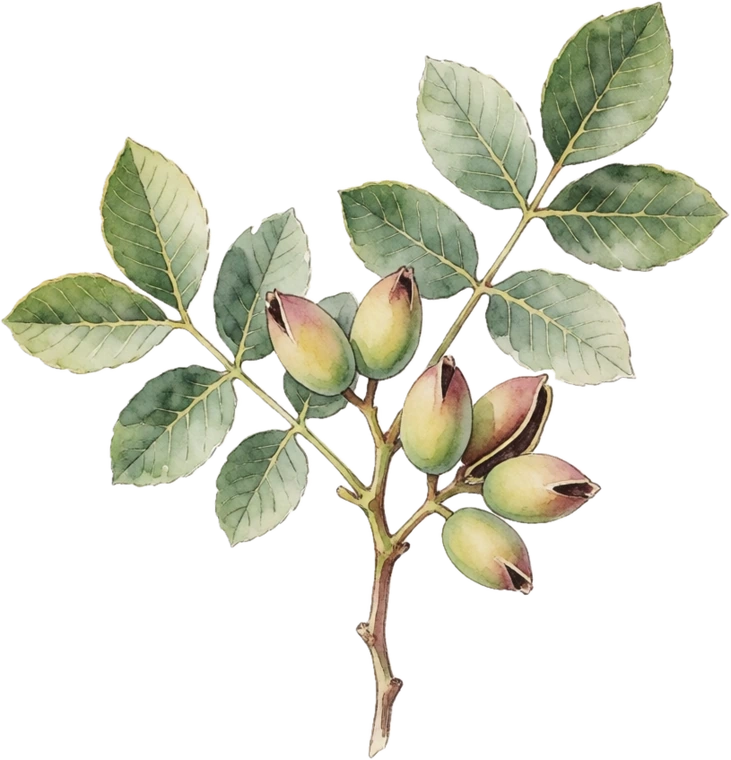
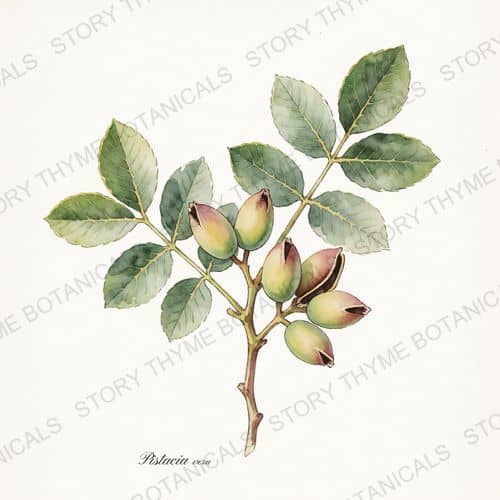
Named varieties of pistachio differ in winter-chill needs, ripening time, hardiness, and whether they set fruit on their own — pick one that fits your climate.
Kerman
Needs a pollinizerRipensEarly September in the San Joaquin Valley, the latest of the major cultivarsZones7-10SizeAveraged 20.7 nuts per ounce in UC trials
PollinationFemale. Pollinized by Famoso as primary male, with Randy earlier and Peters later
The industry standard since the 1960s and still about 255,000 California acres, so its behavior is known over 60 years in a way no other cultivar's is. Its weaknesses are real: only 69.8 percent inshell split nuts and 10.5 percent blanks in UC trials, and in low-chill winters like 2014 and 2015 it loses bloom synchrony with Peters. Needs more chill than Golden Hills or Lost Hills. Training mostly means removing sagging horizontal branches to keep it upright.
Where to buy ‘Kerman’
Story Thyme Farms may earn a small commission from these links, at no cost to you — it never changes what we recommend.
Golden Hills
Needs a pollinizerRipensAbout 11 days before Kerman, late August in the San Joaquin ValleyZones7-10SizeAveraged 21.0 nuts per ounce in UC trials
PollinationFemale. Pollinized by Randy as primary male (about 75 percent) with Tejon covering the early bloom (about 25 percent)
UC release blooming about 5 days ahead of Kerman. In UC trials it hit 86.9 percent inshell split nuts against Kerman's 69.8, with 4.1 percent blanks against Kerman's 10.5, and matched or beat Kerman on cumulative edible yield. Needs less chill than Kerman, which keeps foliation, bloom and nut fill more even in warm winters. Lowest pruning requirement of the UC cultivars, though training focuses on encouraging horizontal growth. Do not tip late in the dormant season. About 35 percent of all new California acreage 2009-2016.
Where to buy ‘Golden Hills’
Story Thyme Farms may earn a small commission from these links, at no cost to you — it never changes what we recommend.
Lost Hills
Needs a pollinizerRipensAhead of Kerman, close to Golden Hills - about two weeks earlier in UC trialsZones7-10SizeLargest individual nut weight of the cultivars UC compared
PollinationFemale. Pollinized by Randy as primary male (about 75 percent) with Tejon covering the early bloom (about 25 percent)
UC release from the same program as Golden Hills, blooming about the same time - roughly 3 to 6 days before Kerman, not a full week. Produces a higher percentage of split inshell nuts than Kerman, and showed less alternate bearing than the other cultivars at UC's Twisselman trial. Fairly upright with a modest pruning requirement. Do not tip late in the dormant season. Judge harvest by hull slip, not hull tatter. Planted on far less acreage than Golden Hills - under 4,000 acres against Golden Hills' 50,000 as of 2016.
Where to buy ‘Lost Hills’
Story Thyme Farms may earn a small commission from these links, at no cost to you — it never changes what we recommend.
Gumdrop
Needs a pollinizerRipensAbout 20 days before Kerman, around mid to late August in the San Joaquin ValleyZones7-10SizeAveraged 20.8 nuts per ounce in UC trials
PollinationFemale. Pollinized by Tejon as primary male (about 50 percent) with Zarand covering the early bloom (about 50 percent)
UC cultivar released in 2016, the earliest blooming female tested - about 10 days ahead of Kerman - which suggests a lower winter rest requirement, and it held up better than Kerman or Golden Hills in the low-chill years of 2014 and 2015. Hit 85.1 percent inshell split nuts in UC trials. Because it comes off so early it should miss most of the last and largest navel orangeworm flight. The catch: a timely early harvest is essential for quality, and delay costs it in staining and insect damage. Plant it only if you actually want the early harvest.
Where to buy ‘Gumdrop’
Story Thyme Farms may earn a small commission from these links, at no cost to you — it never changes what we recommend.
Kalehghouchi
Needs a pollinizerRipensAhead of KermanZones7-10
PollinationFemale. Pollinized by Randy as primary male (about 75 percent) with Tejon covering the early bloom (about 25 percent)
Grown in California since the mid-1980s but on under 2,000 acres. Blooms ahead of Kerman, in the same early group as Golden Hills and Lost Hills - UC ranks it alongside them rather than publishing a separate bloom date for it, so plan pollination on the Golden Hills schedule rather than on a precise day count. Has the heaviest pruning and training requirement of the cultivars UC compared - rated 5 where Golden Hills is 1 - which is the main reason to think twice about it. It also shows the most symptoms of inadequate winter rest of the five, so it is a poor bet where winters are warm.
Where to buy ‘Kalehghouchi’
Story Thyme Farms may earn a small commission from these links, at no cost to you — it never changes what we recommend.
Peters
Needs a pollinizerRipensMale - produces pollen, not nutsZones7-10
PollinationMale pollinizer. The traditional standard for Kerman, now best used as a late adjunct male alongside Famoso or Randy
The historic male for Kerman and still on roughly 255,000 California acres. Blooms about 4 days after Kerman at full bloom, which is the problem: in low-chill, warm winters it flowers too late to cover the front of Kerman's bloom, and many inflorescences desiccate or never push - especially on the sun-exposed south side. If your winters are reliably cold it still works with Kerman; if they are not, do not rely on it alone.
Where to buy ‘Peters’
Story Thyme Farms may earn a small commission from these links, at no cost to you — it never changes what we recommend.
Randy
Needs a pollinizerRipensMale - produces pollen, not nutsZones7-10
PollinationMale pollinizer. Primary male for Golden Hills, Lost Hills and Kalehghouchi; useful as an early male for Kerman
UC male release on about 53,000 California acres. Reaches full bloom around 2 days before Kerman, which puts it in step with Golden Hills and Lost Hills rather than with Kerman's peak - it is generally considered too early to carry Kerman on its own. Plant it as about 75 percent of the males in a Golden Hills or Lost Hills block.
Where to buy ‘Randy’
Story Thyme Farms may earn a small commission from these links, at no cost to you — it never changes what we recommend.
Tejon
Needs a pollinizerRipensMale - produces pollen, not nutsZones7-10
PollinationMale pollinizer. Early supplemental male for Golden Hills, Lost Hills and Kalehghouchi; primary male for Gumdrop
UC male release and the earliest male tested, reaching full bloom about 9 days before Kerman. That earliness is the whole point: it covers the front end of bloom on the early UC females, where Peters and even Randy arrive too late. Use it as roughly 25 percent of the males with Golden Hills or Lost Hills, or as half the males with Gumdrop.
Where to buy ‘Tejon’
Story Thyme Farms may earn a small commission from these links, at no cost to you — it never changes what we recommend.
Famoso
Needs a pollinizerRipensMale - produces pollen, not nutsZones7-10
PollinationMale pollinizer. Suggested primary male for Kerman, about 50 percent of males, with Randy earlier and Peters later
UC male release intended to solve the Kerman pollination problem in warm, low-chill winters where Peters blooms too late. UC's suggested Kerman male mix is Famoso at about 50 percent with Randy at 25 percent covering early bloom and Peters at 25 percent covering late.
Where to buy ‘Famoso’
Story Thyme Farms may earn a small commission from these links, at no cost to you — it never changes what we recommend.