The illustrated growing guide

Banana (Edible)

Musa acuminata hybrids

Family Musaceae

Est. zones 8-11

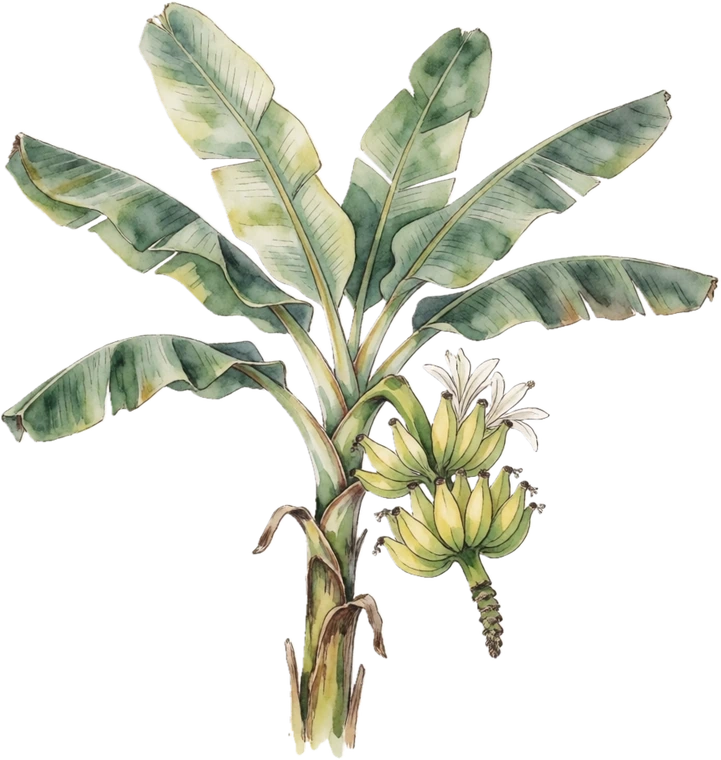
Botanical illustration of Banana (Edible)
Perennial · Musa acuminata hybrids

To actually EAT bananas you need ~15 frost-free months for a stalk to fruit — so zone 9+ or a heated greenhouse, not the hardy ornamental basjoo. In zone 7-8 you can overwinter the roots and MIGHT ripen a bunch in a long summer with heavy feeding. Grocery Cavendish is the classic; 'Ice Cream' is the hardiest good one.

PerennialFull SunHigh waterVery Fast growthExcellent edibleAttracts beesNone winter chill

Where to buy the plant — 3 nurseries

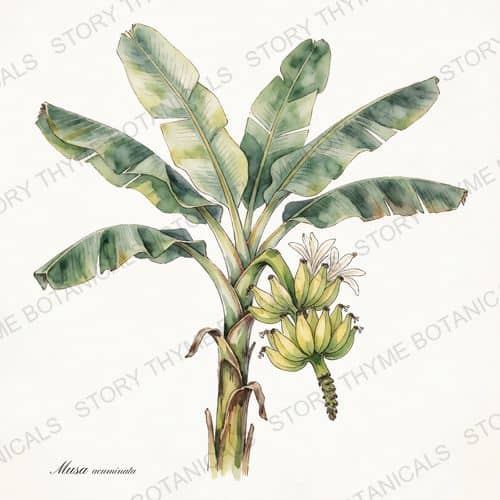
Banana — a print from the Tropical Plants collection

From the print shop

Growing banana (edible)? Hang it.

Our Tropical Plants collection carries banana (edible)Musa acuminata, print Nº 7, “Banana.”

16 designsfrom $21.99white or black groundmatte poster, unframed

Shop Tropical Plants botanical prints →

I

Overview

Will banana (edible) suit your garden, and what goes wrong.

Will it fruit where you are?

Enter your ZIP — we look up your USDA hardiness zone (2023 map) and check it against what banana (edible) actually needs.

Life cyclePerennial zones 8–11, annual elsewhere
Winter chillNone
PollinationSelf-fertile

Banana (Edible) at a glance

Life cyclePerennial zones 8–11, annual elsewhere
Mature size6-20 ft by cultivar
PollinationSelf-fertile (parthenocarpic — no seeds, no pollinator)
Chill requirementNone (not chill-dependent)
Bloom seasonInsignificant to the crop
Harvest seasonA stalk fruits ONCE, ~15-18 frost-free months after the pup emerges, then that stalk dies and a pup replaces it
Growth rateVery Fast

Common banana (edible) problems

II

Growing

Light, water, soil, propagation and the season’s jobs.

How to grow banana (edible): light, water & soil

LightFull Sun
WaterHIGH — a thirsty, hungry tropical
SoilRich, deep, composted · pH 5.5 - 6.5
FertilizerHeavy monthly feed all season
PruningCut the fruited stalk to the ground — Keep ONE follower ('the grandchild') per mat; remove excess pups.
Spacing6-10 ft

How to plant & propagate banana (edible)

PropagateDivision or seed

When to spray banana (edible)

Growing season. Remove diseased leaves; buy clean tissue-cultured stock.

The banana (edible) growing playbook

Field-tested instructions for every job banana (edible) asks of you, compiled from university extension guidance — in the order the season brings them.

Watering

One to one and a half inches a week, and never standing water

Deliver about 1 to 1.5 inches of water per week, roughly 4 to 6 inches a month, concentrated over the root zone during dry weather. Do not put bananas on a lawn sprinkler timer - lawn schedules keep the soil continuously wet and rot the roots. On a high water table or heavy soil, plant on a 2-3 foot mound 4-10 feet across instead of trying to fix it with irrigation. That huge leaf canopy transpires hard and the shallow rhizome dries out fast, but bananas are also extremely susceptible to flooding and continuously wet soil, so the plant fails at both ends of the range - the target is steady moisture in soil that drains.

Feeding

Start the every-two-months potassium feed

As soon as growth resumes, begin feeding and repeat roughly every two months through the growing season, using a fertilizer in a 3-1-6 N-P2O5-K2O ratio such as 6-2-12 with 2-3 percent magnesium. Give a young mat about half a pound to a pound per feeding and work up to 3-4 pounds per mat once the stalk is past 18 months, broadcast over the root zone rather than piled against the pseudostem. Add a micronutrient spray with manganese and zinc once or twice a year. A banana builds a whole pseudostem and a 25-40 pound bunch out of one season of growth, and its potash demand is what limits that bunch - the 3-1-6 ratio exists because potassium, not nitrogen, is the nutrient the fruit runs out of first.

Match the iron source to your soil: iron sulfate at half a pound to a pound works on acid sandy soils, but on high-pH calcareous soil only chelated iron (EDDHA), 1-2 oz during warm months, will stay available.

Thinning

Desucker the mat down to three generations

Keep three ages of pseudostem per mat and no more: one flowering or fruiting, one about half grown, and one small sucker or peeper. Cut every other sucker and peeper off at ground level, then gouge out as much of what remains as you can with a metal digging bar or a piece of rebar to kill the underground bud. The mat is one shared rhizome, so every extra pup is drawing on the same reserves that are supposed to fill the current bunch and grow the follower. Cutting a sucker off at the surface alone just makes it resprout - the bud has to be destroyed.

Maintain a grass- and weed-free area 2 to 5 ft or more from the pseudostem by hand or mulch, and do not put systemic herbicide on or near the pseudostems.

Pruning

Cut off the male bud once the hands have set

Once the female flowers have set their hands of fruit and the stalk has stopped producing new hands, cut the purple male bud off the flower stalk just below the last hand. At the same time strip off dead leaves and any leaf rubbing against the bunch. The bell keeps growing and feeding on the plant long after it can add any fruit; removing it once the fruit is set puts that energy into the hands and speeds the bunch to maturity. Leaves sawing against the young fingers scar the skin.

Cut the fruited stalk down and chop it into mulch

After you take the bunch, cut that pseudostem off at the base and chop it into small pieces, leaving them on the ground around the mat as mulch. Keep the largest remaining follower as the next bearer. A pseudostem flowers and fruits exactly once and then dies - it will never bear again, and standing dead stems are where the banana weevil lays eggs and its grubs tunnel down into the rhizome. Chopping the stem up is both sanitation and a return of that potassium to the mat.

Spraying

Sigatoka leaf spot: copper or oil only in a long wet spell

In prolonged warm, humid, rainy weather, watch for pale flecks that widen into brown streaks with yellow haloes and kill leaves from the oldest up. Strip and destroy the worst leaves first. If the mat is being defoliated, periodic applications of a copper fungicide and/or horticultural oil may be beneficial during prolonged wet periods. Fungicides are available, but may not be necessary for bananas in the home landscape. Yellow and black Sigatoka are Mycosphaerella leaf-spot fungi whose spores germinate on leaves held wet by warm rain. They do not kill the plant, but they strip the canopy early and a mat with no leaves cannot fill its bunch.

Read and follow the product label - copper rates and pre-harvest intervals differ by product and the label is the law. Copper accumulates in soil, so use it only in genuinely disease-heavy wet periods. Note that UF/IFAS already calls for copper in the annual foliar nutritional spray; count that application when timing a copper fungicide rather than stacking both into the same window.

Protection

Mulch the rhizome before winter, and leave the frozen trunks standing

Ahead of the first hard cold, lay a good thick layer of mulch over the rhizomes. Do not cut down frost-blackened plants in the fall or winter - wait until growth restarts in spring and test each trunk then: one that is still strong and resists a moderately strong push is alive and will push new growth, while a dead one has gone soft and mushy with decay and will not stand up to the push. Take only the dead leaf blades off the survivors. Winter cold kills the pseudostems outright across most of the South, but a rhizome under mulch usually lives and resprouts. Since fruit takes three to six months to mature after flowering, every trunk that survives the winter standing is months of progress toward a bunch you would otherwise start over from zero.

Harvesting

Cut the bunch plump and green, not yellow

Harvest when the fingers are plump but before any of them start to turn yellow: the fruit is normal size for the variety, the ridged edges have smoothed and rounded off, and the sides have swelled. Aim to cut roughly 7 to 14 days before it would have ripened on the plant, then hang the bunch in a cool shady place to finish. Bananas ripened off the plant taste better than those left to yellow on the stalk, and a bunch left hanging splits, feeds birds and rots. The rounded edges are the reliable tell that the fingers have filled out.

Never refrigerate bananas before they are ripe - chilling injury dulls them to gray-green, distorts the fruit and increases rotting.

III

The year

What banana (edible) asks for, month by month.

The banana (edible) year, month by month

No fixed season calendar for banana (edible) — its care follows conditions, not the calendar.

IV

Ecology & uses

What it does for the garden, and what it is grown for.

Banana (Edible) in the garden system

  • Herbaceous layer perennial
AttractsBees
MoistureFacultative / average
DeerBrowsed — protect young plants
OriginIntroduced

What banana (edible) is grown for

✓ Commonly eaten

UseFresh eating
UseFrying (plantain types)
UseTropical looks
Edible value4/5

Harvesting & storing banana (edible)

A stalk fruits ONCE, ~15-18 frost-free months after the pup emerges, then that stalk dies and a pup replaces it.

Edibility, identification, and traditional-use notes here are general reference — not medical or veterinary advice, and not a claim that any plant treats or prevents anything. Medicinal ratings record how strongly a plant features in herbal tradition, nothing more. Never eat or dose a plant you have not positively identified. More on how to use this library.

V

Cultivars

Named varieties of banana (edible), ruled as a catalogue.

Best banana (edible) varieties & cultivars

11 on file

Named varieties of banana (edible) differ in winter-chill needs, ripening time, hardiness, and whether they set fruit on their own — pick one that fits your climate.

Dwarf Cavendish · Basrai, Dwarf Chinese

Self-fertile
RipensFruit ripens ~12-15 months after planting; outdoors typically late summer-fallZones9-11Diseasesusceptible to Panama disease (Fusarium TR4) and SigatokaSize6-8 ft pseudostem

classic sweet dessert banana — The most common home/container banana: short enough for pots or greenhouses. Like all cultivated dessert bananas its fruit is seedless and parthenocarpic (self-forming without pollination), so no pollinator is ever needed. AAA Cavendish subgroup.

Where to buy ‘Dwarf Cavendishverified

Story Thyme Farms may earn a small commission from these links, at no cost to you — it never changes what we recommend.
Grand Nain · Grand Naine, Grande Naine, Chiquita

Self-fertile
RipensFruit ripens ~12-15 months after planting; outdoors late summer-fallZones9-11Diseasesusceptible to Panama disease; moderate Sigatoka toleranceSize8-10 ft pseudostem

sweet, the standard commercial dessert banana — The Cavendish clone grown for most supermarket bananas; heavy, reliable bunches in frost-free climates but needs steady warmth and wind protection. Note: 'Williams' is a separate, taller Cavendish clone and is NOT a synonym for Grand Nain (that draft alias was removed).

Where to buy ‘Grand Nainverified

Story Thyme Farms may earn a small commission from these links, at no cost to you — it never changes what we recommend.

Ice Cream · Blue Java; also sold as Ney Mannan, Hawaiian, Cenizo (vendor names vary)

Self-fertile
RipensFruit ripens ~15-18 months after planting; ripens late summer-fall outdoorsZones8-11Diseasegood; more cold- and disease-tolerant than CavendishSize10-15 ft (dwarf strains 6-8 ft)

silky vanilla-custard, eaten fresh — An ABB-type prized for its ice-cream-like flavor and better cold and wind tolerance. Survives to Zone 8, but reliable fruiting is really Zones 9-11; Zone 8 needs a long frost-free run and winter protection. Exact equivalence of the 'Ice Cream' and 'Blue Java' names varies by nursery.

Where to buy ‘Ice Creamverified

Story Thyme Farms may earn a small commission from these links, at no cost to you — it never changes what we recommend.

Dwarf Orinoco · Horse banana; loosely Burro/Bluggoe type (Burro is often a distinct ABB)

Self-fertile
RipensFruit ripens ~14-18 months after planting; late summer-fall outdoorsZones8-11Diseasegood; cold- and wind-hardySize6-10 ft, stout wind-resistant pseudostem

starchy-sweet, good fresh or cooked — One of the toughest, most cold-tolerant fruiting bananas for the US Southeast: cold-hardy, wind-firm, and productive where Cavendish struggles. ABB type. Survives Zone 8 but dependable fruit still favors Zones 9-11.

Where to buy ‘Dwarf Orinoco

Story Thyme Farms may earn a small commission from these links, at no cost to you — it never changes what we recommend.

Raja Puri · Rajapuri

Self-fertile
RipensFruit ripens ~14-18 months after planting; late summer-fall outdoorsZones8-11Diseasegood; drought- and wind-tolerantSize6-10 ft, very sturdy pseudostem

rich, sweet dessert banana — Compact dwarf Indian cultivar, wind- and frost-resistant, and one of the more reliable fruiting bananas for cooler or windier sites. May flower in ~9 months; fruit ready within ~18 months. Zone 8 fruiting needs a long warm season and protection.

Where to buy ‘Raja Puri

Story Thyme Farms may earn a small commission from these links, at no cost to you — it never changes what we recommend.

Dwarf Namwah · Nam Wah, Pisang Awak, Dwarf Namwa, Kluai Namwa

Self-fertile
RipensFruit ripens ~13-16 months after planting; late summer-fall outdoorsZones8-11Diseasegood; cold-tolerant, Panama-tolerantSize8-10 ft

sweet with a hint of vanilla, good fresh or cooked — An ABB type (Pisang Awak) that fruits well in cooler subtropical conditions and shorter seasons; a strong pick for Gulf Coast growers. Survives Zone 8 but reliable fruiting favors Zones 9-11 with protection.

Where to buy ‘Dwarf Namwah

Story Thyme Farms may earn a small commission from these links, at no cost to you — it never changes what we recommend.

Goldfinger · FHIA-01

Self-fertile
RipensFruit ripens ~15-18 months after planting; late summer-fall outdoorsZones8-11Diseaseexcellent (bred for Panama disease and black Sigatoka resistance)Size10-14 ft

sweet-tart, faintly apple-like — A modern FHIA hybrid (AAAB) bred for disease resistance and some cold tolerance; the best choice where Panama disease or Sigatoka has hurt other bananas. Survives Zone 8; dependable fruiting still favors Zones 9-11.

Where to buy ‘Goldfinger

Story Thyme Farms may earn a small commission from these links, at no cost to you — it never changes what we recommend.
Manzano · Apple banana, Silk, Manzana; loosely Latundan (a related AAB Silk banana)

Self-fertile
RipensFruit ripens ~15-18 months after planting; late summer-fall outdoorsZones9-11Diseasemoderate; susceptible to Panama diseaseSize10-16 ft

apple/strawberry notes; must ripen fully or it stays astringent — AAB Silk-subgroup 'apple banana' with distinctive apple-strawberry flavor, but only when the small fruit turns fully black-ripe, so it needs a long warm season to finish. Latundan is a closely related, sometimes-distinct AAB Silk banana rather than an exact synonym.

Where to buy ‘Manzano

Story Thyme Farms may earn a small commission from these links, at no cost to you — it never changes what we recommend.

Mysore · Poovan, Mysore Poovan

Self-fertile
RipensFruit fills roughly 3-6 months after the stalk flowers; outdoors typically late summer to fallZones8b-10bDiseaseresistant to Panama disease; only slightly susceptible to SigatokaSize10-16 ft pseudostem

small, sweet, thin-skinned sub-acid dessert fruit — The AAB cultivar UF/IFAS rates as resistant to Panama disease and only slightly susceptible to Sigatoka, with good cold tolerance - the pick for a site where Panama disease has already taken out a Cavendish. Tall, so give it wind shelter; UF/IFAS notes winds above 25 mph can topple tall banana cultivars. UF/IFAS publishes no USDA zones or heights: the 8b-10b rating and 10-16 ft height are from the plant lust nursery listing (https://plantlust.com/plants/3985/musa-x-paradisiaca-mysore/), and zone 8b is a protected-site gamble for any banana.

Where to buy ‘Mysore

Story Thyme Farms may earn a small commission from these links, at no cost to you — it never changes what we recommend.

Dwarf Brazilian · Dwarf Apple, Santa Catarina Prata; dwarf form of the Brazilian/Prata (Pome, Lady Finger) group

Self-fertile
RipensFruit fills roughly 3-6 months after the stalk flowers; outdoors late summer to fallZones10a-11DiseasePanama-susceptible with good cold tolerance, inherited from the AAB Brazilian/Pome group rating - the dwarf form is not rated separately by UF/IFASSize6 ft pseudostem, about 4 ft wide

small, sweet, sub-acid Pome-type fruit — The dwarf form of the Brazilian/Prata (Pome, Lady Finger) group. UF/IFAS does not list 'Dwarf Brazilian' by name; it rates the AAB Lady Finger/Pome/Brazilian group as cold-tolerant but Panama-susceptible, and that rating is what is inherited here. The dwarf stature answers the wind problem the tall Brazilian has - UF/IFAS puts the topple threshold near 45 mph for short cultivars vs 25 mph for tall ones - but it must still go in Panama-free ground planted from clean material. Zones and size are from the plant lust nursery listing (10a-11, 6 ft); nursery zone claims for this one conflict sharply (8-11 elsewhere), so treat Zone 8-9 as a gamble needing winter protection.

Where to buy ‘Dwarf Brazilian

Story Thyme Farms may earn a small commission from these links, at no cost to you — it never changes what we recommend.

FHIA-17 · FHIA 17

Self-fertile
RipensFruit fills roughly 3-6 months after the stalk flowers; outdoors late summer to fallZones8a-11Diseaseresistant to Panama disease, tolerant of SigatokaSize10-12 ft pseudostem

rich, sweet dessert banana of Gros Michel parentage — One of the FHIA hybrids UF/IFAS calls highly recommended for the home landscape: resistant to Panama disease and tolerant of Sigatoka, with good cold tolerance. It descends from Gros Michel breeding stock and carries that old dessert flavor Cavendish replaced - that lineage is well attested but is not part of the UF/IFAS rating. Sold as tissue-cultured plants, which is also the cleanest way to buy any banana. UF/IFAS gives no zones: the 8a-11 rating and 12 ft height are from the plant lust nursery listing (https://plantlust.com/plants/44788/musa-fhia-17/), and 8a is an optimistic nursery figure - expect the pseudostem to be killed to the ground in any zone 8 winter and to regrow from a mulched rhizome.

Where to buy ‘FHIA-17

Story Thyme Farms may earn a small commission from these links, at no cost to you — it never changes what we recommend.

VI

Sources & plant ID

Where the care distinctions come from, and how the plant is filed.

Research basis

Sources behind this profile

No extension citations are attached to banana (edible)yet. The care figures below come from the library's own catalogue rather than a traced primary source.

Plant ID

BinomialMusa acuminata hybrids
FamilyMusaceae
TypePerennial · Tender Perennial
USDA symbolMUAC
OriginIntroduced
Invasive riskLow

VII

Where to buy

Third-party nurseries — not Story Thyme Farms.

Third-party nurseries, not Story Thyme Farms. Prices are theirs.

Story Thyme Farms may earn a small commission from these links, at no cost to you — it never changes what we recommend.

VIII

Questions

Banana (Edible) questions, answered straight.

Do I need two banana (edible) plants to get fruit?

No — banana (edible) is self-fertile, so a single plant will set a crop. A second one usually improves yields, but it isn't required.

Is banana (edible) safe for kids and pets?

Banana (Edible) is commonly eaten and isn't considered toxic, but "commonly eaten" isn't a guarantee for any particular person or animal — allergies, quantity, and which part you eat all matter. Never eat a plant you haven't positively identified, and check with a vet before letting pets or livestock graze anything new.

When do you harvest banana (edible)?

A stalk fruits ONCE, ~15-18 frost-free months after the pup emerges, then that stalk dies and a pup replaces it.

How do you propagate banana (edible)?

Division or seed.

IX

Elsewhere

Where banana (edible) sits in the library.

Grows in the same world