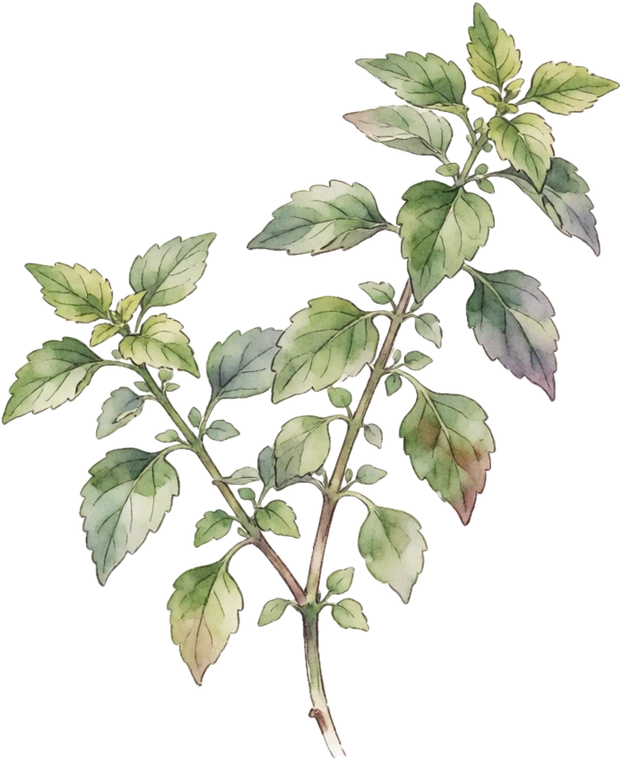
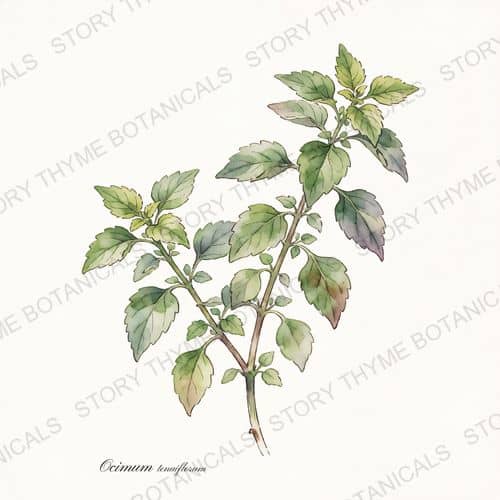
The illustrated growing guide
Holy Basil (Tulsi)
Ocimum tenuiflorum
Family Lamiaceae
Est. zones 10-11

The adaptogen tea of Ayurveda — clove-mint-sweet, brewed fresh or dried, credited with taking the edge off stress. Easier than sweet basil, mobbed by pollinators, and 'Kapoor' returns from seed every year like it signed a lease.

From the print shop
Growing holy basil (tulsi)? Hang it.
Our Tea Herbs collection carries holy basil (tulsi) — Ocimum tenuiflorum, print Nº 3, “Holy Basil.”
16 designsfrom $21.99white or black groundmatte poster, unframed
I
Overview
Will holy basil (tulsi) suit your garden, and what goes wrong.
Will it fruit where you are?
Enter your ZIP — we look up your USDA hardiness zone (2023 map) and check it against what holy basil (tulsi) actually needs.
Holy Basil (Tulsi) at a glance
Common holy basil (tulsi) problems
- Almost none (more pest-free than sweet basil)
- Downy Mildew (less prone than sweet basil)
II
Growing
Light, water, soil, propagation and the season’s jobs.
How to grow holy basil (tulsi): light, water & soil
How to plant & propagate holy basil (tulsi)
The holy basil (tulsi) growing playbook
Field-tested instructions for every job holy basil (tulsi) asks of you, compiled from university extension guidance — in the order the season brings them.
Sowing
Start seed indoors in warmth, four to six weeks before your last frost
Sow seed one eighth inch deep in flats indoors and cover lightly, about four to six weeks before your last spring frost date — that is how long a transplant needs to reach set-out size. Keep the mix at 75 to 85 degrees F and expect ten to fourteen days to sprout. Direct sowing works only after frost has passed and the soil has genuinely warmed. Basil seed germinates on soil warmth rather than calendar date, and seed sown into cold ground sits and rots instead of sprouting. Starting indoors buys a tender tropical a full season in a temperate zone, but starting too early only yields leggy, root-bound seedlings that cannot go out until frost is done.
Planting out
Set plants out only after frost has passed, spaced a foot apart
Move seedlings outdoors after all danger of spring frost is past, once they are sturdy and well rooted. Space plants about twelve inches apart in full sun, six or more hours of direct sunlight, in moist, well drained soil. Holy basil tolerates a wide pH range, from acid through neutral to alkaline, so pH is rarely the thing to fix — drainage is. Holy basil is a tropical subshrub with no frost tolerance at all, and it does poorly in waterlogged soil. The generous spacing is not just for the three feet of growth ahead, it lets wet leaves dry each morning, which is the main lever a home grower has against downy mildew.
Feeding
Feed lightly with nitrogen once plants are big enough to cut
Once plants reach harvestable size, apply a liquid nitrogen fertilizer every two to three weeks at about one to two tablespoons per ten feet of row. Plants in pots need feeding roughly weekly, since watering flushes nutrients out the bottom. You are harvesting leaves and stems repeatedly, so you are removing nitrogen from the plant all season. Steady light feeding keeps regrowth succulent rather than woody.
Pruning
Cut stems back as flower spikes appear, do not just nip the buds
When flowering tops form, cut the whole stem back so only two to four leaves remain, rather than picking off flower buds alone. If you want the plant for tea and leaf, do this across the patch as bloom starts. If you want the bees, let a portion of the patch flower and keep cutting the rest. Once basil flowers and sets seed it turns woody and leaf yield drops hard. Pinching flowers alone does not push new foliage, it just moves flowering into the leaf axils, so removing leaf-bearing stem is what actually forces branching.
What to watch for
Turn leaves over and look for downy mildew's grey fuzz
Through warm humid weather, flip lower leaves and check their undersides for velvety grey to purplish fuzz, with pale yellowing above that stops at the leaf veins. Scout early morning when spores are thickest. Pull and destroy infected plants, water at the soil in the morning rather than overhead, and keep plants spaced for airflow. The yellowing on top reads like a nitrogen deficiency and gets fed instead of pulled, which is how the disease wins. The pathogen cannot cross major veins, which is why the yellow blocks look angular, and it sporulates on the underside in leaf wetness and high humidity.
⚠ Fungicide products available to home gardeners are not effective against this water mold. Do not spray it, remove infected plants and rely on spacing, morning watering and airflow instead.
Hand-pick Japanese beetles off the foliage
Watch for Japanese beetles skeletonizing and defoliating leaves in summer. Knock them off by hand into soapy water, ideally in the cool of the morning when they are sluggish. Adults chew leaf tissue between the veins and leave a lace skeleton behind, and on a plant grown for its leaves that damage is the whole crop. Hand removal is the recommended control here and it costs the plant nothing.
⚠ Do not reach for an insecticide on flowering holy basil. The blooms are heavily worked by bees, and this is a plant you are harvesting leaves from continuously, so there is no meaningful pre-harvest interval to observe.
Protection
Bring a potted plant in before the first frost, or let it go
Holy basil is perennial only in zones 10 to 11. Everywhere colder, either grow it in a container and move it indoors to a bright window ahead of the first autumn frost, or treat it as an annual and take a final cutting. Deadhead or contain plants you do not overwinter, since it self-seeds freely. This is a tropical subshrub with no dormancy and no frost hardiness, so a single frost ends it. It also reseeds itself readily and can behave weedily outside its native range, which is why a confined bed or a container is the sane way to keep it.
Harvesting
Start cutting at six to eight leaves, and leave two to four leaves on the stem
Begin harvesting once a plant carries six to eight leaves. Cut stems just above a leaf node, removing enough stem that only two to four leaves remain. Take leaves and flowering tops through the whole season, fresh or dried for tea. New shoots break from the buds sitting at the nodes below your cut, so cutting above a node is what turns one stem into two. Leaving two to four leaves gives the plant enough to power the regrowth without leaving so much standing that it never branches — and stripping a plant completely bare removes the growing points it needs to come back, ending the harvest early.
III
The year
What holy basil (tulsi) asks for, month by month.
The holy basil (tulsi) year, month by month
What each band means
- Bloom — flowers open — pollinators working, frost on blossoms is the danger.
The holy basil (tulsi) year as text
- Jan quiet month
- Feb quiet month
- Mar quiet month
- Apr quiet month
- May quiet month
- Jun bloom
- Jul bloom
- Aug bloom
- Sep quiet month
- Oct quiet month
- Nov quiet month
- Dec quiet month
These are the species' typical months — expect them a few weeks earlier in warm zones and later in cold ones. Watch the plant, not just the calendar.
IV
Ecology & uses
What it does for the garden, and what it is grown for.
Holy Basil (Tulsi) in the garden system
- Herbaceous layer annual
- Nectary/insectary
What holy basil (tulsi) is grown for
✓ Commonly eaten
Harvesting & storing holy basil (tulsi)
Leaves + flowering tops all season — fresh or dried for tea. About 60-90 days from planting.
Edibility, identification, and traditional-use notes here are general reference — not medical or veterinary advice, and not a claim that any plant treats or prevents anything. Medicinal ratings record how strongly a plant features in herbal tradition, nothing more. Never eat or dose a plant you have not positively identified. More on how to use this library.
V
Cultivars
Named varieties of holy basil (tulsi), ruled as a catalogue.
Best holy basil (tulsi) varieties & cultivars
'Kapoor' (self-sows, adaptogen standard); 'Rama'; 'Vana' (wild type)
VI
Sources & plant ID
Where the care distinctions come from, and how the plant is filed.
Research basis
Sources behind this profile
No extension citations are attached to holy basil (tulsi)yet. The care figures below come from the library's own catalogue rather than a traced primary source.
Plant ID
VII
Where to buy
Third-party nurseries — not Story Thyme Farms.
Third-party nurseries, not Story Thyme Farms. Prices are theirs.
Story Thyme Farms may earn a small commission from these links, at no cost to you — it never changes what we recommend.
VIII
Questions
Holy Basil (Tulsi) questions, answered straight.
Is holy basil (tulsi) safe for kids and pets?
Holy Basil (Tulsi) is commonly eaten and isn't considered toxic, but "commonly eaten" isn't a guarantee for any particular person or animal — allergies, quantity, and which part you eat all matter. Never eat a plant you haven't positively identified, and check with a vet before letting pets or livestock graze anything new.
When do you harvest holy basil (tulsi)?
Leaves + flowering tops all season — fresh or dried for tea. From planting, expect about 60-90 days to maturity.
How do you propagate holy basil (tulsi)?
From seed.
IX
Elsewhere
Where holy basil (tulsi) sits in the library.
Comfrey
Lavender
Rosemary
Anise Hyssop