The illustrated growing guide

Parsley

Petroselinum crispum

Family Apiaceae

Est. zones 5-9

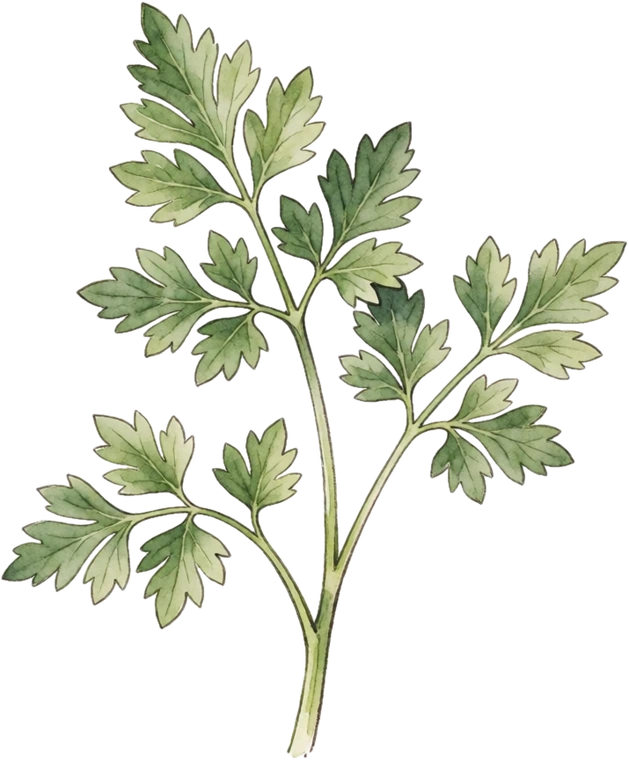
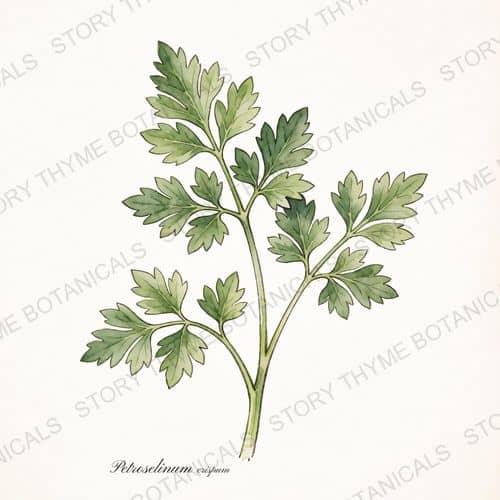
Botanical illustration of Parsley
Biennial · Petroselinum crispum

Soak seed overnight to shortcut the legendary slow germination. One 6-plant patch covers a kitchen all year — and feeds the black swallowtails you actually want around.

BiennialFull Sun to Part ShadeModerate waterSlow start growthAttracts butterflies

Where to buy the plant — 2 nurseries

Parsley — a print from the Herbs, Greenery & Desert collection

From the print shop

Growing parsley? Hang it.

Our Herbs, Greenery & Desert collection carries parsleyPetroselinum crispum, print Nº 2, “Parsley.”

16 designsfrom $21.99white or black groundmatte poster, unframed

Shop Herbs, Greenery & Desert botanical prints →

I

Overview

Will parsley suit your garden, and what goes wrong.

Will it fruit where you are?

Enter your ZIP — we look up your USDA hardiness zone (2023 map) and check it against what parsley actually needs.

Life cycleBiennial, grown as an annual

Parsley at a glance

Life cycleBiennial, grown as an annual
Mature size12-18 in
PollinationSecond-year umbels feed beneficials
Chill requirementNot yet established
Bloom seasonSecond spring (let one overwinter — swallowtail nursery + seed)
Harvest seasonAll season; cut outer stems at the base
Growth rateSlow start (3-week germination), then steady

Common parsley problems

  • Swallowtail Caterpillars (a gift — plant extra)
  • Aphids
  • Crown Rot in soggy soil

II

Growing

Light, water, soil, propagation and the season’s jobs.

How to grow parsley: light, water & soil

LightFull Sun to Part Shade
WaterModerate
SoilRich, moist · pH 6.0 - 7.0
FertilizerMonthly light feed for heavy cutting
PruningNone — Cut stems at soil level, never just leaves — regrows from the crown all year.
Spacing8-10 in

How to plant & propagate parsley

Maturity70-90 days
From seedDirect-sow or start; slow (soak seed); swallowtail host
PropagateFrom seed

The parsley growing playbook

Field-tested instructions for every job parsley asks of you, compiled from university extension guidance — in the order the season brings them.

Sowing

Soak the seed, then sow parsley early

Soak seed in warm water for up to 24 hours before sowing. Start indoors six to eight weeks before your last frost, or direct sow once the soil has warmed and frost danger has passed, keeping the surface damp the whole time. Expect two to five weeks before anything comes up, so do not give the row up for dead and reseed over it. Parsley germinates erratically and slowly even under ideal conditions, and a long soak helps leach the seed coat. Most parsley failures are impatience, not bad seed.

Feeding

Feed parsley once or twice through the season

Work in a 5-10-5 fertilizer at about three ounces per ten feet of row, once or twice over the growing season. For parsley in outdoor containers, use a liquid feed at half strength every three to four weeks; indoors, stretch that to every four to six weeks. Parsley is cut repeatedly, and every harvest carries off leaf nitrogen the plant has to rebuild before it can push the next flush of outer stems.

Thinning

Thin parsley seedlings to a hand's width apart

When seedlings are two to three inches tall, thin leaf parsley to a final spacing of ten to twelve inches. If you are growing a root type like Hamburg for the taproot, thin to three to five inches instead (Arkansas Cooperative Extension), which is tighter than you would space it for leaves. Crowded parsley shades itself into thin, soft growth and holds leaf wetness long enough for leaf spot to take. Root types are thinned tighter on purpose because spacing drives root size and shape rather than leaf yield.

What to watch for

Septoria leaf spot: water low and rotate the ground

Look for small sunken angular tan to brown spots with red-brown margins, later going gray in the center with tiny black specks in them. Pick off and bin spotted leaves as you see them, water at the base with drip or a wand instead of overhead, and do not work through the planting while the foliage is wet. Move parsley and its carrot-family relatives to fresh ground for two to three years, or four if the spot was bad. Septoria petroselini arrives on infested seed and then spreads by splash, so every rain or sprinkler cycle carries it to new leaves. Its spores stay infectious on dead, dried parsley debris for several years, which is why last year's bed reinfects this year's crop.

Leave the striped caterpillars alone

If you find fat green caterpillars banded with black and yellow eating your parsley, leave them be. They are black swallowtail larvae, and parsley is one of their few host plants. Extension notes they are seldom numerous enough to cause much damage; if a plant is truly being stripped, handpick them onto another parsley or carrot-family plant rather than spraying. Aphids also show up but are usually cleaned up by natural predators and parasites, and a hose-off handles the rest. Black swallowtails can only lay on carrot-family plants, so your parsley patch is a butterfly nursery whether or not you meant it to be. A few chewed stems is the whole cost, and an insecticide here kills the larvae along with the predators that were already handling your aphids.

No insecticide is warranted on parsley for caterpillars. Handpick or relocate instead — the damage is cosmetic and the spray costs you the butterflies and the aphid predators both.

Protection

Overwinter one plant for flowers and seed

Let one or two plants ride through winter instead of pulling them, mulching them in cold zones to improve their odds; flat-leaved types come through winter better than curly ones. Sow fresh parsley for eating next spring regardless. The overwintered plants will send up greenish-yellow flower umbels in compound clusters their second year, followed by small ridged seed you can collect. Parsley is a biennial: it only flowers in its second year, and once it bolts the leaves go tough and bitter, which is why it is normally restarted annually. Sacrificing a plant to the second year is how you get the umbel bloom, the self-sown seed, and a swallowtail nectar and egg-laying stop, without giving up your kitchen supply.

Harvesting

Cut the outer stalks at the ground, not the top

Snip whole stalks off close to the ground, always starting with the outermost ones and working in. Never shear the top of the plant. Keep cutting right through fall and light frosts, until the plant flowers. If you are growing a root type, go easy on the tops — the leaves are what fill the root. Parsley grows from a central crown, so the newest leaves are in the middle. Taking the outer stalks leaves that growing point intact and the plant simply keeps producing, while cutting across the top removes the young leaves and stalls it.

III

The year

What parsley asks for, month by month.

The parsley year, month by month

MonthJanFebMarAprMayJunJulAugSepOctNovDec
Bloom

What each band means

  • Bloomflowers open — pollinators working, frost on blossoms is the danger.

The parsley year as text

  • Jan quiet month
  • Feb quiet month
  • Mar bloom
  • Apr bloom
  • May bloom
  • Jun quiet month
  • Jul quiet month
  • Aug quiet month
  • Sep quiet month
  • Oct quiet month
  • Nov quiet month
  • Dec quiet month

These are the species' typical months — expect them a few weeks earlier in warm zones and later in cold ones. Watch the plant, not just the calendar.

IV

Ecology & uses

What it does for the garden, and what it is grown for.

Parsley in the garden system

  • Herbaceous layer biennial
  • Hosts Black swallowtail butterfly
AttractsButterflies
MoistureFacultative / average
DeerBrowsed — protect young plants
OriginIntroduced

What parsley is grown for

✓ Commonly eaten

UseCooking backbone
UseTabbouleh
UseButterfly host
Edible value3/5

Harvesting & storing parsley

All season; cut outer stems at the base. About 70-90 days from planting.

Edibility, identification, and traditional-use notes here are general reference — not medical or veterinary advice, and not a claim that any plant treats or prevents anything. Medicinal ratings record how strongly a plant features in herbal tradition, nothing more. Never eat or dose a plant you have not positively identified. More on how to use this library.

V

Cultivars

Named varieties of parsley, ruled as a catalogue.

Best parsley varieties & cultivars

7 on file

Named varieties of parsley differ in winter-chill needs, ripening time, hardiness, and whether they set fruit on their own — pick one that fits your climate.

Hamburg Root · Hamburg; turnip-rooted parsley; Petroselinum crispum var. tuberosum

RipensFallZones5-9Size6-8 inch taproot

parsnip-like root, parsley tops — Grown mainly for the 6- to 8-inch root, similar to parsnips. Thin to 3-5 inches, tighter than leaf parsley, and go easy on the tops so the root fills. Roots are cold hardy and can be lifted after field freezing, and store like carrots or parsnips.

Where to buy ‘Hamburg Root

Story Thyme Farms may earn a small commission from these links, at no cost to you — it never changes what we recommend.

Gigante d'Italia · Prezzemolo Gigante D'Italia; Giant of Italy

RipensAll seasonZones5-9Sizelarge plant

strong, robust — Large dark green flat leaves. The most widely grown Italian flat-leaf type, favored for cooking where the leaf is an ingredient rather than a garnish.

Where to buy ‘Gigante d'Italia

Story Thyme Farms may earn a small commission from these links, at no cost to you — it never changes what we recommend.

Dark Green Italian · Plain Italian Dark Green

RipensAll seasonZones5-9Size12-24 inches

excellent, strong — 12- to 24-inch plants with flat, deeply cut, glossy green leaves. Named by Illinois Extension as the standard plain-leaf variety for flavoring.

Where to buy ‘Dark Green Italian

Story Thyme Farms may earn a small commission from these links, at no cost to you — it never changes what we recommend.

Moss Curled

RipensAll seasonZones5-9Sizecompact

mild — Compact plants with curled, very finely cut leaves. A long-standing curly standard, listed with gardener ratings in Cornell's Vegetable Varieties for Gardeners database.

Where to buy ‘Moss Curledverified

Story Thyme Farms may earn a small commission from these links, at no cost to you — it never changes what we recommend.

Forest Green

RipensAll seasonZones5-9Size10-12 inches

mild — 10- to 12-inch plants with double- and triple-curled leaves. Its compact size and long stems suit containers and repeated cutting for bunches.

Where to buy ‘Forest Green

Story Thyme Farms may earn a small commission from these links, at no cost to you — it never changes what we recommend.

Triple Curled · Darki Triple Curled

RipensAll seasonZones5-9Sizemedium

mild — Plants produce dark green, highly curled leaves. At 70 days it is among the faster curly types to reach cutting size.

Where to buy ‘Triple Curled

Story Thyme Farms may earn a small commission from these links, at no cost to you — it never changes what we recommend.

Single Italian

RipensAll seasonZones5-9Size15-18 inches

strong — 15- to 18-inch plants with plain, flat, dark green, glossy, deeply cut leaves. A mid-sized flat-leaf alternative where Gigante d'Italia would overgrow the bed.

Where to buy ‘Single Italian

Story Thyme Farms may earn a small commission from these links, at no cost to you — it never changes what we recommend.

VI

Sources & plant ID

Where the care distinctions come from, and how the plant is filed.

Research basis

Sources behind this profile

No extension citations are attached to parsleyyet. The care figures below come from the library's own catalogue rather than a traced primary source.

Plant ID

BinomialPetroselinum crispum
FamilyApiaceae
TypeBiennial
USDA symbolPECR2
OriginIntroduced
Invasive riskLow

VII

Where to buy

Third-party nurseries — not Story Thyme Farms.

Third-party nurseries, not Story Thyme Farms. Prices are theirs.

Story Thyme Farms may earn a small commission from these links, at no cost to you — it never changes what we recommend.

VIII

Questions

Parsley questions, answered straight.

Is parsley safe for kids and pets?

Parsley is commonly eaten and isn't considered toxic, but "commonly eaten" isn't a guarantee for any particular person or animal — allergies, quantity, and which part you eat all matter. Never eat a plant you haven't positively identified, and check with a vet before letting pets or livestock graze anything new.

When do you harvest parsley?

All season; cut outer stems at the base. From planting, expect about 70-90 days to maturity.

How do you propagate parsley?

From seed.

IX

Elsewhere

Where parsley sits in the library.

Where parsley sits in the library

Grows in the same world