The illustrated growing guide

Peanut

Arachis hypogaea

Family Fabaceae

Grown as an annual

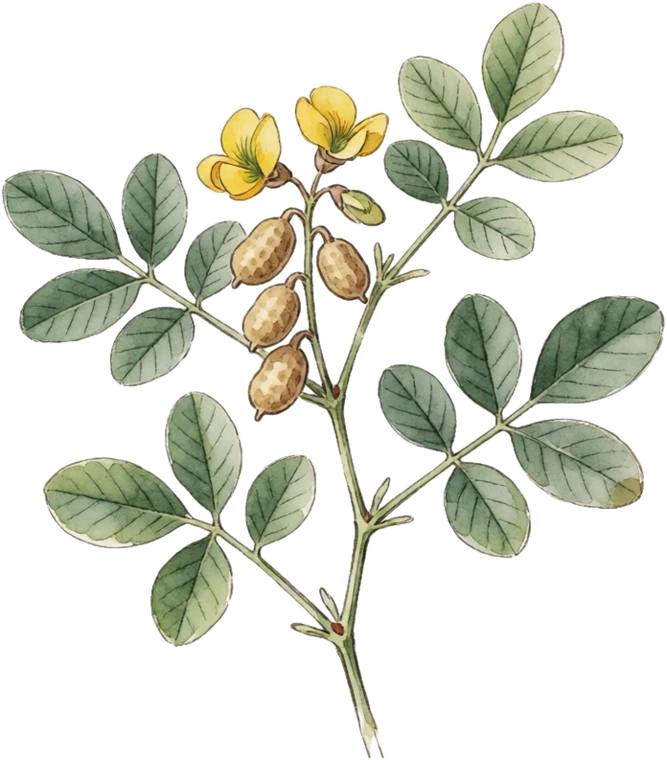
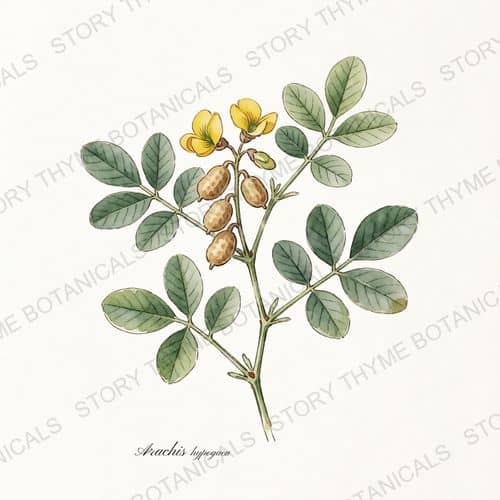
Botanical illustration of Peanut
Annual · Arachis hypogaea

The plant that plants itself: flowers above, then drills its babies underground — the single best show-a-kid crop in agriculture. 'Valencia' in a sandy raised bed brings real boiled-peanut season to zone 5. Cure properly before roasting.

AnnualFull SunModerate waterModerate growthExcellent edibleNone winter chill

Where to buy the plant — 1 nursery

Peanut — a print from the Beans & Legumes collection

From the print shop

Growing peanut? Hang it.

Our Beans & Legumes collection carries peanutArachis hypogaea, print Nº 15, “Peanut.”

16 designsfrom $21.99white or black groundmatte poster, unframed

Shop Beans & Legumes botanical prints →

I

Overview

Will peanut suit your garden, and what goes wrong.

Will it fruit where you are?

Enter your ZIP — we look up your USDA hardiness zone (2023 map) and check it against what peanut actually needs.

Life cycleAnnual
Winter chillNone
PollinationSelf-fertile

Peanut at a glance

Life cycleAnnual
Mature size1-2 ft bushes
PollinationSelf-pollinating flowers, then the magic: fertilized 'pegs' dive INTO the soil to fruit underground
Chill requirementNone (not chill-dependent)
Bloom seasonSummer (yellow pea blooms)
Harvest seasonSeptember - October when leaves yellow: pull whole plants, shake, cure upside-down 2 weeks — then roast or boil
Growth rateModerate

Common peanut problems

  • Voles/Mice (they find cured pods)
  • Leafhoppers
  • Leaf Spot late (cosmetic by then)

II

Growing

Light, water, soil, propagation and the season’s jobs.

How to grow peanut: light, water & soil

LightFull Sun
WaterModerate; dry-down at maturity
SoilSANDY, loose — pegs must penetrate; clay = crop failure · pH 5.8 - 6.5
FertilizerNone (N-fixer); calcium (gypsum) at bloom for filled pods
PruningNone — Hill loose soil at bloom like potatoes so pegs land soft.
Spacing8-12 in

How to plant & propagate peanut

Maturity120-140 days
From seedDirect-sow after frost in sandy soil; needs a long warm season
PropagateFrom seed

The peanut growing playbook

Field-tested instructions for every job peanut asks of you, compiled from university extension guidance — in the order the season brings them.

Sowing

Direct sow into warm soil, once frost is past

Wait until soil at the 4-inch depth averages at least 65 F for three straight days with warm weather in the forecast, then sow shelled seed 1 to 1.5 inches deep, 10 to 12 inches apart, in rows 36 inches apart. Warmer is better: UGA measured 70 percent germination after a week at 65 F versus 90 percent at 70 F, and prefers to wait for 68 F. Peanuts are tender and resent transplanting, so seed them in place. Count your frost-free days first: the crop needs a minimum of 120 of them, so short-season gardeners should choose a Spanish or Valencia type rather than a Virginia or Runner. Peanut is a warm-season annual from South America with no frost tolerance, and seed sown into cold soil emerges erratically or rots, which invites seedling disease and thrips damage. The whole crop has to flower, peg, and fill pods before the first freeze, so the length of your frost-free window, not hardiness zone, decides which type can finish. Arkansas Extension gives the depth, spacing, and the 120 frost-free day minimum; the 65 F at 4 inches threshold is the standard extension planting rule rather than a figure from that fact sheet.

Watering

Keep water steady through pegging and pod fill

From roughly 55 days after planting until about 95 to 100 days, keep soil moisture up: peak use can reach 0.3 inches per day, more than 1.5 inches per week. Water before the plants look stressed rather than after. On sandy soil, reserves can run out in about three days at peak demand. Blooming, pegging, and pod development are when the crop's water use peaks, and this is also when soil water carries calcium to the pods. Dry soil bakes the surface so pegs cannot enter, and once drought symptoms are visible the yield loss is already irreversible. Steady moisture also cools the soil, which suppresses the Aspergillus flavus and A. parasiticus that make aflatoxin under hot, droughty conditions.

Mulching

Loosen and lightly mulch the row as pegs form, then stop digging

Once flowering starts, hill loose soil toward the plants and lay 1 to 2 inches of light organic mulch around them. Pull weeds in the row by hand from here on. Do not cultivate or disturb the soil after the pegs have buried themselves. After a flower is pollinated its stalk elongates into a peg that drives down into the soil, and the pod forms at the tip. A peg will push through loose soil on its own but cannot penetrate a hard baked crust, and a hoe run through the row after pegging simply severs the crop you are growing. Only about 15 percent of flowers ever set a pod, so protecting the ones that peg matters.

Feeding

Inoculate the seed and hold back the nitrogen

Dust the seed with a peanut-type Rhizobium inoculant at planting, especially in ground that has never grown peanuts. Skip nitrogen fertilizer. Aim for a soil pH of 5.8 to 6.2, and avoid heavy spring potassium near the row. Peanuts fix their own nitrogen once Rhizobium bacteria nodulate the roots, so added nitrogen just buys vine at the expense of pods, and the bacteria are often absent from soil with no peanut history. High potassium in the pegging zone competes directly with calcium uptake, which is the nutrient the pods actually need.

Gypsum at early bloom, before the pegs go down

As the first yellow flowers open, work agricultural gypsum into the top few inches of soil along the row. Virginia types, with their big pods, need roughly twice the calcium of Spanish and Runner types. If a pegging-zone soil test taken 3 inches deep beside the row already shows 500 lb per acre of calcium and a calcium-to-potassium ratio of 3:1 or better, you can skip it. The developing pod cannot pull calcium up from the roots; it absorbs it directly out of the soil water surrounding it, and about 92 percent of that uptake happens within 20 to 80 days after the peg enters the ground. Miss the window and you get empty shells called pops, pod rot, and seed that will not germinate next year.

Spraying

Leaf spot: start chlorothalonil around 30 days after planting in humid regions

Where summers are warm and rainy, begin chlorothalonil about 30 days after planting and no later than 45 days, repeating every 14 days. Look for pencil-width brown spots with a yellow halo on upper leaf surfaces, or darker black spots with feathery margins and heavy sporulation underneath. In dry-summer gardens, scout instead and spray only if lesions appear. Stop spraying 14 days before you plan to dig; a last application around 120 days after planting usually carries control through to harvest. Early leaf spot (Passalora arachidicola) and late leaf spot (Nothopassalora personata) infect during prolonged leaf wetness between 65 and 90 F, and lesions do not surface for 10 to 14 days after infection, so by the time you see spots the next cycle is already underway. Unchecked, they defoliate the plant and the pods stop filling.

Chlorothalonil carries a 14-day pre-harvest interval on peanut and a 12-hour restricted-entry interval (UGA Georgia Pest Management Handbook): do not apply within 14 days of digging. Do not feed peanut hay or vines treated with chlorothalonil to livestock. Chlorothalonil is a fungicide, not an insecticide, so it does not put pollinators at risk on peanut's self-pollinating flowers, but never substitute an insecticide at bloom. Other peanut fungicides run from 14-day to 40-day PHIs, so read the label of whatever you actually buy rather than assuming this one's interval.

Protection

Cure dry and fast, or risk aflatoxin

Following Arkansas Extension's curing sequence: stack or hang the pulled plants upside down in an open shelter or a warm, dry shed or garage with free air movement for about a week. Then shake off the remaining soil, pull the pods from the vines, and air-dry them another one to two weeks. Do not pile wet pods in a closed container or bag. The target is about 7 percent moisture in the pod; once dry, pods keep for close to a year at around 70 percent relative humidity and 77 to 81 F. Freshly dug pods are wet and must be dried down to about 7 percent moisture. Aspergillus flavus and A. parasiticus grow and produce aflatoxin once pod moisture sits above 8 percent, with optimal growth at ambient temperatures between 82 and 98 F and high relative humidity above 85 percent, which is exactly the microclimate inside a heap of undried peanuts.

Aflatoxins are potent liver toxins and are not broken down by roasting or boiling, so cooking will not rescue a contaminated batch. Discard any peanuts that are moldy, discolored, shriveled, or off-smelling rather than sorting around the damage.

Harvesting

Dig when the hulls darken inside, not when the calendar says so

For boiling peanuts, dig green at 90 to 110 days after planting. For roasting, wait 130 to 150 days and check maturity by scraping or blasting the outer hull off a sample of pods: dig when 65 to 70 percent show dark hull color inside. The foliage yellowing is your cue to start checking. Dig when the soil is dry enough to shake off the plants, and lift the whole plant rather than pulling pods. Pods on one plant mature over a long span, and the hull's inner color is the only reliable read on the crop as a whole. Dig too early and the kernels are immature and flat; wait too long and the pegs rot through so the oldest, best pods stay behind in the ground. Late-season rain on an over-mature crop also drives fungal growth and aflatoxin.

III

The year

What peanut asks for, month by month.

The peanut year, month by month

MonthJanFebMarAprMayJunJulAugSepOctNovDec
Bloom
Harvest

What each band means

  • Bloomflowers open — pollinators working, frost on blossoms is the danger.
  • Harvestpicking time — check ripeness every few days.

The peanut year as text

  • Jan quiet month
  • Feb quiet month
  • Mar quiet month
  • Apr quiet month
  • May quiet month
  • Jun bloom
  • Jul bloom
  • Aug bloom
  • Sep harvest
  • Oct harvest
  • Nov quiet month
  • Dec quiet month

These are the species' typical months — expect them a few weeks earlier in warm zones and later in cold ones. Watch the plant, not just the calendar.

IV

Ecology & uses

What it does for the garden, and what it is grown for.

Peanut in the garden system

  • Root layer annual
  • N-fixer
MoistureFacultative / average
DeerBrowsed — protect young plants
OriginIntroduced

What peanut is grown for

✓ Commonly eatenPeanut allergy is serious — otherwise safe; raw green peanuts must be boiled/roasted

UseBoiled peanuts
UseRoasting
UseKid science
Edible value4/5

Harvesting & storing peanut

September - October when leaves yellow: pull whole plants, shake, cure upside-down 2 weeks — then roast or boil. About 120-140 days from planting.

Edibility, identification, and traditional-use notes here are general reference — not medical or veterinary advice, and not a claim that any plant treats or prevents anything. Medicinal ratings record how strongly a plant features in herbal tradition, nothing more. Never eat or dose a plant you have not positively identified. More on how to use this library.

V

Cultivars

Named varieties of peanut, ruled as a catalogue.

Best peanut varieties & cultivars

7 on file

Named varieties of peanut differ in days to maturity, disease resistance, flavor, and habit — pick one that fits your season and space.

Early Spanish

Self-fertile
Zones3-11SizeUpright, compact bunch plants

Small kernels, the classic roasted and candy peanut — The fastest peanut in the Arkansas Extension table at 105 days, which is what makes it the safe pick where the frost-free window is short. Two to three kernels per pod. Zone range reflects the sourced maturity figure against the crop's 120 frost-free day minimum, not cold hardiness, since peanut is a tender annual everywhere.

Where to buy ‘Early Spanish

Story Thyme Farms may earn a small commission from these links, at no cost to you — it never changes what we recommend.

Improved Spanish

Self-fertile
Zones4-11SizeEarly-bearing bunch type

Large kernels for a Spanish type — Larger kernels and heavier yields than standard Spanish, with one or two kernels per pod, at the cost of ten extra days. Zone range reflects the sourced 115-day maturity against the crop's 120 frost-free day minimum, not cold hardiness.

Where to buy ‘Improved Spanish

Story Thyme Farms may earn a small commission from these links, at no cost to you — it never changes what we recommend.

Tennessee Red · Valencia Tennessee Red

Self-fertile
Zones3-11SizeLong pods, two to five kernels per pod

Sweet Valencia type, the standard for boiling — Arkansas Extension calls Valencia the best class for home gardens from Texas to Canada because it matures quickly, and rates Tennessee Red easy to grow and a heavy yielder. Zone range reflects the sourced 110-day maturity, not cold hardiness.

Where to buy ‘Tennessee Red

Story Thyme Farms may earn a small commission from these links, at no cost to you — it never changes what we recommend.

Carolina Black

Self-fertile
Zones3-11SizeTwo kernels per pod, slightly larger than Spanish

Sweet, with black seed coats — A rare heirloom with black-skinned, sweet-tasting kernels. Grown for the novelty and the flavor rather than for yield. Zone range reflects the sourced 110-day maturity, not cold hardiness.

Where to buy ‘Carolina Black

Story Thyme Farms may earn a small commission from these links, at no cost to you — it never changes what we recommend.

Improved Virginia

Self-fertile
Zones6-11SizeBush type about 18 inches tall

Large-podded, high-quality roasting nut — Large pods with one or two kernels each on a hardy bush plant that stays put instead of running. Arkansas Extension notes Virginia types need 130 to 150 days and tolerate neither drought nor cool conditions, which is what sets the zone floor here; this is a long-season gamble north of the mid-Atlantic.

Where to buy ‘Improved Virginia

Story Thyme Farms may earn a small commission from these links, at no cost to you — it never changes what we recommend.

Virginia Jumbo

Self-fertile
Zones6-11SizeRunner habit, vines 18 inches tall spreading 3.5 feet

Large kernels, ballpark roasting quality — A Virginia strain with a running habit, so give it room: vines spread about three and a half feet. One or two large kernels per pod. Needs the full 130 to 150 day season and dislikes cool, dry conditions, which sets the zone floor.

Where to buy ‘Virginia Jumbo

Story Thyme Farms may earn a small commission from these links, at no cost to you — it never changes what we recommend.

Mammoth Jumbo · Jumbo

Self-fertile
Zones6-11SizeLarge-podded

Large roasting kernels — Large-podded with one or two kernels, and Arkansas Extension singles it out as shelling easily and being easy to grow and harvest, which matters when you are hand-picking pods off vines. Long season required, which sets the zone floor.

Where to buy ‘Mammoth Jumbo

Story Thyme Farms may earn a small commission from these links, at no cost to you — it never changes what we recommend.

VI

Sources & plant ID

Where the care distinctions come from, and how the plant is filed.

Research basis

Sources behind this profile

No extension citations are attached to peanutyet. The care figures below come from the library's own catalogue rather than a traced primary source.

Plant ID

BinomialArachis hypogaea
FamilyFabaceae
TypeAnnual
USDA symbolARHY
OriginIntroduced
Invasive riskLow

VII

Where to buy

Third-party nurseries — not Story Thyme Farms.

Third-party nurseries, not Story Thyme Farms. Prices are theirs.

Story Thyme Farms may earn a small commission from these links, at no cost to you — it never changes what we recommend.

VIII

Questions

Peanut questions, answered straight.

Do I need two peanut plants to get fruit?

No — peanut is self-fertile, so a single plant will set a crop. A second one usually improves yields, but it isn't required.

Is peanut safe for kids and pets?

Peanut is commonly eaten and isn't considered toxic, but "commonly eaten" isn't a guarantee for any particular person or animal — allergies, quantity, and which part you eat all matter. One caveat on this one: Peanut allergy is serious — otherwise safe; raw green peanuts must be boiled/roasted. Never eat a plant you haven't positively identified, and check with a vet before letting pets or livestock graze anything new.

When do you harvest peanut?

September - October when leaves yellow: pull whole plants, shake, cure upside-down 2 weeks — then roast or boil. From planting, expect about 120-140 days to maturity.

How do you propagate peanut?

From seed.

IX

Elsewhere

Where peanut sits in the library.

Where peanut sits in the library

Grows in the same world