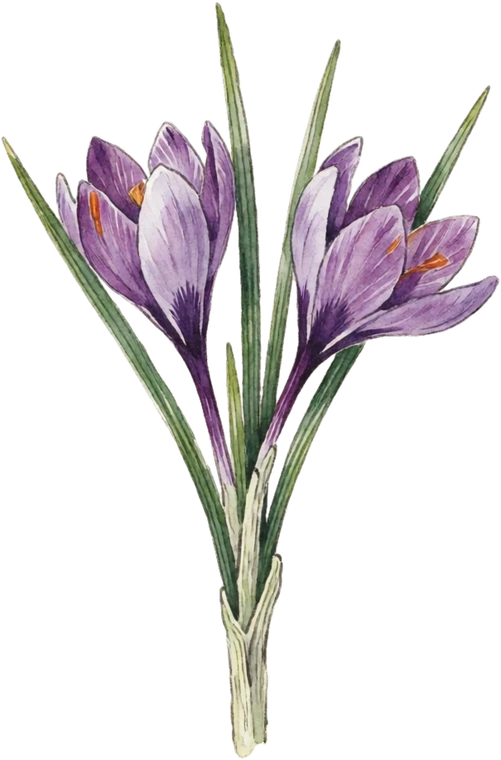
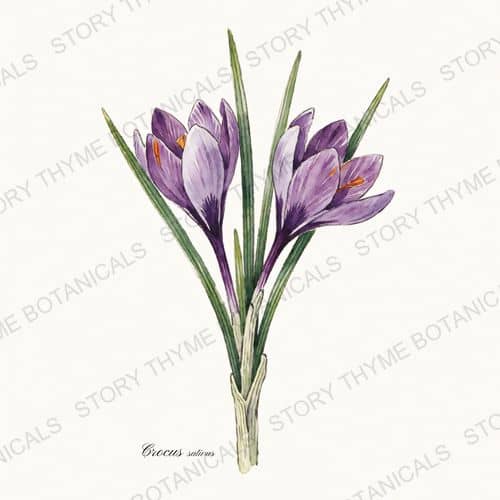
The illustrated growing guide
Saffron Crocus
Crocus sativus
Family Iridaceae
Est. zones 6-9

The world's priciest spice from a fall crocus that grows in Missouri: ~150 flowers = 1 gram, but 50 corms in a raised bed spice a year of paella and multiply for free. Distinguish carefully from look-alike Colchicum (toxic) — buy Crocus sativus by name.
I
Overview
Will saffron crocus suit your garden, and what goes wrong.
Will it fruit where you are?
Enter your ZIP — we look up your USDA hardiness zone (2023 map) and check it against what saffron crocus actually needs.
Saffron Crocus at a glance
Common saffron crocus problems
- Voles/mice (plant in buried wire baskets)
- Rabbits graze foliage
- Corm Rot in summer-wet soil
II
Growing
Light, water, soil, propagation and the season’s jobs.
How to grow saffron crocus: light, water & soil
How to plant & propagate saffron crocus
The saffron crocus growing playbook
Field-tested instructions for every job saffron crocus asks of you, compiled from university extension guidance — in the order the season brings them.
Sowing
Plant saffron corms in late summerAug – Sep
Plant corms as soon as you get them in August or early September, about 6 inches deep and 3-4 inches apart, pointed end up and hairy side down, at 6-12 corms per square foot. Choose full sun and light, well-drained soil, or use a raised bed or a pot at least 11-12 inches square. Water once after planting; sprouts follow in about 30 days and flowers 30-40 days after planting. Saffron flowers on a clock set by the planting date, not by spring warmth. Corms held over to spring sprout in storage and then die, so a corm that misses the late-summer window is simply lost.
⚠ Corms sitting in standing water will rot, so never plant saffron in a low or poorly drained spot.
Watering
Leave dormant saffron dry through summer
Once the leaves have yellowed and dried, stop watering entirely and leave the corms alone. Outdoor plantings need no irrigation at all after the initial watering at planting; natural rainfall is enough. Only saffron grown in a high tunnel or greenhouse gets water again, starting in August. The corms are fully dormant in summer and take up nothing. Water on a dormant corm in warm soil just invites rot, which is the main way home plantings are lost.
Dividing
Lift and divide crowded corms during summer dormancy
Every few years, after the leaves have turned brown and dried and the clump has gotten crowded, lift the corms during dormancy, separate the daughter corms from the spent mother corm, and replant immediately at the usual depth and spacing. Penn State Extension advises dividing every 4-6 years during the July-August dormant period; Nebraska Extension says every 2-5 years. Let crowding and falling flower counts be your trigger rather than the calendar. Each mother corm spends the winter producing several daughter corms stacked on top of it, so a planting silently doubles up on itself until the corms are competing and flower yield drops.
⚠ Wait until the leaves have fully yellowed and dried, which signals the daughter corms have finished bulking. If you must hold corms before replanting, store them dry at around 77 F (UVM life-cycle fact sheet). Replant immediately where you can, and never replant into a low or poorly drained spot.
Protection
Screen the bed from deer and rodents once bloom ends
After flowering finishes, the grassy leaves keep growing straight through winter and spring. Cover the planting with deer netting if deer browse your ground, and expect squirrels and voles to dig for the corms themselves in a garden bed. Those winter leaves are the only thing building next year's daughter corms on top of the mother corm. Browse them off and you do not just lose foliage, you lose the crop two seasons out.
Harvesting
Pick saffron flowers each morning through bloom
Once flowering starts, walk the bed every morning after the dew or frost has dried and pick the flowers just before they open. Pull the three red stigmas away from the purple petals and yellow stamens, then dry them in an oven or dehydrator at about 200 F until fully brittle. Bloom runs 5-6 weeks, with most flowers arriving in a single two-week rush. The stigma is the spice, and it degrades once the open flower is exposed to sun and wind. Picking closed flowers in the cool of the morning is what preserves the color and aroma compounds you are growing the crop for.
⚠ Store dried threads in a glass or metal jar with a tight lid in a dark, dry place, and wait one month before using newly harvested saffron.
III
The year
What saffron crocus asks for, month by month.
The saffron crocus year, month by month
What each band means
- Bloom — flowers open — pollinators working, frost on blossoms is the danger.
The saffron crocus year as text
- Jan quiet month
- Feb quiet month
- Mar quiet month
- Apr quiet month
- May quiet month
- Jun quiet month
- Jul quiet month
- Aug quiet month
- Sep quiet month
- Oct bloom
- Nov quiet month
- Dec quiet month
These are the species' typical months — expect them a few weeks earlier in warm zones and later in cold ones. Watch the plant, not just the calendar.
IV
Ecology & uses
What it does for the garden, and what it is grown for.
Saffron Crocus in the garden system
- Root layer bulb
What saffron crocus is grown for
✓ Commonly eatenSafe (culinary saffron); don't confuse with toxic fall Colchicum!
Harvesting & storing saffron crocus
The three red stigmas per bloom, plucked at dawn, dried on paper — that IS saffron.
Edibility, identification, and traditional-use notes here are general reference — not medical or veterinary advice, and not a claim that any plant treats or prevents anything. Medicinal ratings record how strongly a plant features in herbal tradition, nothing more. Never eat or dose a plant you have not positively identified. More on how to use this library.
V
Cultivars
Named varieties of saffron crocus, ruled as a catalogue.
Best saffron crocus varieties & cultivars
Sativus (the only saffron)
VI
Sources & plant ID
Where the care distinctions come from, and how the plant is filed.
Research basis
Sources behind this profile
No extension citations are attached to saffron crocusyet. The care figures below come from the library's own catalogue rather than a traced primary source.
Plant ID
VII
Where to buy
Third-party nurseries — not Story Thyme Farms.
Third-party nurseries, not Story Thyme Farms. Prices are theirs.
Story Thyme Farms may earn a small commission from these links, at no cost to you — it never changes what we recommend.
VIII
Questions
Saffron Crocus questions, answered straight.
Is saffron crocus safe for kids and pets?
Saffron Crocus is commonly eaten and isn't considered toxic, but "commonly eaten" isn't a guarantee for any particular person or animal — allergies, quantity, and which part you eat all matter. One caveat on this one: culinary saffron); don't confuse with toxic fall Colchicum!. Never eat a plant you haven't positively identified, and check with a vet before letting pets or livestock graze anything new.
When do you harvest saffron crocus?
The three red stigmas per bloom, plucked at dawn, dried on paper — that IS saffron.
How do you propagate saffron crocus?
Offsets, division, or bulbils.
IX
Elsewhere
Where saffron crocus sits in the library.
Ginger
Turmeric
Comfrey
Lavender