Sorghum-Sudangrass
Sorghum × drummondii
Family Poaceae
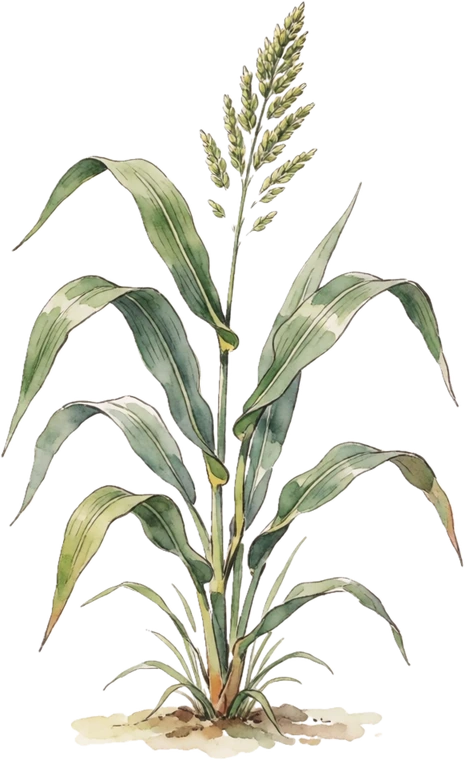
Sorghum-sudangrass rebuilds worn-out soil at a sprint — sown into summer heat, it towers head-high in weeks, shading out every weed beneath it while pumping roots and organic matter into ground that other crops abandoned. No warm-season cover crop moves more biomass in a single season.
One midseason mowing sends the roots plunging deeper to break compaction, and winter finishes the job by killing it in place — spring finds the bed loose, mulched, and ready. It's a soil tool rather than a pasture. Hand it your most exhausted plot and stand back.
 Full Sun
 Low water
 Very Fast in heat growth
 None winter chill
From the print shop
Growing sorghum-sudangrass? Hang it.
Our Plant Library collection carries sorghum-sudangrass — Sorghum drummondii, print Nº 440, “Sorghum-Sudangrass.”
526 designsfrom $12.99white or black backgroundmatte poster, unframed
Will it fruit where you are?
Enter your ZIP — we look up your USDA hardiness zone (2023 map) and check it against what sorghum-sudangrass actually needs.
 Life cycleAnnual
Sorghum-Sudangrass · Common problems
Common sorghum-sudangrass problems

Pests
3 problems on file
- Almost none
- European Corn Borer
- Armyworms

Diseases
1 problem on file
- Almost none
Sorghum-Sudangrass · Growing & propagation
Growing sorghum-sudangrass
- Light
- Full Sun
- Water
- Low
Heat- and drought-tough
 Soil
Soil- Any · pH 5.5 - 7.5
 Fertilizer
- Light N boosts biomass
 Pruning
- Mow midseason then again; winter-kills
The biomass monster of summer cover crops — a fast, heat-loving grass hybrid that grows shoulder-high, smothers weeds, and (mowed once at 3-4 ft) puts down massive deep roots that break compaction and add enormous organic matter when it winter-kills. Sow after the soil is hot. Its roots are allelopathic, suppressing weeds. The ultimate 'build poor soil fast in one hot summer' crop.
 Spacing
- Broadcast dense
How to plant & propagate sorghum-sudangrass
- Propagate
- From seed
Sorghum-Sudangrass · Calculators & field guides
A little help in the garden.
Sorghum-Sudangrass · Yearly calendar
The sorghum-sudangrass year, month by month
Jan
PruneDecember to February
PrunePruneDecember to February
What each band means
- Prune — shape it now — cuts heal cleanly and structure is visible.
These are the species' typical months — expect them a few weeks earlier in warm zones and later in cold ones. Watch the plant, not just the calendar.
Sorghum-Sudangrass · Ecology & uses
Ecology & uses
Sorghum × drummondii
Sorghum-Sudangrass in the garden system
- Herbaceous layer annual
 Moisture
- Upland / dry
 Deer
Deer- Browsed
Protect young plants
 Origin
- Introduced
What sorghum-sudangrass is grown for
! Some parts toxic — see notesYoung/stressed regrowth can contain prussic acid — a cover crop, not forage without care
 Use
Use- Biomass builder
- Use
- Compaction buster
- Use
- Weed smother
- Use
- Summer cover
Harvesting & storing sorghum-sudangrass
Cover crop — mow at 3-4 ft to force deep roots and huge biomass.
Edibility, identification, and traditional-use notes here are general reference — not medical or veterinary advice, and not a claim that any plant treats or prevents anything. Medicinal ratings record how strongly a plant features in herbal tradition, nothing more. Never eat or dose a plant you have not positively identified. More on how to use this library.
Sorghum-Sudangrass · Varieties & cultivars
Choosing a sorghum-sudangrass variety
'Sudex' and common sorghum-sudan hybrids
Sources & plant identity
Know what you’re growing.
See where the knowledge comes from.
Sorghum-Sudangrass
Sorghum × drummondii
The plant, at a glance.
- Botanical name
- Sorghum × drummondii
- Plant family
- Poaceae
- Growth habit
- Annual
- Origin
- Introduced
- USDA plant symbol
- SODR3
- Invasive risk
- Low
Hardiness, size and timing vary with your cultivar, soil and climate.
Rooted in research.
University extension research, brought together with hands-on growing experience at Story Thyme Farms.
Where to buy
Third-party nurseries — not Story Thyme Farms.
Third-party nurseries, not Story Thyme Farms. Prices are theirs.
Story Thyme Farms may earn a small commission from these links, at no cost to you — it never changes what we recommend.
Questions
Sorghum-Sudangrass questions, answered straight.
Is sorghum-sudangrass safe for kids and pets?
With care. Young/stressed regrowth can contain prussic acid — a cover crop, not forage without care Site it accordingly if children or pets roam the garden. This is general reference, not medical or veterinary advice — call a vet or poison control if something has actually been eaten.
When do you harvest sorghum-sudangrass?
Cover crop — mow at 3-4 ft to force deep roots and huge biomass.
How do you propagate sorghum-sudangrass?
From seed.
Elsewhere
Where sorghum-sudangrass sits in the library.
 Cereal Rye (Winter Rye)
 Siberian Pea Shrub
 Tomato
 Pepper