The illustrated growing guide

Witch Hazel

Hamamelis virginiana

Family Hamamelidaceae

Est. zones 3-8

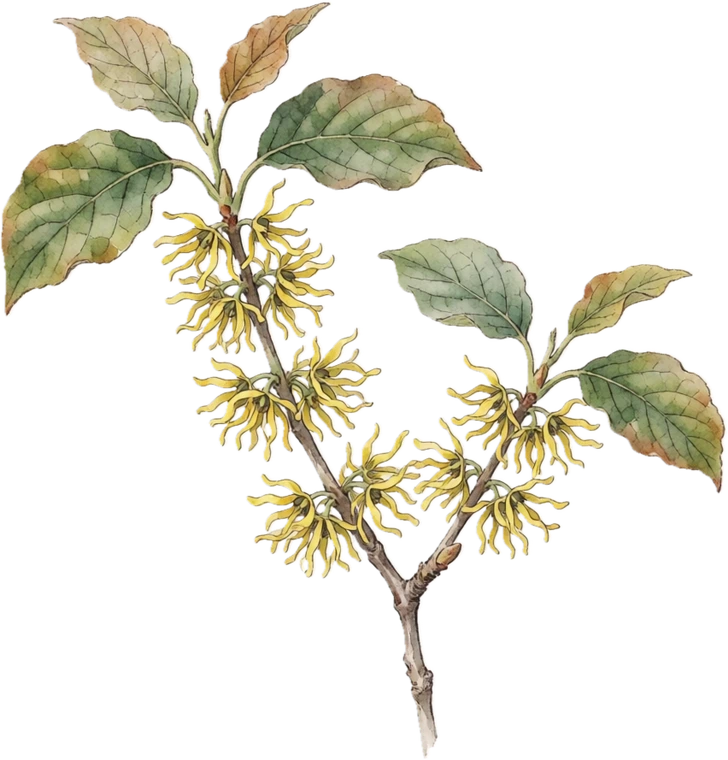
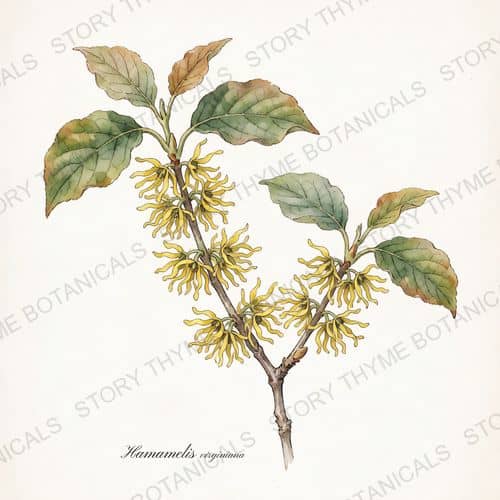
Botanical illustration of Witch Hazel
Shrub · Hamamelis virginiana

The LAST bloom of the American year — ribbons unfurling in November woods — and the bark is the witch hazel on every pharmacy shelf. Seed pods launch seeds 20 feet with an audible snap. A food-forest medicine layer classic.

Shrub · NativeFull Sun to Part ShadeModerate waterSlow-Moderate growthNative to North AmericaAttracts bees

Where to buy the plant — 1 nursery

Ozark Witch Hazel — a print from the Native Missouri Plants collection

From the print shop

The closest print we make

We don’t print Hamamelis virginiana. The closest we have is Hamamelis vernalis (“Ozark Witch Hazel”) in the Native Missouri Plants collection — the same genus, Hamamelis, not the same species.

16 designsfrom $21.99white or black groundmatte poster, unframed

Shop Native Missouri Plants botanical prints →

I

Overview

Will witch hazel suit your garden, and what goes wrong.

Will it fruit where you are?

Enter your ZIP — we look up your USDA hardiness zone (2023 map) and check it against what witch hazel actually needs.

Hardy inZones 3-8

Witch Hazel at a glance

HardinessUSDA 3–8
Mature size15-20 ft vase
PollinationLate-flying moths and the last bees — it blooms when nothing else dares
Chill requirementNot yet established
Bloom seasonOCTOBER - DECEMBER — spidery yellow ribbons as the leaves drop; vernal/hybrid types bloom Jan-Mar
Harvest seasonBark + twigs: the astringent distillate in every drugstore (harvest prunings)
Growth rateSlow-Moderate

Common witch hazel problems

II

Growing

Light, water, soil, propagation and the season’s jobs.

How to grow witch hazel: light, water & soil

LightFull Sun to Part Shade (understory native)
WaterModerate
SoilMoist, acid-leaning, humusy · pH 5.5 - 6.5
FertilizerNone needed
PruningLate Winter — Minimal — remove suckers below graft on hybrids; enjoy the natural vase.
Spacing10-15 ft

How to plant & propagate witch hazel

PropagateSeed (stratify), cuttings, or layering

The witch hazel growing playbook

Field-tested instructions for every job witch hazel asks of you, compiled from university extension guidance — in the order the season brings them.

Planting out

Plant from a container, early in the season

Set out containerized plants early in the growing season in moist, well-drained soil, in light shade to full sun. Avoid both wet, poorly drained ground and dry sites. Do not plan to move it later. Witch hazel establishes best from containers and resents transplanting once established, so the spot you choose now is effectively permanent; flowering improves with more sun, but the roots want steady moisture.

Watering

Keep it evenly moist through its first two summers

Water consistently through the first two growing seasons, enough to keep the root zone moist rather than soggy. Witch hazel grows best in moist, well-drained soil: avoid wet, poorly drained sites and avoid dry locations. Even once established it prefers steady moisture, and it will tolerate somewhat drier sites but not a genuinely dry one. Iowa State calls for consistent moisture through the first couple of growing seasons and says to avoid dry locations. This is a woodland understory shrub — Maryland Extension describes it as ideally moist, tolerant of temporary wetness and somewhat drier sites, and vulnerable to sunscorch in full sun — so a young plant on a dry, exposed site checks and stalls rather than establishing.

Mulching

Two to four inches of mulch over the root zone

Spread a 2 to 4 inch layer of mulch out over the root zone, kept back off the stems. Mulch holds the even soil moisture this shrub needs and keeps the shallow woodland root system from swinging between wet and dry, which is the condition it evolved under on a forest floor.

Pruning

Late winter: take out dead and crossing wood, nothing moreFeb – Mar

Remove dead or crossing branches back to their point of origin, and cut suckers off at the base, so the shrub keeps its natural arching vase form. Common witch hazel flowers in October through December, so a late winter cut costs you nothing, but if you grow a vernal or hybrid type that blooms February into March, wait until its flowers have faded before you cut. Witch hazel sets its flowers on old growth, so wood removed now is wood that would have bloomed; heading cuts also destroy the layered, spreading branch habit that is the whole reason to plant this shrub.

Rejuvenate a tired, crowded clump by thinning the oldest stemsFeb – Mar

On an established multi-stemmed plant that has gone thin and twiggy inside, selectively cut the oldest, thickest stems out at ground level while it is leafless, leaving the younger stems to carry the canopy. Witch hazel also tolerates an occasional hard cut back to renew the whole plant. Established witch hazel responds well to heavy renewal pruning and resprouts vigorously from the base, which is the same trait that lets harvested plants regrow; the oldest stems flower least and shade out the young wood that flowers best.

Rub off suckers, especially on a grafted hybrid

Pull or cut suckers at the base as they appear through the growing season. If your plant is a named hybrid like Arnold Promise or Jelena, look hard at anything rising from below the graft union and remove it immediately. Hybrid witch hazels are commonly grafted onto common witch hazel rootstock, and common witch hazel is especially prone to suckering, so unchecked rootstock shoots will outgrow and eventually replace the cultivar you paid for.

What to watch for

Cone and spiny galls on the leaves: identify them, then leave them alone

Expect cone-shaped bumps standing up from the leaf surface, and spiny galls on the leaves and seed pods. These are the witch hazel cone gall aphid and the spiny witch hazel gall aphid, both native. Do not spray. If a small infestation bothers you, prune the affected shoots out in summer. Both aphids are native insects that alternate between witch hazel and birch, and the galls are cosmetic. They do not harm the plant and do not need managing, so any insecticide here buys you nothing and costs the beneficial insects in the shrub.

Do not apply insecticide to witch hazel in flower. Common witch hazel blooms in late autumn and is pollinated by noctuid moths, and it is one of very few nectar sources left that late in the season.

Harvesting

Cut twigs and bark for distillate once the leaves are downNov – Dec

Take your prunings for distillate in late fall and early winter, after leaf drop. The twigs and bark are the parts used; commercially they are chipped and boiled, and the condensed steam is the astringent product. Note that common witch hazel is still flowering in this window, so cut what you need and leave the rest of the flowering wood standing. Late fall and early winter is the harvest window used by the commercial witch hazel trade, and the shrub is leafless then, so a cut takes wood rather than a working canopy and the plant resprouts from the base. Do not mistake leafless for dormant: common witch hazel blooms mid-October into early December, so wood cut now is wood in flower, and those flowers are one of the last nectar sources of the year — take prunings selectively rather than stripping the plant.

Home-cut witch hazel is a horticultural harvest, not a medicine. Do not ingest it, and do not treat homemade preparations as equivalent to a labeled drugstore product.

III

The year

What witch hazel asks for, month by month.

The witch hazel year, month by month

MonthJanFebMarAprMayJunJulAugSepOctNovDec
Bloom
Prune

What each band means

  • Bloomflowers open — pollinators working, frost on blossoms is the danger.
  • Pruneshape it now — cuts heal cleanly and structure is visible.

The witch hazel year as text

  • Jan bloom
  • Feb bloom, pruning
  • Mar bloom, pruning
  • Apr quiet month
  • May quiet month
  • Jun quiet month
  • Jul quiet month
  • Aug quiet month
  • Sep quiet month
  • Oct bloom
  • Nov bloom
  • Dec bloom

These are the species' typical months — expect them a few weeks earlier in warm zones and later in cold ones. Watch the plant, not just the calendar.

IV

Ecology & uses

What it does for the garden, and what it is grown for.

Witch Hazel in the garden system

  • Understory layer shrub
  • Nectary/insectary
AttractsBees
HabitatWoodland
MoistureFacultative / average
DeerBrowsed — protect young plants
OriginNative to North America

What witch hazel is grown for

✓ Commonly eatentopical use traditional; not for casual internal use

UseAstringent (topical)
UseWinter bloom
UseNative understory
Traditional use rating4/5 in herbal tradition

Harvesting & storing witch hazel

Bark + twigs: the astringent distillate in every drugstore (harvest prunings).

Edibility, identification, and traditional-use notes here are general reference — not medical or veterinary advice, and not a claim that any plant treats or prevents anything. Medicinal ratings record how strongly a plant features in herbal tradition, nothing more. Never eat or dose a plant you have not positively identified. More on how to use this library.

V

Cultivars

Named varieties of witch hazel, ruled as a catalogue.

Best witch hazel varieties & cultivars

11 on file

Named varieties of witch hazel differ in winter-chill needs, ripening time, hardiness, and whether they set fruit on their own — pick one that fits your climate.

Harvest Moon

Zones3-8Size15 to 20 feet tall

Common witch hazel, Hamamelis virginiana. Lemon yellow flowers on a vase-shaped plant, blooming mid October to early December. The full-size form, and the hardiest group.

Where to buy ‘Harvest Moon

Story Thyme Farms may earn a small commission from these links, at no cost to you — it never changes what we recommend.

Little Suzie

Zones3-9Size4 to 6 feet tall

Common witch hazel, Hamamelis virginiana. Soft yellow fragrant flowers in late fall and early winter. NC State rates it 3a to 9b and notes it blooms younger and more densely than the species, and tolerates moist soil and occasional flooding.

Where to buy ‘Little Suzie

Story Thyme Farms may earn a small commission from these links, at no cost to you — it never changes what we recommend.

Autumn Embers

Zones4-8Size8 to 10 feet tall

Vernal witch hazel, Hamamelis vernalis. Copper-red flowers, fall color orange to burgundy red. Vernal types bloom early February to late March, so prune after the flowers fade, not before.

Where to buy ‘Autumn Embers

Story Thyme Farms may earn a small commission from these links, at no cost to you — it never changes what we recommend.

Amethyst

Zones4-8Size6 to 8 feet tall

Vernal witch hazel, Hamamelis vernalis. Reddish purple flowers, early February to late March. Vernal witch hazel tolerates higher soil pH than the other species.

Where to buy ‘Amethyst

Story Thyme Farms may earn a small commission from these links, at no cost to you — it never changes what we recommend.

Carnea

Zones4-8Size6 to 8 feet tall

Vernal witch hazel, Hamamelis vernalis. Burgundy red flowers, early February to late March.

Where to buy ‘Carnea

Story Thyme Farms may earn a small commission from these links, at no cost to you — it never changes what we recommend.

Red Imp

Zones4-8

Vernal witch hazel, Hamamelis vernalis. Clemson describes it as a cultivar 'with petals ranging from copper-red to maroon' but gives no zone or mature size for it specifically. The 4-8 range here is the vernal species rating, not a cultivar listing: Clemson says H. vernalis 'is hardy to Zone 4' and Iowa State gives the vernal group as Zones 4-8. Vernal witch hazel takes higher soil pH than the other species and is the group most associated with powdery mildew, though Clemson notes it 'is not a significant problem in most instances.' Vernal types bloom early February to late March, so prune after the flowers fade.

Where to buy ‘Red Imp

Story Thyme Farms may earn a small commission from these links, at no cost to you — it never changes what we recommend.

Arnold Promise

Zones5-8DiseaseSubject to leaf anthracnose per ClemsonSize12 to 15 feet tall

Hybrid witch hazel, Hamamelis x intermedia. Bright yellow flowers February to March, with yellow, orange and reddish fall color. Usually grafted on common witch hazel rootstock, so watch the base for suckers. Clemson flags it as prone to leaf anthracnose.

Where to buy ‘Arnold Promise

Story Thyme Farms may earn a small commission from these links, at no cost to you — it never changes what we recommend.

Diane

Zones5-8Size8 to 12 feet tall

Hybrid witch hazel, Hamamelis x intermedia. Copper red flowers February to March, fall foliage yellow, orange, to red. Typically grafted, so remove rootstock suckers.

Where to buy ‘Diane

Story Thyme Farms may earn a small commission from these links, at no cost to you — it never changes what we recommend.

Jelena · Copper Beauty

Zones5-8Size8 to 12 feet tall

Hybrid witch hazel, Hamamelis x intermedia, also sold as Copper Beauty. Coppery orange flowers February to March, orange-red fall color. Typically grafted, so remove rootstock suckers.

Where to buy ‘Jelena

Story Thyme Farms may earn a small commission from these links, at no cost to you — it never changes what we recommend.

Pallida

Zones5-8Size9 to 12 feet tall

Hybrid witch hazel, Hamamelis x intermedia. Pale yellow flowers February to March, yellow-orange fall color. Typically grafted, so remove rootstock suckers.

Where to buy ‘Pallida

Story Thyme Farms may earn a small commission from these links, at no cost to you — it never changes what we recommend.

Ruby Glow

Zones5-8Size15 feet tall

Hybrid witch hazel, Hamamelis x intermedia. Copper-red flowers aging to reddish-brown, February to March, reddish fall color. The largest of the hybrids listed by Iowa State.

Where to buy ‘Ruby Glow

Story Thyme Farms may earn a small commission from these links, at no cost to you — it never changes what we recommend.

VI

Sources & plant ID

Where the care distinctions come from, and how the plant is filed.

Research basis

Sources behind this profile

No extension citations are attached to witch hazelyet. The care figures below come from the library's own catalogue rather than a traced primary source.

Plant ID

BinomialHamamelis virginiana
FamilyHamamelidaceae
TypeShrub · Perennial
USDA symbolHAVI4
OriginNative to North America
Invasive riskLow

VII

Where to buy

Third-party nurseries — not Story Thyme Farms.

Third-party nurseries, not Story Thyme Farms. Prices are theirs.

Story Thyme Farms may earn a small commission from these links, at no cost to you — it never changes what we recommend.

VIII

Questions

Witch Hazel questions, answered straight.

Is witch hazel safe for kids and pets?

Witch Hazel is commonly eaten and isn't considered toxic, but "commonly eaten" isn't a guarantee for any particular person or animal — allergies, quantity, and which part you eat all matter. One caveat on this one: topical use traditional; not for casual internal use. Never eat a plant you haven't positively identified, and check with a vet before letting pets or livestock graze anything new.

When do you harvest witch hazel?

Bark + twigs: the astringent distillate in every drugstore (harvest prunings).

How do you propagate witch hazel?

Seed (stratify), cuttings, or layering.

IX

Elsewhere

Where witch hazel sits in the library.

Where witch hazel sits in the library

Grows in the same world