The illustrated growing guide

Aronia (Chokeberry) — Improved

Aronia melanocarpa 'Viking'

Family Rosaceae

Est. zones 3-8

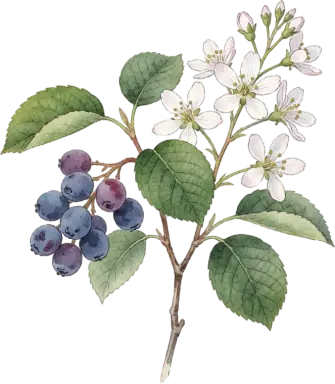
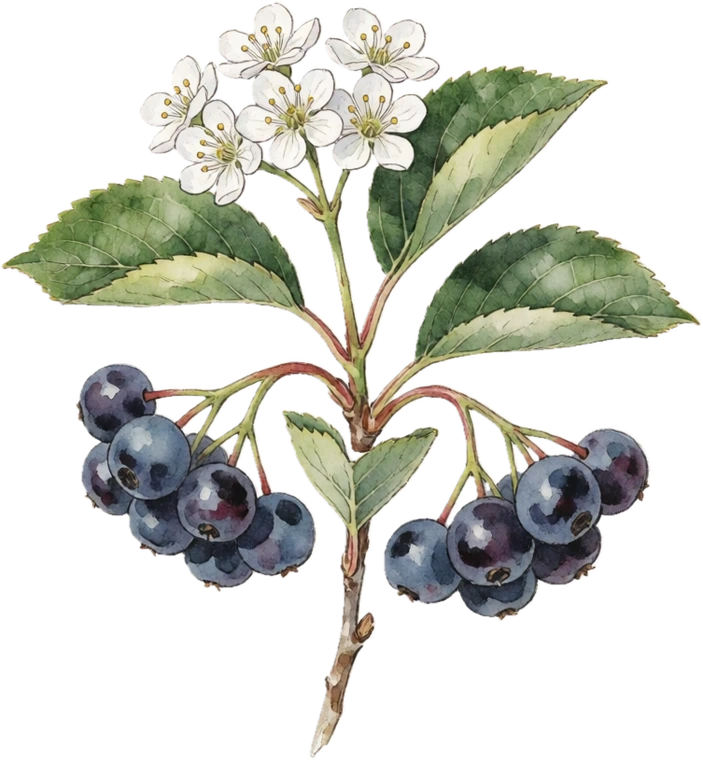
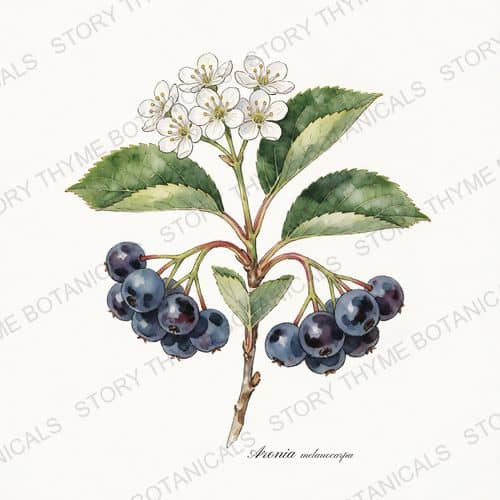
Botanical illustration of Aronia (Chokeberry) — Improved
Shrub · Aronia melanocarpa 'Viking'

The toughest superfruit you can grow: native, no-spray, adaptable from bogs to bad clay, with off-the-charts antioxidants, brilliant scarlet fall foliage, and spring bee flowers. Too astringent to snack, magnificent as juice, wine, and jam. A commercial superfood crop hiding as a landscape shrub.

Shrub · NativeFull Sun to Part ShadeLow waterModerate growthNative to North AmericaExcellent edibleAttracts bees1000+ winter chill

Where to buy the plant — 1 nursery

Aronia — a print from the Berry Plants collection

From the print shop

Growing aronia (chokeberry) — improved? Hang it.

Our Berry Plants collection carries aronia (chokeberry) — improvedAronia melanocarpa, print Nº 14, “Aronia.”

16 designsfrom $21.99white or black groundmatte poster, unframed

Shop Berry Plants botanical prints →

I

Overview

Will aronia (chokeberry) — improved suit your garden, and what goes wrong.

Will it fruit where you are?

Enter your ZIP — we look up your USDA hardiness zone (2023 map) and check it against what aronia (chokeberry) — improved actually needs.

Hardy inZones 3-8
Winter chill1000+
PollinationSelf-fertile

Aronia (Chokeberry) — Improved at a glance

HardinessUSDA 3–8
Mature size3-6 ft
PollinationSelf-fertile; white spring flowers feed bees
Chill requirement1000+
Bloom seasonMay (white clusters)
Harvest seasonSeptember: intensely dark antioxidant berries — astringent fresh, superb in juice/wine/jam
Growth rateModerate

Common aronia (chokeberry) — improved problems

  • Almost none
  • Almost none — nearly bulletproof

II

Growing

Light, water, soil, propagation and the season’s jobs.

How to grow aronia (chokeberry) — improved: light, water & soil

LightFull Sun to Part Shade
WaterLow-Moderate — extremely adaptable
SoilAny, wet to dry · pH 5.5 - 7.0
FertilizerNone needed
PruningLate Winter — Renewal-prune old canes; suckers can be dug and shared.
Spacing4-6 ft

How to plant & propagate aronia (chokeberry) — improved

PropagateGrafted, or from cuttings/layering (seed won't come true)

The aronia (chokeberry) — improved growing playbook

Field-tested instructions for every job aronia (chokeberry) — improved asks of you, compiled from university extension guidance — in the order the season brings them.

Watering

Drip-irrigate through the first two growing seasons

Run drip irrigation on new plantings through their first two growing seasons. On sandy ground, water several short cycles of 15 to 30 minutes across an irrigation day. On clay, one or two applications of 15 to 30 minutes is enough. Established aronia is drought-tough and rarely needs this. Aronia's reputation for toughness is earned only after the root system reaches out. Establishment is the one stage where drought actually kills plants, and drip keeps water at the root ball without wetting foliage.

Mulching

Mulch young plants while the row fills in

Mulch around young aronia to hold down weeds while the plants fill in; plastic mulch is one recommended option, pulled after two to three years as the plants sucker into a hedgerow. Once a planting is three to four years old the shrubs and their suckers close the row and in-row weed control is usually no longer needed. As general practice with any thin-barked shrub, keep string trimmers and mowers away from the canes and crown. Aronia suckers into a hedgerow that shades out its own weeds given a few years, so mulch is a temporary establishment tool rather than a permanent job.

Feeding

Feed lightly: about a quarter to a half ounce of nitrogen per plant

Apply roughly 0.25 to 0.5 oz of actual nitrogen per plant per year, spread around the base while the plant is still dormant or just breaking. Do not scale this up hoping for more berries. A slow-release source such as composted litter suits aronia better than a soluble hit. Trials found a half-ounce rate roughly doubled yield against an eighth-ounce rate, but pushing nitrogen past that mostly buys vegetative growth on a shrub that already suckers hard, and it does not raise the sugar content of the fruit at all.

Pruning

Renewal-prune: take out canes over five years oldFeb – Mar

While the shrub is still dormant and before bud break, cut the oldest canes right off at the base of the crown rather than heading them back. Start this once the planting is about five years old, and take out the canes that have passed five years, keeping the center of the bush open. Aim to hold the bush under six to eight feet so you can still reach the fruit. An aronia cane hits peak productivity around three years old and falls off steadily after that, so a bush left unpruned slowly fills with old wood that makes leaves instead of berries. Cutting at the crown pushes new canes from the base, which is where the next crop comes from.

What to watch for

Check leaf undersides for lace bug

Turn leaves over through the summer and look for lace bug and the dark varnish-like spotting they leave underneath. Lace bug is the one insect on aronia that can actually take a bush down in vigor. Note an infestation now, because the practical control is next spring's dormant oil. Lace bugs feed from the underside of the leaf, draining chlorophyll and bronzing the canopy, and because they sit beneath the leaf they go unnoticed until the top surface has already gone dull and stippled.

Do not reach for a rescue insecticide during bloom - aronia's white clusters are a genuine bee draw, and very few products are labeled for aronia in any case.

Spotted wing drosophila: do not spray aronia on reflex

If you already spray SWD on raspberries or blueberries, do not extend that program to aronia by default. Traps near aronia will catch adults, but adult catches do not predict infestation in this crop. Instead just avoid leaving split or machine-damaged berries around, and harvest on time. Intact unwounded aronia berries are unsuitable hosts - field sampling turned up only three larvae all season, against nearly fifty larvae per fruit in raspberry, and a Maryland orchard monitored since 2013 recorded no infestation at all. The fly can only complete its cycle in aronia when the skin is already broken.

This rule exists to prevent an unnecessary near-harvest insecticide. If a wounded-fruit infestation is genuinely confirmed, check that any product names IR-4 crop group 13-07B and follow its stated pre-harvest interval.

Spraying

Dormant oil before bud break for lace bug and Japanese maple scaleFeb – Apr

If lace bug or Japanese maple scale showed up last season, apply horticultural dormant oil before bud break, covering the cane bark and dormant buds thoroughly to the point of runoff - the plant is leafless at this stage, so bark coverage is the whole job. For Japanese maple scale, expect to repeat: several sprays through spring are usually required rather than a single pass. This is the one well-supported chemical control on aronia, and skipping it is reasonable on a clean planting. Dormant oil works by smothering overwintering scale and the first developing lace bug generation before leaves harden and the insects disperse, which is the only window where a contact oil reaches them all at once.

Apply only when temperatures are above 55 F and are expected to stay above freezing for at least 3 days after application, or the oil will injure the plant. Do not delay this into leaf-out expecting the same result - past bud break a dormant-rate oil risks phytotoxicity and the target insects have already dispersed. Very few insecticides carry an aronia label at all - aronia sits in IR-4 crop group 13-07B, bushberry and small fruit - so check that any product names that group and names the pest before you spray.

Harvesting

Pick when Brix stabilizes and berries are fully black

Harvest once the berries are completely black and the sugar reading has stopped climbing, around 16 to 18 Brix. Pick before the fruit begins to wrinkle and dry, even if that means giving up the last points of sugar. Refrigerate the berries promptly after picking. Aronia hits maximum weight weeks before it hits maximum anthocyanin, so the two goals pull apart and a stabilized Brix reading is the honest signal that ripening has finished. Waiting past that point trades fruit quality for pigment you will lose to shrivel anyway.

Aronia is safe raw but intensely astringent - the fruit is best juiced, cooked or dried rather than eaten fresh.

III

The year

What aronia (chokeberry) — improved asks for, month by month.

The aronia (chokeberry) — improved year, month by month

MonthJanFebMarAprMayJunJulAugSepOctNovDec
Bloom
Prune
Harvest

What each band means

  • Bloomflowers open — pollinators working, frost on blossoms is the danger.
  • Pruneshape it now — cuts heal cleanly and structure is visible.
  • Harvestpicking time — check ripeness every few days.

The aronia (chokeberry) — improved year as text

  • Jan quiet month
  • Feb pruning
  • Mar pruning
  • Apr quiet month
  • May bloom
  • Jun quiet month
  • Jul quiet month
  • Aug quiet month
  • Sep harvest
  • Oct quiet month
  • Nov quiet month
  • Dec quiet month

These are the species' typical months — expect them a few weeks earlier in warm zones and later in cold ones. Watch the plant, not just the calendar.

IV

Ecology & uses

What it does for the garden, and what it is grown for.

Aronia (Chokeberry) — Improved in the garden system

  • Shrub layer shrub
AttractsBees
MoistureUpland / dry
DeerBrowsed — protect young plants
OriginNative to North America

What aronia (chokeberry) — improved is grown for

✓ Commonly eatenvery astringent raw

UseJuice/wine
UseSuperfood
UseNative hedge
UseFall color
Edible value4/5
Traditional use rating3/5 in herbal tradition

Harvesting & storing aronia (chokeberry) — improved

September: intensely dark antioxidant berries — astringent fresh, superb in juice/wine/jam.

Edibility, identification, and traditional-use notes here are general reference — not medical or veterinary advice, and not a claim that any plant treats or prevents anything. Medicinal ratings record how strongly a plant features in herbal tradition, nothing more. Never eat or dose a plant you have not positively identified. More on how to use this library.

V

Cultivars

Named varieties of aronia (chokeberry) — improved, ruled as a catalogue.

Best aronia (chokeberry) — improved varieties & cultivars

6 on file

Named varieties of aronia (chokeberry) — improved differ in winter-chill needs, ripening time, hardiness, and whether they set fruit on their own — pick one that fits your climate.

Viking

Self-fertile
RipensLate Aug-SeptZones3-8Diseaseexcellent (few pests or diseases)Size6-8 ft, upright suckering

astringent-tart raw, excellent for juice, wine, jam and drying — The most widely planted, highest-yielding aronia and the default pick for a productive home berry patch. Self-fruitful (no pollinizer needed), though a second plant can boost yield and berry size. One of the commercial A. mitschurinii fruit types (aronia x mountain ash lineage). Chill requirement is not formally established; ~800-1000 hrs is a published estimate.

Where to buy ‘Vikingverified

Story Thyme Farms may earn a small commission from these links, at no cost to you — it never changes what we recommend.

Nero

Self-fertile
RipensLate Aug-SeptZones3-8Diseaseexcellent (few pests or diseases)Size3-5 ft, compact

tart, high-antioxidant; best cooked, juiced or dried — Stays compact yet nearly matches Viking's yield, making it a strong fit for small gardens and mixed borders. Self-fruitful. Like Viking, a commercial A. mitschurinii fruit type. Chill figure is an estimate; aronia's true chilling need is poorly documented.

Where to buy ‘Nero

Story Thyme Farms may earn a small commission from these links, at no cost to you — it never changes what we recommend.

McKenzie

Self-fertile
RipensSeptZones3-8Diseaseexcellent (few pests or diseases)Size9-12 ft, large upright (can exceed 10 ft)

tart; juice, jam and drying — A USDA-NRCS conservation release (2008) selected for windbreaks, wildlife plantings and hedges rather than commercial fruit production; extension notes it is not recommended as a primary fruit cultivar, so expect a bigger shrub than a heavy dessert crop. Self-fruitful. Very cold-hardy. Chill value is an estimate.

Where to buy ‘McKenzie

Story Thyme Farms may earn a small commission from these links, at no cost to you — it never changes what we recommend.

Autumn Magic

Self-fertile
RipensSeptZones3-8Diseaseexcellent (few pests or diseases)Size3-4 ft, ornamental

tart; smaller crop, grown more for looks than yield — A true Aronia melanocarpa (not the A. mitschurinii commercial type of Viking/Nero), a UBC introduction prized for glossy foliage and brilliant red-purple fall color. Extension classes it as ornamental and a lighter fruiter than Viking. Self-fruitful. Chill value is an estimate.

Where to buy ‘Autumn Magic

Story Thyme Farms may earn a small commission from these links, at no cost to you — it never changes what we recommend.

Aron

Self-fertile
RipensLate Aug-SeptZones3-8Diseaseexcellent (few pests or diseases)Size5-6 ft

tart, juicy; commercial juice and processing use — An older Danish commercial selection (c. 1987). Frequently classified as Aronia x prunifolia (purple chokeberry hybrid) rather than strictly A. melanocarpa, so its species identity is ambiguous. Self-fruitful. The 'Serina' alias in the source draft could not be verified against any reliable source and was removed. Chill value is an estimate.

Where to buy ‘Aron

Story Thyme Farms may earn a small commission from these links, at no cost to you — it never changes what we recommend.

Galicjanka · Galicianka

Self-fertile
RipensSeptZones3-8Diseaseexcellent (few pests or diseases)Size5-7 ft

the largest, sweetest berries of the major cultivars (~16.6 Brix vs ~14 for Viking/Nero); excellent for juice and jam though still tart-astringent raw — A Polish processing cultivar noted for the largest berries and highest sugar of the common commercial types, with uniform ripening suited to mechanical harvest. A commercial A. mitschurinii fruit type. Self-fruitful. Very cold-hardy (reported to about -37 C). Chill value is an estimate.

Where to buy ‘Galicjanka

Story Thyme Farms may earn a small commission from these links, at no cost to you — it never changes what we recommend.

VI

Sources & plant ID

Where the care distinctions come from, and how the plant is filed.

Research basis

Sources behind this profile

No extension citations are attached to aronia (chokeberry) — improvedyet. The care figures below come from the library's own catalogue rather than a traced primary source.

Plant ID

BinomialAronia melanocarpa 'Viking'
FamilyRosaceae
TypeShrub · Perennial
USDA symbolARME6
OriginNative to North America
Invasive riskLow

VII

Where to buy

Third-party nurseries — not Story Thyme Farms.

Third-party nurseries, not Story Thyme Farms. Prices are theirs.

Story Thyme Farms may earn a small commission from these links, at no cost to you — it never changes what we recommend.

VIII

Questions

Aronia (Chokeberry) — Improved questions, answered straight.

Do I need two aronia (chokeberry) — improved plants to get fruit?

No — aronia (chokeberry) — improved is self-fertile, so a single plant will set a crop. A second one usually improves yields, but it isn't required.

Will aronia (chokeberry) — improved fruit in a warm-winter climate?

Aronia (Chokeberry) — Improved needs roughly 1000+ hours of winter chill (hours between 32–45°F) to break dormancy and set fruit. Mild-winter growers should count their chill hours before planting.

Is aronia (chokeberry) — improved safe for kids and pets?

Aronia (Chokeberry) — Improved is commonly eaten and isn't considered toxic, but "commonly eaten" isn't a guarantee for any particular person or animal — allergies, quantity, and which part you eat all matter. One caveat on this one: very astringent raw. Never eat a plant you haven't positively identified, and check with a vet before letting pets or livestock graze anything new.

When do you harvest aronia (chokeberry) — improved?

September: intensely dark antioxidant berries — astringent fresh, superb in juice/wine/jam.

IX

Elsewhere

Where aronia (chokeberry) — improved sits in the library.

Where aronia (chokeberry) — improved sits in the library

Grows in the same world