The illustrated growing guide

Serviceberry / Juneberry

Amelanchier spp.

Family Rosaceae

Est. zones 4-8

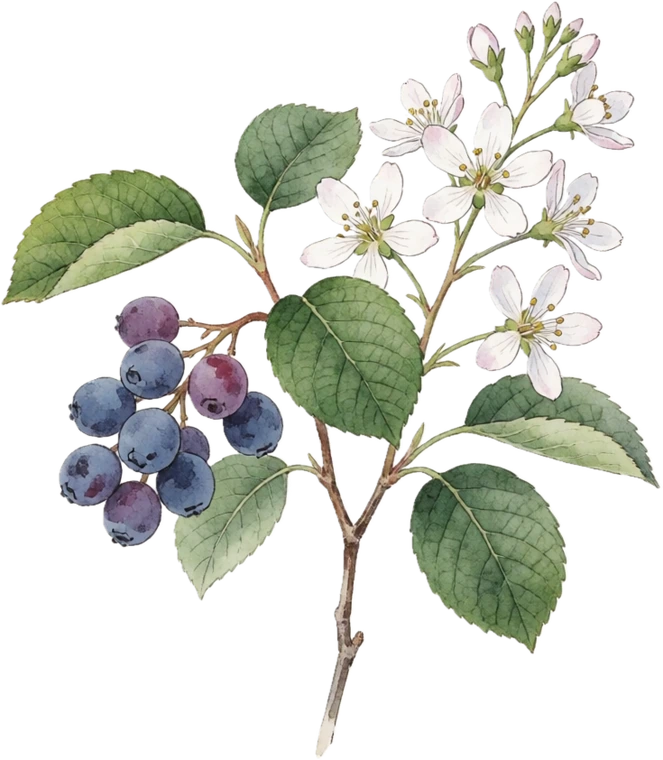
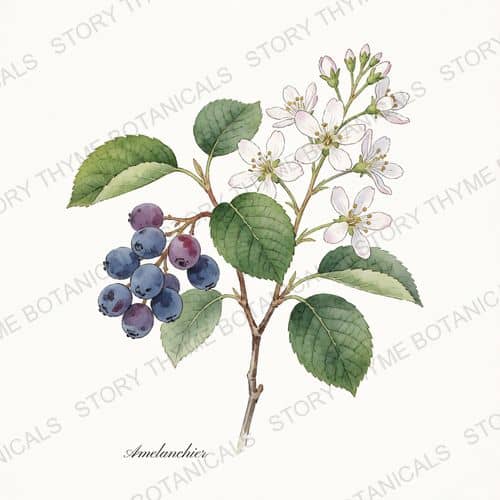
Botanical illustration of Serviceberry / Juneberry
Shrub · Amelanchier spp.

Fruit tastes like blueberry/almond mix. Extremely high wildlife value. Rust can ruin fruit if Red Cedars are nearby.

ShrubFull Sun to Part ShadeModerate waterModerate growthExcellent edibleAttracts bees

Where to buy the plant — 1 nursery

Serviceberry — a print from the Native Missouri Plants collection

From the print shop

The closest print we make

We don’t print Amelanchier spp. The closest we have is Amelanchier arborea (“Serviceberry”) in the Native Missouri Plants collection — the same genus, Amelanchier, not the same species.

16 designsfrom $21.99white or black groundmatte poster, unframed

Shop Native Missouri Plants botanical prints →

I

Overview

Will serviceberry / juneberry suit your garden, and what goes wrong.

Will it fruit where you are?

Enter your ZIP — we look up your USDA hardiness zone (2023 map) and check it against what serviceberry / juneberry actually needs.

Hardy inZones 4-8
PollinationSelf-fertile

Serviceberry / Juneberry at a glance

HardinessUSDA 4–8
Mature size15-25 ft
PollinationSelf-Fertile
Chill requirementNot yet established
Bloom seasonVery Early Spring
Harvest seasonJune (Hence 'Juneberry')
Growth rateModerate

Common serviceberry / juneberry problems

  • Birds (Major pest for fruit)
  • Rust
  • Mites
  • Cedar-Serviceberry Rust (creates orange spikes on fruit)

II

Growing

Light, water, soil, propagation and the season’s jobs.

How to grow serviceberry / juneberry: light, water & soil

LightFull Sun to Part Shade
WaterModerate
SoilMoist, Well-drained, Acidic to Neutral · pH 5.5 - 7.0
FertilizerEarly Spring
PruningWinter — Thinning crowd stems. Renew from base if shrub form.
Spacing10-15 ft

How to plant & propagate serviceberry / juneberry

PropagateGrafted, or from cuttings/layering (seed won't come true)

The serviceberry / juneberry growing playbook

Field-tested instructions for every job serviceberry / juneberry asks of you, compiled from university extension guidance — in the order the season brings them.

Watering

Water at the base, not over the leaves

In the first season keep the soil moist but not wet, watering about twice a week. After that, water roughly every two weeks, aiming for about 30 inches over the season, and cut back when rain does the job. Use drip or a deep soak at the base and keep the canopy dry. Serviceberry needs steady moisture to size its fruit, but the splash-and-wetness diseases that cost you the crop - Entomosporium leaf and berry spot, and saskatoon-juniper rust - need free water sitting on the tissue to infect. Watering at the base gives the roots what they want without handing those fungi the wet canopy they need, and the airflow of an open, dry canopy also makes life harder for powdery mildew, which wants humid, crowded growth rather than wet leaves.

Feeding

Feed the bush as dormancy breaks

Apply about 4 ounces of all-purpose 16-16-16 per established shrub in spring as the plant comes out of dormancy. If a soil test shows phosphorus and potassium are already adequate, use a nitrogen-only fertilizer instead. Adjust the rate up or down based on shoot growth, yield, and leaf color. The berries are sized in the few weeks between bloom and harvest, so the nitrogen has to already be in the root zone when growth starts. Feeding blind with a complete fertilizer on soil that is already high in phosphorus just loads the soil, which is why the soil test decides which product you reach for.

Pruning

Renewal-prune your serviceberry while it is still dormantFeb – Mar

Prune in late winter or early spring before new growth starts. For the first three years take out only weak or damaged branches. After year three, when the plant is in production, prune more vigorously: remove about a third of the oldest growth each year to encourage new growth, keep the plant a manageable size, and maintain an open canopy. Serviceberry flowers on stems that are two to four years old, so a bush left unpruned fills up with old wood that has stopped fruiting and shades out the young canes that would replace it. Taking a third of the old growth every year keeps a steady supply of fruiting-age wood and lets air move through a canopy that is otherwise a leaf-spot factory. Serviceberry is also prone to biennial bearing, like apple, which is another reason to keep young wood coming rather than letting the bush swing between a glut and nothing.

What to watch for

Insects come back on the list at petal fall

Once the petals are down, check for saskatoon bud moth, fruit-infesting weevils, and foliar aphids, and treat only what you actually find. Acetamiprid (Assail) is listed at this stage for all three, and spinetoram (Delegate) for bud moth. If you need an OMRI-listed option, note that MSU lists spinosad (Entrust) at green tip, white tip and red fruit, but not at petal fall. Petal fall is the first moment insecticide is safe to use, because the bees have finished and the fruit is just setting - and it is also when bud moth larvae and weevils move into the young berries, where no later spray can reach them.

Carbaryl (Sevin) can cause fruit to abort if used within 30 days after fruit set, so keep it off the bush at petal fall. Near harvest, mind the pre-harvest intervals: Assail 1 day, Delegate 3 days, Avaunt 7 days. Spray only against a pest you have actually found, and follow the label.

Spraying

Entomosporium leaf and berry spot: start at green tip

Begin fungicide coverage as the buds break and the first green shows, before any leaf is fully out. Azoxystrobin (Abound), boscalid plus pyraclostrobin (Pristine), metconazole (Quash), or propiconazole (Tilt) are all listed for this timing. Keep coverage going through white tip, bloom, and petal fall, rotating between chemical groups. Entomosporium spores are splashed onto the newest tissue by spring rain and infect leaves and developing berries as they expand, and by the time you can see the purple-red spots the infection is weeks old and already producing the next round of spores. This is a protectant job that only works ahead of the rain.

Propiconazole (Tilt) and Quilt Xcel carry a 30-day pre-harvest interval on saskatoon, so they are early-season only - drop them once fruit is set and switch to azoxystrobin or Pristine, which MSU still lists at late green and red fruit.

Saskatoon-juniper rust: fungicide from white tip through petal fall

If there are junipers or eastern red cedars near your planting, cover the bush with azoxystrobin (Abound), azoxystrobin plus difenoconazole (Quadris Top), or boscalid plus pyraclostrobin (Pristine) starting at white tip and continuing through bloom, petal fall, and green fruit. Cut the galls out of nearby junipers during dormancy, and do not plant new junipers near the bush. Saskatoon-juniper rust is a Gymnosporangium that cannot spread serviceberry to serviceberry - it must bounce off a juniper. In warm spring rain the galls on the juniper push out gelatinous horns that release wind-borne spores onto your blooming bush, which is why the juniper is both the cause and the cure, and why the spray window tracks the bloom rather than the calendar.

Fungicides only at this stage. MSU lists no insecticides at all during bloom, to protect the pollinating insects setting your crop - if a pest shows up now, wait until petal fall. Mind the pre-harvest intervals as fruit develops: Quadris Top carries a 7-day PHI on saskatoon, as does Quash. Read and follow the label rate and seasonal use limits, and rotate chemical groups to slow resistance.

Protection

Net the bush before the berries are worth stealing

Put bird netting up near the end of flowering, before the fruit sizes up. Support it on a frame rather than draping it straight onto the branches, and make sure it reaches the ground on all sides with no gaps. Netting is the only reliable protection - birds work out within days that pie pans and inflatable snakes cannot hurt them. Going up early is the whole trick: once the berries have swelled, netting laid on bare branches snags the clusters and rips off ripe and unripe fruit alike, and any gap left at the bottom becomes a door birds go in through and then cannot find their way back out of.

Close the netting to the ground on every side. Birds that get inside a gapped net become trapped and die there.

Harvesting

Pick in the cool of the morning

Wait until about two-thirds of the berries on the bush have ripened, then start picking. Pick by hand early in the morning while the berries are dry and cool. Plan on going over the bush more than once, and let how evenly your particular cultivar ripens set how many passes you make. Berries picked warm and wet bruise and mold on the way to the kitchen, while fruit picked cool and dry holds up. Serviceberries do not sweeten once they are off the bush, so the two-thirds rule is about the bush, not the berry: it starts you when enough fruit has actually coloured to be worth a pass, rather than stripping green berries that will never improve or waiting for the last one and losing the early fruit to birds and drop.

III

The year

What serviceberry / juneberry asks for, month by month.

The serviceberry / juneberry year, month by month

MonthJanFebMarAprMayJunJulAugSepOctNovDec
Bloom
Prune
Harvest

What each band means

  • Bloomflowers open — pollinators working, frost on blossoms is the danger.
  • Pruneshape it now — cuts heal cleanly and structure is visible.
  • Harvestpicking time — check ripeness every few days.

The serviceberry / juneberry year as text

  • Jan pruning
  • Feb pruning
  • Mar bloom
  • Apr bloom
  • May quiet month
  • Jun harvest
  • Jul quiet month
  • Aug quiet month
  • Sep quiet month
  • Oct quiet month
  • Nov quiet month
  • Dec pruning

These are the species' typical months — expect them a few weeks earlier in warm zones and later in cold ones. Watch the plant, not just the calendar.

IV

Ecology & uses

What it does for the garden, and what it is grown for.

Serviceberry / Juneberry in the garden system

  • Shrub layer shrub
  • Nectary/insectary
AttractsBees, Birds
MoistureFacultative / average
DeerBrowsed — protect young plants

What serviceberry / juneberry is grown for

✓ Commonly eaten

UseFresh
UsePie
UseJam
UseOrnamental
Edible value4/5

Harvesting & storing serviceberry / juneberry

June (Hence 'Juneberry').

Edibility, identification, and traditional-use notes here are general reference — not medical or veterinary advice, and not a claim that any plant treats or prevents anything. Medicinal ratings record how strongly a plant features in herbal tradition, nothing more. Never eat or dose a plant you have not positively identified. More on how to use this library.

V

Cultivars

Named varieties of serviceberry / juneberry, ruled as a catalogue.

Best serviceberry / juneberry varieties & cultivars

9 on file

Named varieties of serviceberry / juneberry differ in winter-chill needs, ripening time, hardiness, and whether they set fruit on their own — pick one that fits your climate.

Smoky · Smokey

Self-fertile
Chill500–650 hrsRipensLate June - early JulyZones2-7Diseasemoderate; prone to entomosporium leaf/berry spot and saskatoon-juniper rustSize8-15 ft, suckers freely

sweet, mild almond note; classic fresh/canning/drying berry — The old commercial workhorse of the Prairies: heavy, reliable yields, but it suckers aggressively so give it room. Measured chilling requirement ~576 hrs (0-7C).

Where to buy ‘Smoky

Story Thyme Farms may earn a small commission from these links, at no cost to you — it never changes what we recommend.

Northline

Self-fertile
Chill500–800 hrsRipensJuly (late-ripening)Zones2-7Diseasemoderate; susceptible to entomosporium leaf spot and rustSize6-10 ft, suckers freely

large, sweet berries that ripen evenly for easy picking — Widely planted commercial saskatoon in Canada thanks to uniform ripening and good size, though it forms a suckering thicket. No published cultivar-specific chill value; range is an estimate.

Where to buy ‘Northline

Story Thyme Farms may earn a small commission from these links, at no cost to you — it never changes what we recommend.

Thiessen

Self-fertile
Chill450–700 hrsRipensMid-June onward (early, long ripening)Zones2-7Diseasemoderate; susceptible to entomosporium leaf spot and rustSizeto 16 ft, low suckering

among the largest and best-flavored of the common cultivars; excellent fresh — Earliest of the standards with excellent flavor, but its extended ripening means several pickings rather than one. Chill value not individually published; range is an estimate.

Where to buy ‘Thiessen

Story Thyme Farms may earn a small commission from these links, at no cost to you — it never changes what we recommend.

Martin

Self-fertile
Chill500–800 hrsRipensEarly-mid JulyZones2-7Diseasemoderate; susceptible to entomosporium leaf spot and rustSize6-10 ft, moderate suckering

very large, sweet, uniform berries — Prized for very large, evenly ripening fruit, though total yield runs lower than Smoky or Northline. Chill value not individually published; range is an estimate.

Where to buy ‘Martin

Story Thyme Farms may earn a small commission from these links, at no cost to you — it never changes what we recommend.

Pembina

Self-fertile
Chill650–750 hrsRipensLate June - JulyZones2-7Diseasemoderate; susceptible to entomosporium leaf spot and rustSizecompact 6-8 ft, very low suckering

small-to-medium sweet berries; high yielding — Compact and barely suckers, making it a good fit for smaller urban gardens; measured chilling requirement ~696 hrs (0-7C) is among the higher published values.

Where to buy ‘Pembina

Story Thyme Farms may earn a small commission from these links, at no cost to you — it never changes what we recommend.

Honeywood

Self-fertile
Chill500–800 hrsRipensMid-late July (late)Zones2-7Diseasemoderate; susceptible to entomosporium leaf spot and rustSize6-10 ft, low suckering

large, rich, full-flavored berries in long clusters — A late, low-suckering cultivar that stretches the harvest and is a favorite for its full flavor. Chill value not individually published; range is an estimate.

Where to buy ‘Honeywood

Story Thyme Farms may earn a small commission from these links, at no cost to you — it never changes what we recommend.

Regent

Self-fertile
Chill450–700 hrsRipensLate June - JulyZones2-7Diseasemoderate; susceptible to entomosporium leaf spot and rustSizecompact 4-6 ft, very low suckering

small, sweet berries; also grown as ornamental — The smallest common cultivar and nearly non-suckering, so it doubles as an edible landscape shrub for tight spaces. Zone corrected to 2-7 (zone 8 is too warm/low-chill for saskatoon). Chill value not individually published; range is an estimate.

Where to buy ‘Regent

Story Thyme Farms may earn a small commission from these links, at no cost to you — it never changes what we recommend.

JB30 · JB-30

Self-fertile
Chill500–800 hrsRipensLate June - JulyZones2-7Diseasemoderate; susceptible to entomosporium leaf spot and rustSize7+ ft, low suckering

very large (~15 mm), juicy, mild-sweet berries — Newer selection valued for very large, juicy fruit and heavy yields with minimal suckering; verified real cultivar sold across Prairie/Western Canada nurseries. Chill value not individually published; range is an estimate.

Where to buy ‘JB30

Story Thyme Farms may earn a small commission from these links, at no cost to you — it never changes what we recommend.

Parkhill

Self-fertile
RipensMid-seasonZones3-7DiseaseReported resistant to Entomosporium leaf spotSize12 ft tall by 8 ft wide

Medium-large purplish-black berries, mildly sweet with no trace of acid — A hybrid of Amelanchier stolonifera x A. alnifolia. Utah State Extension calls it well suited to home growers and you-pick operations and rates it mid-season and high-yielding. Sources disagree on how it ripens: USU says the fruit ripen over a long period, while Fedco, which sells the plant, describes a very uniform ripening pattern - so treat the long harvest window as reported, not settled, and watch your own bush. Somewhat upright with loose arching branches, and it will sucker. Hardy to zone 3 (USU and Fedco); the zone 7 warm limit is the species range rather than a Parkhill-specific published figure. No published chill figure for this cultivar, so chill is left blank rather than guessed.

Where to buy ‘Parkhill

Story Thyme Farms may earn a small commission from these links, at no cost to you — it never changes what we recommend.

VI

Sources & plant ID

Where the care distinctions come from, and how the plant is filed.

Research basis

Sources behind this profile

No extension citations are attached to serviceberry / juneberryyet. The care figures below come from the library's own catalogue rather than a traced primary source.

Plant ID

BinomialAmelanchier spp.
FamilyRosaceae
TypeShrub · Perennial
USDA symbolAMELA
Invasive riskLow

VII

Where to buy

Third-party nurseries — not Story Thyme Farms.

Third-party nurseries, not Story Thyme Farms. Prices are theirs.

Story Thyme Farms may earn a small commission from these links, at no cost to you — it never changes what we recommend.

VIII

Questions

Serviceberry / Juneberry questions, answered straight.

Do I need two serviceberry / juneberry plants to get fruit?

No — serviceberry / juneberry is self-fertile, so a single plant will set a crop. A second one usually improves yields, but it isn't required.

Is serviceberry / juneberry safe for kids and pets?

Serviceberry / Juneberry is commonly eaten and isn't considered toxic, but "commonly eaten" isn't a guarantee for any particular person or animal — allergies, quantity, and which part you eat all matter. Never eat a plant you haven't positively identified, and check with a vet before letting pets or livestock graze anything new.

When do you harvest serviceberry / juneberry?

June (Hence 'Juneberry').

How do you propagate serviceberry / juneberry?

Grafted, or from cuttings/layering (seed won't come true).

IX

Elsewhere

Where serviceberry / juneberry sits in the library.

Where serviceberry / juneberry sits in the library

Grows in the same world