The illustrated growing guide

Jujube

Ziziphus jujuba

Family Rhamnaceae

Est. zones 6-9

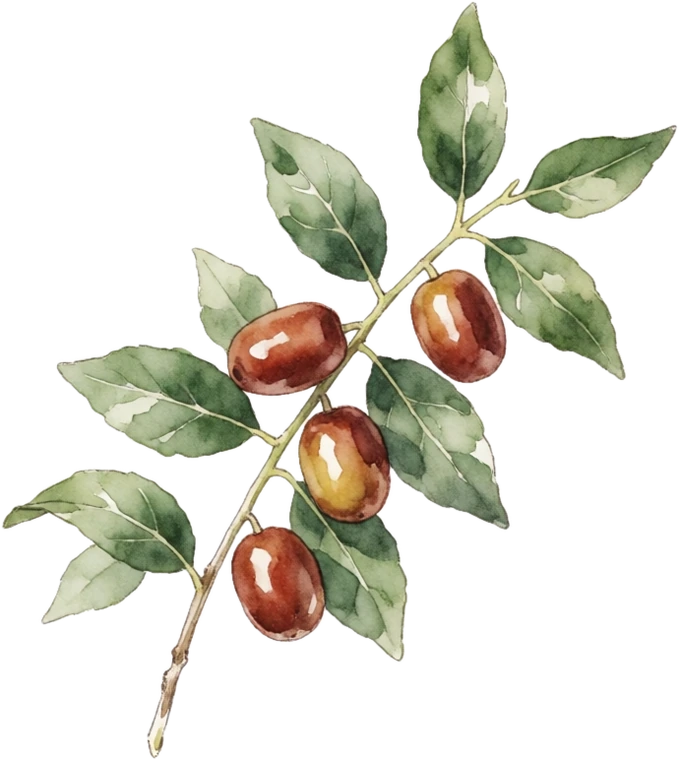
Botanical illustration of Jujube
Tree · Ziziphus jujuba

Apple-crisp texture fresh, date-sweet dried, zero spray schedule, laughs at heat and drought. The catch: thorny, and it suckers — mow around it. Fruits on current-season wood so late frosts rarely cost the crop.

TreeFull SunDrought-tolerant · low waterModerate growthExcellent edibleAttracts beesAttracts butterflies150-150 winter chill (unconfirmed)Needs a pollination partner

Where to buy the plant — 2 nurseries

I

Overview

Will jujube suit your garden, and what goes wrong.

Will it fruit where you are?

Enter your ZIP — we look up your USDA hardiness zone (2023 map) and check it against what jujube actually needs.

Hardy inZones 6-9
Winter chill150-150
Unconfirmed

Commonly quoted, but we have not traced this range to a university extension trial or another primary source, and published figures for the same plant often disagree. Chill-hour requirements were only ever established by trial for a handful of commercial fruit crops; for most species the work was never funded. Treat it as a starting point and check your local extension office before you plant on it.

PollinationPartner needed

Jujube at a glance

HardinessUSDA 6–9
Mature size15-30 ft
PollinationPartially self-fertile; two cultivars set heavier crops
Chill requirement150-150
Unconfirmed

Commonly quoted, but we have not traced this range to a university extension trial or another primary source, and published figures for the same plant often disagree. Chill-hour requirements were only ever established by trial for a handful of commercial fruit crops; for most species the work was never funded. Treat it as a starting point and check your local extension office before you plant on it.

Bloom seasonLate Spring - Early Summer (fragrant, bee-loved)
Harvest seasonSeptember - October
Growth rateModerate

Common jujube problems

  • Almost none in the US
  • Almost none — the low-spray fruit tree
  • Poor pollination → low fruit set (plant a partner)

II

Growing

Light, water, soil, propagation and the season’s jobs.

How to grow jujube: light, water & soil

LightFull Sun
WaterLow once established — famously drought-proof
SoilAdaptable, well-drained; thrives where other fruit fails · pH 6.0 - 8.0
FertilizerLight compost in spring; overfeeding = suckers
PruningLate Winter — Minimal — remove suckers (it suckers enthusiastically) and crossing wood.
Spacing10-15 ft

How to plant & propagate jujube

PropagateGrafted, or from cuttings/layering (seed won't come true)

The jujube growing playbook

Field-tested instructions for every job jujube asks of you, compiled from university extension guidance — in the order the season brings them.

Watering

Keep water on the tree through fruit sizing

Once fruit has set and is sizing, irrigate through the summer instead of letting the tree ride out the dry spell. Drip irrigation and microsprinklers are both effective ways to deliver it and can double as fertigation (UF/IFAS HS1477). Newly planted trees, bare-root ones especially, need water two or three times a week until they are established. Jujube shrugs off drought, which is exactly why growers under-water it. NMSU is direct about the tradeoff: the plants are quite tolerant to drought, but for a premium fruit set and yield the trees still need to be irrigated in a semiarid climate. The tree survives either way; the crop does not.

Feeding

Spring nitrogen, measured off the trunk diameter

As growth begins in spring, apply 0.2 lb of actual nitrogen per inch of trunk diameter in a single application, up to a maximum of 1.0 lb per tree. First and second year trees do better on three smaller doses, a third of the total each month across the first three months of growth. Nitrogen is the nutrient jujube actually responds to, and scaling the rate to trunk diameter sizes the dose to the tree instead of guessing at it. Rate and split-application schedule are from Texas A&M AgriLife.

Do not fertilize a newly planted tree until it has leafed out (NMSU H-330, https://pubs.nmsu.edu/_h/H330/). Avoid heavy applications of quick-release nitrogen, which push leafy growth and increase fruit drop at the expense of the crop (UF/IFAS HS1477, https://ask.ifas.ufl.edu/publication/HS1477). Neither caution appears on the Texas A&M page that carries the fertilizer rate.

Pruning

Winter pruning: open the canopy but spare the fruiting spurs

Prune while the tree is dormant and leafless. Take out dead, damaged, weak, and competing branches with thinning cuts back to their base, and keep the center open on upright varieties so you can reach the fruit. Leave the short stubby fruiting spurs alone, and shorten secondary shoots to one or two nodes only where you want more branching. Jujube fruit hangs on deciduous branchlets that grow fresh each spring from permanent fruiting spurs on the secondary shoots, so a spur you cut off in winter is a crop you will not pick. One heading cut on a primary shoot stops its extension and turns the tree toward fruiting, while two cuts sprout new primary growth and expand the canopy.

Cut root suckers off at or below the soil line

Jujube throws suckers from its lateral roots, often several feet out from the trunk. Cut them off at or under ground level as soon as they appear, and keep cultivation, tilling, and digging away from the root zone. Root injury is what triggers the sprouting, so cultivating around the tree makes the problem worse rather than better. On a grafted tree the suckers come up from the rootstock, not from your named variety, so they will never bear the fruit you planted and only divert the tree's growth.

What to watch for

Scout the fruit rather than spraying a schedule

Walk the tree while the fruit is sizing and look for larval entry holes in the fruit from peach fruit moth, dark leaf spots from Alternaria, and bird or stinkbug damage. Treat only if you actually find a problem, because there is no routine spray program for this crop. Across twelve years of New Mexico trials jujube was almost disease- and pest-free, turning up only occasional peach fruit moth damage on fruit and an Alternaria alternata leaf spot at a single site. A calendar spray on this tree spends money and chemical against pests that are mostly not there.

Jujube bloom runs two months or longer and is heavily worked by honey bees, wild bees, and hover flies. Never put an insecticide on this tree while it is flowering.

Harvesting

Pick by color stage, according to what the fruit is for

For fresh eating, pick anywhere from the creamy white mature stage, when skin shifts from dark green to yellow-green and the first brown-red spots show, through to fully red but still firm. For drying varieties wait for fully red, then lay tarps under the tree and shake the branches or knock fruit down with long poles. The two uses want opposite ripeness. Fresh fruit is crisp and at its best before it softens or wrinkles, while sugar keeps loading into a drying cultivar right up to full red, so picking a drying variety early costs you the sweetness that made it worth drying.

Cool the fresh fruit, and dry the drying fruit fast

Fresh fruit picked at first ripe holds two weeks or more at 40F without losing quality. If you are drying and your climate is humid, harvest at fully red and get the fruit into a dryer immediately rather than letting it hang. Letting jujube dry on the tree works in desert air but fails in a humid climate, where yeast and mold infect the fruit before it can ever dry down.

III

The year

What jujube asks for, month by month.

The jujube year, month by month

MonthJanFebMarAprMayJunJulAugSepOctNovDec
Bloom
Prune
Harvest

What each band means

  • Bloomflowers open — pollinators working, frost on blossoms is the danger.
  • Pruneshape it now — cuts heal cleanly and structure is visible.
  • Harvestpicking time — check ripeness every few days.

The jujube year as text

  • Jan quiet month
  • Feb pruning
  • Mar pruning
  • Apr quiet month
  • May bloom
  • Jun bloom
  • Jul quiet month
  • Aug quiet month
  • Sep harvest
  • Oct harvest
  • Nov quiet month
  • Dec quiet month

These are the species' typical months — expect them a few weeks earlier in warm zones and later in cold ones. Watch the plant, not just the calendar.

IV

Ecology & uses

What it does for the garden, and what it is grown for.

Jujube in the garden system

  • Understory layer tree
AttractsBees, Birds, Butterflies
MoistureUpland / dry
DeerBrowsed — protect young plants
OriginIntroduced

What jujube is grown for

✓ Commonly eaten

UseFresh eating
UseDrying
UseLow-input orchards
Edible value4/5

Harvesting & storing jujube

September - October.

Edibility, identification, and traditional-use notes here are general reference — not medical or veterinary advice, and not a claim that any plant treats or prevents anything. Medicinal ratings record how strongly a plant features in herbal tradition, nothing more. Never eat or dose a plant you have not positively identified. More on how to use this library.

V

Cultivars

Named varieties of jujube, ruled as a catalogue.

Best jujube varieties & cultivars

14 on file

Named varieties of jujube differ in winter-chill needs, ripening time, hardiness, and whether they set fruit on their own — pick one that fits your climate.

Li · Li Jujube, Ta-Jujube

Partly self-fertile
Chill100–200 hrsRipensLate Aug-SeptZones6-9Diseaseexcellent (few pest/disease issues)Size10-15 ft small tree, nearly thornless
Pollinationself-fruitful; sets more and larger fruit with a second variety (e.g. Lang or Honey Jar)

large round, apple-crisp, sweet, best fresh — The standard beginner jujube: large fruit, self-fertile in NMSU trials (cross-pollination still improves set/size), and the most widely sold variety.

Where to buy ‘Li

Story Thyme Farms may earn a small commission from these links, at no cost to you — it never changes what we recommend.
Lang · Lang Jujube

Needs a pollinizer
Chill100–200 hrsRipensSept-OctZones6-9Diseasegood (can split fruit in wet weather)Size12-18 ft upright tree
Pollinationpoor self-pollinator; needs a pollinizer such as Li or Honey Jar for a good crop

large pear-shaped, best dried — The classic drying jujube and Li's traditional partner. NMSU trials found it set no fully developed seed on its own, so plant a pollinizer nearby.

Where to buy ‘Lang

Story Thyme Farms may earn a small commission from these links, at no cost to you — it never changes what we recommend.

Honey Jar · Honey Jar Jujube

Partly self-fertile
Chill100–200 hrsRipensAug-SeptZones5-10DiseaseexcellentSize8-12 ft compact tree
Pollinationlargely self-fruitful; a second variety boosts yield

small, extremely sweet and crisp, best fresh — Widely rated the best fresh-eating jujube for flavor; very precocious (can fruit the planting year), though fruit is small.

Where to buy ‘Honey Jar

Story Thyme Farms may earn a small commission from these links, at no cost to you — it never changes what we recommend.

GA-866 · GA866, GA 866, Georgia 866

Partly self-fertile
Chill150–250 hrsRipensSept-OctZones5-10DiseaseexcellentSize12-18 ft tree
Pollinationself-fruitful but crops better with a pollinizer

very large, elongated, exceptionally high sugar, good fresh and dried — One of the sweetest jujubes with very large fruit, but it is slow to come into bearing and ripens mid- to late-season, needing a long hot season to finish.

Where to buy ‘GA-866

Story Thyme Farms may earn a small commission from these links, at no cost to you — it never changes what we recommend.

Sugar Cane · Sugarcane Jujube

Needs a pollinizer
Chill150–400 hrsRipensSeptZones6-9DiseasegoodSize10-15 ft, spiny/thorny
Pollinationneeds a pollinizer variety (e.g. Li) plus bee activity; not reliably self-fruitful per NMSU

small-medium, very sweet and crunchy, fresh and dried — Intensely sweet and productive, but NMSU reports it requires pollenizers and bee activity, so pair it with another jujube. Notably thorny, so site it away from paths. (Some nurseries market it as self-fruitful; treat that as uncertain.)

Where to buy ‘Sugar Cane

Story Thyme Farms may earn a small commission from these links, at no cost to you — it never changes what we recommend.

So · So Jujube, Contorted Jujube

Partly self-fertile
Chill100–200 hrsRipensSeptZones6-9DiseasegoodSize8-12 ft with ornamental contorted, zigzagged branches
Pollinationself-fruitfulness not well documented; plant a second variety to be safe

medium, sweet-tart balance, fresh and dried — Grown as much for its ornamental contorted/zigzag branching as its fruit. Its self-fertility is not confirmed by extension sources, so a pollinizer is recommended.

Where to buy ‘So

Story Thyme Farms may earn a small commission from these links, at no cost to you — it never changes what we recommend.

Sherwood · Sherwood Jujube

Partly self-fertile
Chill100–200 hrsRipensOctZones6-9DiseasegoodSize15-20 ft, nearly thornless, upright narrow tree
Pollinationself-fruitful; benefits from a second variety

large, firm, sweet apple-like, fresh and dried — Large, firm late-season fruit on an almost thornless upright tree, ideal where handling thorns is a concern. Slow to come into heavy bearing (often 7-10 years).

Where to buy ‘Sherwood

Story Thyme Farms may earn a small commission from these links, at no cost to you — it never changes what we recommend.

Shanxi Li · Shan Xi Li, Pear Jujube

Partly self-fertile
Chill100–200 hrsRipensSept-OctZones6-9DiseaseexcellentSize12-18 ft tree
Pollinationself-fruitful in NMSU trials; cross-pollination increases fruit size

very large, crisp and sweet; good fresh and a traditional drying jujube — Produces some of the largest fruit and was self-fertile and productive in NMSU trials, though crop size improves with a partner. A classic Chinese drying variety as well as fresh.

Where to buy ‘Shanxi Li

Story Thyme Farms may earn a small commission from these links, at no cost to you — it never changes what we recommend.
Sugarcane · Coco

Needs a pollinizer
RipensEarly to midseasonZones6-9SizeSpreading tree, dense canopy, spiny

Sweet, 25 to 30 Brix — Midsize ovoid fruit at 9 to 11.5 g with reddish-brown skin, from Nikita Botanical Garden in Ukraine. Very good both fresh and dried, with medium to high yields. NMSU notes this one needs pollenizer cultivars and bee activity to set a good crop, so do not plant it by itself. The canopy is dense and genuinely thorny.

Where to buy ‘Sugarcane

Story Thyme Farms may earn a small commission from these links, at no cost to you — it never changes what we recommend.

GA866 · GA 866

RipensLateZones6-9SizeVery upright tree with few branches on the trunk

The sweetest jujube tested by NMSU, 36 to 39.5 Brix — Midsize elongated fruit at 15 to 18 g, sometimes slightly curved with a tapered stigma end, from the Chico Plant Introduction Station in California (William Ackerman, parentage unknown). Mainly fresh but also good dried. NMSU rates it 'not precocious, nor productive for young trees' with medium yields; UF/IFAS adds that trees 'are reported to not bear well until well-established in about 8-10 years' (https://ask.ifas.ufl.edu/publication/HS1477), so this is a patience cultivar. Its late ripening needs a long season to finish.

Where to buy ‘GA866

Story Thyme Farms may earn a small commission from these links, at no cost to you — it never changes what we recommend.

Sihong · Si-Hong

RipensMid to lateZones6-9SizeHigh vigor tree with plenty of branches

Very sweet, 34 to 36.8 Brix — Medium to large ovoid fruit at 14.8 to 17.9 g with attractive brown-red skin, from Sihong County, Jiangsu Province, imported by R. Meyer via Nanjing Botanical Garden, released 1995. NMSU rates it excellent for fresh eating AND excellent for drying, which is rare, and dried fruit shows fine surface wrinkles. Yields are only moderate. UF/IFAS adds that it is 'considered by many to have the best flavor' and is precocious (https://ask.ifas.ufl.edu/publication/HS1477). NMSU states no ripening season for this cultivar, so the mid-to-late window is approximate.

Where to buy ‘Sihong

Story Thyme Farms may earn a small commission from these links, at no cost to you — it never changes what we recommend.

Dongzao · Winter Delight

RipensLateZones7-9SizeMidsize bushy tree with plenty of branches

Sweet, crisp, juicy with a melting texture, 30 to 36 Brix — Midsize fruit at 12 to 13 g in northern New Mexico and 14 to 17 g further south, from Shandong and Hebei Provinces. NMSU rates it the best fresh-eating quality of all, but it is not precocious and yields only medium without cultural intervention. Rated for USDA Zone 7 and higher, and its late ripening needs a long season to finish.

Where to buy ‘Dongzao

Story Thyme Farms may earn a small commission from these links, at no cost to you — it never changes what we recommend.

Alcalde #1 · Qiyuexian

Partly self-fertile
RipensEarlyZones6-9SizeCompact tree, moderate to weak vigor

Good, 28.9 to 32.3 Brix at full red — Large shiny dark red ovoid fruit at 25 to 30 g, from Northwest A&F University, Shaanxi, released 2003. Good fresh and also usable for drying, with medium yields on a relatively small tree. NMSU lists it as self-fertile and specifically recommends it for marginal regions with short growing seasons, since it ripens early.

Where to buy ‘Alcalde #1

Story Thyme Farms may earn a small commission from these links, at no cost to you — it never changes what we recommend.

Russian 2 · Black Sea

RipensEarlyZones6-9SizeCompact tree, productive

Excellent fresh quality, 30 to 33 Brix — Small ovoid fruit at 6 to 7 g with dark brown-red skin, from Nikita Botanical Garden in Ukraine and imported by James Gilbert. A home-garden cultivar rather than a commercial one because of fruit size. NMSU recommends it for marginal regions with short growing seasons on the strength of its early ripening on a compact, productive tree.

Where to buy ‘Russian 2

Story Thyme Farms may earn a small commission from these links, at no cost to you — it never changes what we recommend.

VI

Sources & plant ID

Where the care distinctions come from, and how the plant is filed.

Research basis

Sources behind this profile

No extension citations are attached to jujubeyet. The care figures below come from the library's own catalogue rather than a traced primary source.

Plant ID

BinomialZiziphus jujuba
FamilyRhamnaceae
TypeTree · Perennial
USDA symbolZIJU
OriginIntroduced
Invasive riskLow

VII

Where to buy

Third-party nurseries — not Story Thyme Farms.

Third-party nurseries, not Story Thyme Farms. Prices are theirs.

Story Thyme Farms may earn a small commission from these links, at no cost to you — it never changes what we recommend.

Jujube needs a pollination partner — plant two genetically distinct trees (two different cultivars, or a cultivar plus a seedling).

VIII

Questions

Jujube questions, answered straight.

Why isn't my jujube fruiting?

Most often: it has no genetically distinct partner nearby. Jujube is only partly self-fertile, so a lone plant sets a light crop at best — partially self-fertile; two cultivars set heavier crops. Plant a second, unrelated one nearby; two different cultivars, or a cultivar plus a seedling, is the classic pairing.

Will jujube fruit in a warm-winter climate?

Jujube needs roughly 150-150 hours of winter chill (hours between 32–45°F) to break dormancy and set fruit. That range is commonly quoted but we have not traced it to a university extension trial, and published figures for this plant disagree — treat it as a starting point and check your local extension office. Mild-winter growers should count their chill hours before planting.

Is jujube safe for kids and pets?

Jujube is commonly eaten and isn't considered toxic, but "commonly eaten" isn't a guarantee for any particular person or animal — allergies, quantity, and which part you eat all matter. Never eat a plant you haven't positively identified, and check with a vet before letting pets or livestock graze anything new.

When do you harvest jujube?

September - October.

IX

Elsewhere

Where jujube sits in the library.