The illustrated growing guide

Loquat

Eriobotrya japonica

Family Rosaceae

Est. zones 8-10

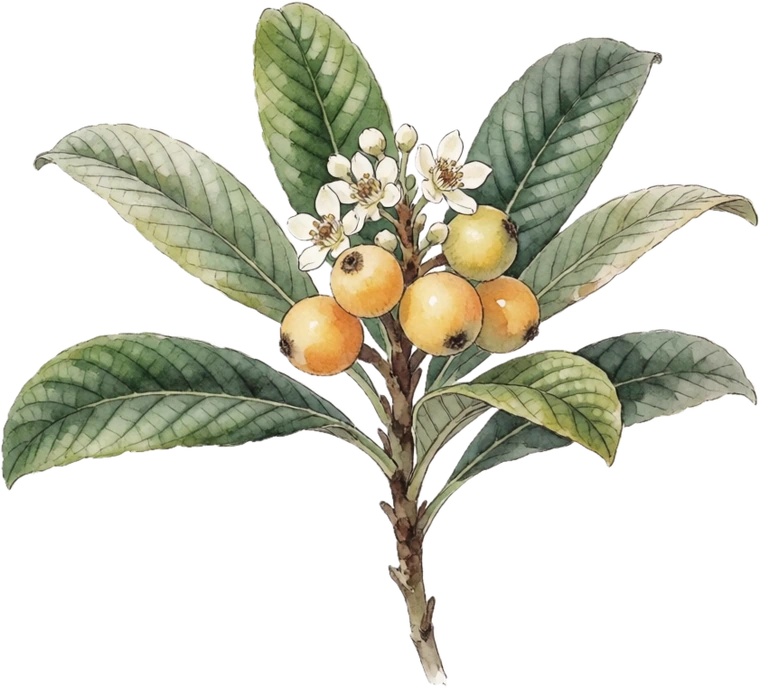
Botanical illustration of Loquat
Tree · Eriobotrya japonica

Blooms in November, fruits in April — which is why zone 7 gets a gorgeous evergreen and zone 9 gets fruit. Apricot-honey flavor worth coastal envy.

TreeFull SunModerate waterModerate growthExcellent edibleSalt-tolerantAttracts beesAttracts hummingbirdsNone winter chill

Where to buy the plant — 1 nursery

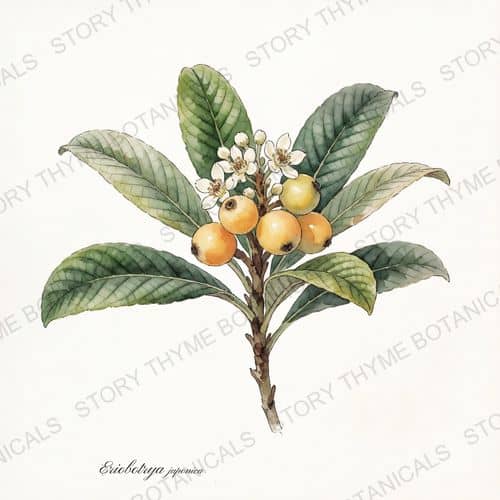
Loquat — a print from the Orchard Vol. 2 collection

From the print shop

Growing loquat? Hang it.

Our Orchard Vol. 2 collection carries loquatEriobotrya japonica, print Nº 8, “Loquat.”

16 designsfrom $21.99white or black groundmatte poster, unframed

Shop Orchard Vol. 2 botanical prints →

I

Overview

Will loquat suit your garden, and what goes wrong.

Will it fruit where you are?

Enter your ZIP — we look up your USDA hardiness zone (2023 map) and check it against what loquat actually needs.

Hardy inZones 8-10
Winter chillNone
PollinationSelf-fertile

Loquat at a glance

HardinessUSDA 8–10
Mature size15-25 ft
PollinationSelf-fertile (better with two)
Chill requirementNone (not chill-dependent)
Bloom seasonFALL-WINTER (the odd one out) — fragrant
Harvest seasonMarch - May where winters allow
Growth rateModerate

Common loquat problems

II

Growing

Light, water, soil, propagation and the season’s jobs.

How to grow loquat: light, water & soil

LightFull Sun
WaterModerate
SoilWell-drained loam · pH 6.0 - 7.0
FertilizerLight citrus-style feeding 3x/year in fruiting climates
PruningAfter harvest — Open center; thin fruit clusters to 4-5 for size.
Spacing15 ft

How to plant & propagate loquat

PropagateGrafted, or from cuttings/layering (seed won't come true)

When to spray loquat

Growing season. Watch fireblight in bloom-time warmth.

The loquat growing playbook

Field-tested instructions for every job loquat asks of you, compiled from university extension guidance — in the order the season brings them.

Mulching

Keep a mulch ring, held back off the trunk

Maintain a 2 to 6 inch layer of bark, wood chips or similar mulch out under the canopy, and keep it pulled back 8 to 12 inches from the trunk. Top it up as it breaks down. Mulch holds soil moisture through the dry stretches while the tree is filling fruit, and it keeps turf and the mowers and trimmers that follow turf away from the trunk. Piled against the bark instead, it holds the trunk wet and invites rot.

Feeding

Feed once the crop is off, and keep the nitrogen modest

With the crop picked, give a bearing tree a complete fertilizer such as 6-6-6, 8-3-9 or similar material. This is the summer feeding in a bearing tree's schedule of two to three applications a year: one just before or at the fall bloom, one in March while the crop is still on, and this one after harvest. Let a soil test set the rate instead of guessing high. A bearing loquat is fed two to three times a year, and the post-harvest feeding rebuilds the tree after a crop it carried all winter. Keep the rate honest: excessive nitrogen pushes soft, succulent new growth, and succulent shoots are exactly what fire blight infects most readily.

Thinning

Thin each panicle to 4 to 10 fruits

Once fruit have set and are still small, hand-thin each fruiting panicle down to four to ten fruits, pulling the smallest, the misshapen and the ones wedged tight against a neighbor. An obviously overloaded cluster can be thinned back at the flower stage instead. A loquat panicle sets far more fruit than it can ever fill, and the fruit compete for the same sugar. Thinning to four to ten increases the size of what remains by 25 to 100 percent.

Pruning

Prune for height and cut out fire blight strikes after harvest

With the crop picked, bring the tree back to a working height of 6 to 12 ft and thin the canopy so air moves through it. Cut every blackened, blighted shoot 12 to 18 inches back into clean wood, and disinfect the shears between cuts. On trees in their first year or two, tip any shoot longer than 2 to 3 ft to force it to branch. Where winter cold damages loquats, hold off pruning until new shoots emerge so you can see what actually survived. This is the window between harvest and the fall bloom, so you are shaping the tree without cutting off the flower buds that carry next year's crop. Cutting blight well below the visible edge is the only way to get ahead of bacteria that have already travelled down the shoot past the blackening.

Disinfect between every cut, not just between trees - the shears themselves are how fire blight gets carried from a strike into healthy wood.

What to watch for

Fire blight: watch the blossoms while they are open

While the tree is flowering, check the clusters after every warm rain for blossoms that wilt, blacken and then hang on the shoot instead of dropping. Mark every strike you find so you can cut it out after harvest. Do not reach for an insecticide here - the bees working those flowers are not a problem you can spray away. Fire blight bacteria move in rain and on insect visitors including bees, ants and flies, and the open flower is the doorway. From there the infection runs downward into the shoot and on into larger wood, which is why blighted growth blackens from the top down.

Never apply an insecticide to a tree in bloom.

Protection

Protect the crop through winter freezes

Loquat carries its flowers and swelling fruit straight through the cold months, so track the forecast and cover a small tree, or run a heat source under it, whenever a night below 27 F is coming. Siting matters more than any blanket: a tree in a courtyard or against a south-facing wall rides out the same freeze that strips one standing in the open. The wood itself is hardy down to roughly 8 to 12 F, but flowers and developing fruit are killed at 27 F - so a freeze can take the entire crop and leave you looking at a tree that appears perfectly healthy.

Bag the fruit panicles where fruit flies are established

Right after thinning, slip a paper bag over each entire fruiting panicle and close it around the stem, then leave the bags on until you pick. This is worth the work mainly in areas where the Caribbean fruit fly is present, such as peninsular Florida. Paper bagging the whole panicle is the recommended defense against the Caribbean fruit fly, which stings developing fruit and ruins it from inside; the bag also shelters the fruit and brings the panicle along somewhat faster.

Harvesting

Pick at full color - loquat does not ripen off the tree

Wait until fruit reaches nearly full to full color, then taste one or two from the tree before you strip a cluster; the color your particular tree tastes right at is the color to pick at from then on. Ripe fruit refrigerated in a plastic bag holds for several weeks. No further ripening happens once a loquat is picked, so fruit taken early stays sour permanently - there is no windowsill fix. The wait is long: after bloom, fruit takes four to five months to ripen in the spring, so let it finish on the branch.

III

The year

What loquat asks for, month by month.

The loquat year, month by month

MonthJanFebMarAprMayJunJulAugSepOctNovDec
Bloom
Prune
Harvest

What each band means

  • Bloomflowers open — pollinators working, frost on blossoms is the danger.
  • Pruneshape it now — cuts heal cleanly and structure is visible.
  • Harvestpicking time — check ripeness every few days.

The loquat year as text

  • Jan bloom
  • Feb bloom
  • Mar harvest
  • Apr harvest
  • May harvest
  • Jun quiet month
  • Jul pruning
  • Aug pruning
  • Sep bloom
  • Oct bloom
  • Nov bloom
  • Dec bloom

These are the species' typical months — expect them a few weeks earlier in warm zones and later in cold ones. Watch the plant, not just the calendar.

IV

Ecology & uses

What it does for the garden, and what it is grown for.

Loquat in the garden system

  • Understory layer tree
AttractsBees, Hummingbirds
HabitatCoastal
MoistureFacultative / average
SaltSalt-tolerant — fine near roads and coasts
DeerBrowsed — protect young plants
OriginIntroduced

What loquat is grown for

! Some parts toxic — see notesSeeds toxic — don't eat them

UseFresh
UseJam
UseEvergreen landscaping
Edible value4/5

Harvesting & storing loquat

March - May where winters allow.

Edibility, identification, and traditional-use notes here are general reference — not medical or veterinary advice, and not a claim that any plant treats or prevents anything. Medicinal ratings record how strongly a plant features in herbal tradition, nothing more. Never eat or dose a plant you have not positively identified. More on how to use this library.

V

Cultivars

Named varieties of loquat, ruled as a catalogue.

Best loquat varieties & cultivars

13 on file

Named varieties of loquat differ in winter-chill needs, ripening time, hardiness, and whether they set fruit on their own — pick one that fits your climate.

Big Jim

Self-fertile
RipensMarch-AprilZones8-11Diseasemoderate; watch for fire blightSizestandard, upright 15-20 ft

large juicy fruit, sweet with mild acidity, excellent fresh — A California-bred loquat (not the nectarine of the same name) with some of the largest, best-flavored fruit; self-fertile, so a strong single-tree choice, though a second variety boosts crop size.

Where to buy ‘Big Jim

Story Thyme Farms may earn a small commission from these links, at no cost to you — it never changes what we recommend.
Gold Nugget · Thales, Placentia

Self-fertile
RipensApril-May (late)Zones8-11DiseasemoderateSizestandard, vigorous upright 15-25 ft

firm orange flesh, sweet and apricot-like, holds well on the tree — Self-fertile and late-ripening (UF/IFAS and CRFG), so it extends the season and needs no pollinizer partner. Commonly listed under the synonyms Thales and Placentia.

Where to buy ‘Gold Nugget

Story Thyme Farms may earn a small commission from these links, at no cost to you — it never changes what we recommend.

Champagne

Needs a pollinizer
RipensLate spring (May)Zones8-11DiseasemoderateSizestandard, 15-20 ft with long narrow leaves
Pollinationneeds a second variety

melting, very juicy white-to-yellow flesh, mild subacid to sweet, prized for eating — Outstanding melting-flesh flavor but self-infertile (confirmed by UF/IFAS), so plant a second loquat nearby for any crop.

Where to buy ‘Champagne

Story Thyme Farms may earn a small commission from these links, at no cost to you — it never changes what we recommend.

Advance

Needs a pollinizer
RipensMarch-AprilZones8-11Diseasegood (noted fire-blight resistance)Sizenatural dwarf, just over 5 ft
Pollinationneeds a second variety; also a good pollinizer

cream flesh, sweet-tart, very good flavor — A naturally dwarf, highly fire-blight-resistant tree ideal for small yards; self-infertile per UF/IFAS and serves best as a pollinizer for other loquats (notably nearly doubling Tanaka's yield).

Where to buy ‘Advance

Story Thyme Farms may earn a small commission from these links, at no cost to you — it never changes what we recommend.

Tanaka

Partly self-fertile
RipensMay (very late)Zones8-11DiseasemoderateSizestandard, ~10-20 ft
Pollinationpartly self-fertile; better with a pollinizer

very large firm fruit, rich aromatic orange flesh, subacid to sweet — One of the latest and largest-fruited loquats and among the more cold-tolerant; only partly self-fertile, with yields improving markedly when pollinated by another variety such as Advance.

Where to buy ‘Tanaka

Story Thyme Farms may earn a small commission from these links, at no cost to you — it never changes what we recommend.

Early Red

Self-fertile
RipensLate winter (Feb-March)Zones8-11DiseasemoderateSizestandard, upright 15-20 ft

orange-red skin dotted white, juicy sweet orange flesh — Documented as self-fertile; among the earliest to ripen, giving fruit in late winter and useful for spreading harvest when paired with a late variety.

Where to buy ‘Early Red

Story Thyme Farms may earn a small commission from these links, at no cost to you — it never changes what we recommend.

MacBeth · McBeth

Partly self-fertile
RipensApril-MayZones8-11DiseasemoderateSizestandard, often stays smallish 8-15 ft
Pollinationself-fertility not documented; plant a second variety to be safe

very large fruit, sweet mild flavor with apricot/plum notes — A real, large-fruited selection (UF/IFAS) that has performed well in the humid Gulf South (LSU AgCenter), a good pick for southeastern growers. Its self-fertility is not documented by extension sources, so pairing with a second loquat is the safe assumption.

Where to buy ‘MacBeth

Story Thyme Farms may earn a small commission from these links, at no cost to you — it never changes what we recommend.

Wolfe

Partly self-fertile
RipensMarch-May (mid to late)Zones8-11Diseasenot documented; loquat generally susceptible to fire blightSizestandard, 15-25 ft
Pollinationself-fertility not documented for this cultivar; plant a second loquat to be safe

sweet-tart with a spicy note, good flavor; light yellow peel over white to pale orange flesh — Large-fruited with only 1-2 seeds, so there is a lot of flesh per fruit, and UF/IFAS recommends it for the home landscape. Like all loquats it needs no winter chill - the limit on growing it is whether your winter stays above 27 F while the fruit hangs.

Where to buy ‘Wolfe

Story Thyme Farms may earn a small commission from these links, at no cost to you — it never changes what we recommend.

Oliver

Partly self-fertile
RipensMarch-May (mid to late)Zones8-11Diseasenot documented; loquat generally susceptible to fire blightSizestandard, 15-25 ft
Pollinationself-fertility not documented for this cultivar; plant a second loquat to be safe

very sweet, good flavor; orange peel over pale orange pulp — Rated very sweet by UF/IFAS and recommended for home planting, with just 1-2 seeds in a medium to large fruit. A good pick if you want the sweetest fresh-eating loquat rather than the subacid types.

Where to buy ‘Oliver

Story Thyme Farms may earn a small commission from these links, at no cost to you — it never changes what we recommend.
Emanuel

Partly self-fertile
RipensMarch-April (mid-season)Zones8-11Diseasenot documented; loquat generally susceptible to fire blightSizestandard, 15-25 ft
Pollinationself-fertility not documented for this cultivar; plant a second loquat to be safe

mildly sweet, good flavor; dark yellow-orange skin and flesh — A medium to large, deep-colored mid-season fruit that UF/IFAS recommends for the home landscape. Ripening in the March-April middle of the season, it pairs well with a mid-to-late cultivar such as Wolfe or Oliver to stretch the picking window into May.

Where to buy ‘Emanuel

Story Thyme Farms may earn a small commission from these links, at no cost to you — it never changes what we recommend.

Thursby

Partly self-fertile
RipensMarch-May (mid to late)Zones8-11Diseasenot documented; loquat generally susceptible to fire blightSizestandard, 15-25 ft
Pollinationself-fertility not documented for this cultivar; plant a second loquat to be safe

mildly sweet-tart, good flavor; dark yellow-orange peel over dark yellow flesh — Fruit runs small to medium with 2-3 seeds, so it is less of a fresh-eating showpiece than Wolfe, but the sweet-tart balance makes it one of the better loquats for preserves and it is UF/IFAS-recommended for home planting.

Where to buy ‘Thursby

Story Thyme Farms may earn a small commission from these links, at no cost to you — it never changes what we recommend.

Judith

Partly self-fertile
RipensMarch-April (mid-season)Zones8-11Diseasenot documented; loquat generally susceptible to fire blightSizestandard, 15-25 ft
Pollinationself-fertility not documented for this cultivar; plant a second loquat to be safe

mild and sweet; dark yellow-orange skin and flesh — A small to medium mid-season fruit, mild and sweet, recommended by UF/IFAS for the home landscape. Availability is mostly through Florida nurseries.

Where to buy ‘Judith

Story Thyme Farms may earn a small commission from these links, at no cost to you — it never changes what we recommend.

SES #1

Partly self-fertile
RipensMarch-May (mid to late)Zones8-11Diseasenot documented; loquat generally susceptible to fire blightSizestandard, 15-25 ft
Pollinationself-fertility not documented for this cultivar; plant a second loquat to be safe

sweet and distinctly apple-like, good flavor; yellow peel over white flesh — A medium to large white-fleshed selection with an unusual apple-like flavor, 1-2 seeds, and a UF/IFAS recommendation for home planting. It is a numbered selection rather than a widely marketed name, so expect to hunt for a source.

Where to buy ‘SES #1

Story Thyme Farms may earn a small commission from these links, at no cost to you — it never changes what we recommend.

VI

Sources & plant ID

Where the care distinctions come from, and how the plant is filed.

Research basis

Sources behind this profile

No extension citations are attached to loquatyet. The care figures below come from the library's own catalogue rather than a traced primary source.

Plant ID

BinomialEriobotrya japonica
FamilyRosaceae
TypeTree · Perennial
USDA symbolERJA3
OriginIntroduced
Invasive riskLow

VII

Where to buy

Third-party nurseries — not Story Thyme Farms.

Third-party nurseries, not Story Thyme Farms. Prices are theirs.

Story Thyme Farms may earn a small commission from these links, at no cost to you — it never changes what we recommend.

VIII

Questions

Loquat questions, answered straight.

Do I need two loquat plants to get fruit?

No — loquat is self-fertile, so a single plant will set a crop. A second one usually improves yields, but it isn't required.

Is loquat safe for kids and pets?

With care. Seeds toxic — don't eat them Site it accordingly if children or pets roam the garden. This is general reference, not medical or veterinary advice — call a vet or poison control if something has actually been eaten.

When do you harvest loquat?

March - May where winters allow.

How do you propagate loquat?

Grafted, or from cuttings/layering (seed won't come true).

IX

Elsewhere

Where loquat sits in the library.