The illustrated growing guide

Papaya

Carica papaya

Family Caricaceae

Est. zones 9-11

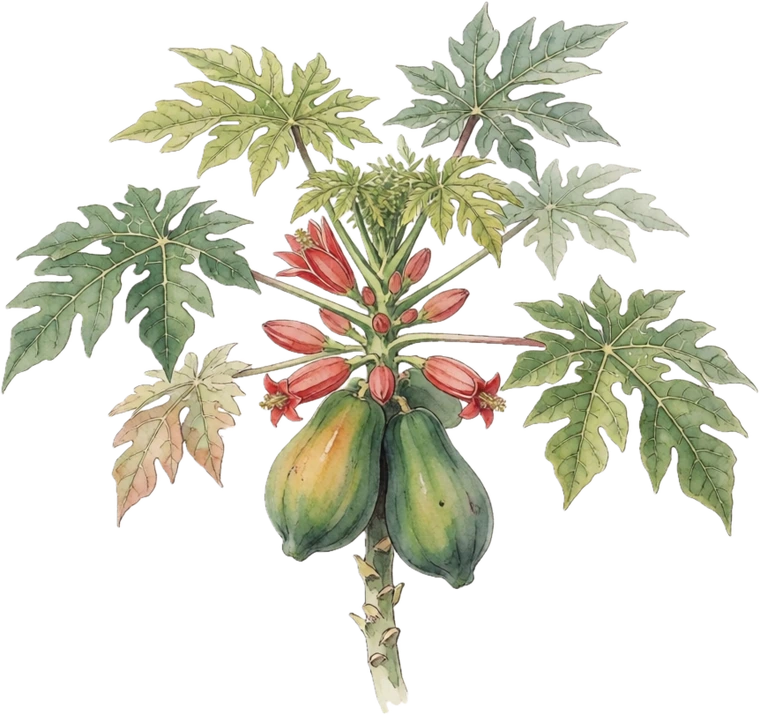
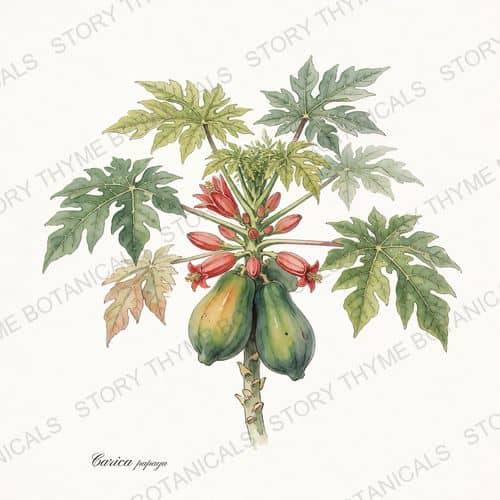
Botanical illustration of Papaya
Tree · Carica papaya

Not a tree but a giant fast herb: a spring-sown 'Red Lady' can hit 8 feet and hang fruit by fall in a hot climate or big greenhouse pot. Plant several seedlings unless the variety is self-fertile — many papayas are male or female. Ringspot virus is the reason home crops fade after a year or two.

TreeFull SunModerate waterVERY Fast growthExcellent edibleNone winter chillNeeds a pollination partner

Where to buy the plant — 2 nurseries

I

Overview

Will papaya suit your garden, and what goes wrong.

Will it fruit where you are?

Enter your ZIP — we look up your USDA hardiness zone (2023 map) and check it against what papaya actually needs.

Life cyclePerennial zones 9–11, annual elsewhere
Winter chillNone
PollinationPartner needed

Papaya at a glance

Life cyclePerennial zones 9–11, annual elsewhere
Mature size10-20 ft (really a giant herb, not wood)
PollinationOften dioecious — plant 4-5 seedlings to get a female/bisexual; 'Solo' types are self-fertile
Chill requirementNone (not chill-dependent)
Bloom seasonNearly continuous in warmth
Harvest seasonFruit ripens on the plant when skin yellows; a long warm season is essential
Growth rateVERY Fast (seed to fruit in under a year)

Common papaya problems

II

Growing

Light, water, soil, propagation and the season’s jobs.

How to grow papaya: light, water & soil

LightFull Sun
WaterModerate-High; never soggy (stem rot)
SoilRich, fast-draining · pH 6.0 - 6.5
FertilizerHeavy feeder — monthly N-rich feed
PruningNot pruned (single stem) — None — it's a single soft trunk; protect from wind.
Spacing6-8 ft

How to plant & propagate papaya

PropagateGrafted, or from cuttings/layering (seed won't come true)

When to spray papaya

Growing season. Control aphids to slow ringspot; rogue infected plants.

The papaya growing playbook

Field-tested instructions for every job papaya asks of you, compiled from university extension guidance — in the order the season brings them.

Sowing

Start seed in sterile cells once the cold is done

Sow seed about half an inch deep into individual 2 x 2 inch cells filled with sterile, well drained potting media and set them in full sun. Expect germination in 10 to 21 days. Harden the seedlings off in the nursery and move them out at about 6 weeks old, when they are 4 to 8 inches tall, after all danger of frost has passed. In cold regions you can hold seedlings in a greenhouse over winter and plant them out in spring. Papaya needs a long, unbroken warm season to reach fruit, and a plant set out too early loses it to frost. The media has to be sterile because damping-off from Pythium, Phytophthora and Rhizoctonia is what kills papaya seedlings, and used media carries those fungi in with the seed.

Planting out

Plant into full sun, sharp drainage, and soil that has never grown papaya

Pick the warmest, sunniest spot you have and dig a hole 3 to 4 times the diameter and 3 times as deep as the container the plant came in. Space plants 7 to 12 feet apart, and at least 7 to 10 feet from other plants. Staking is optional, but if you stake, never tie with wire or nylon rope, which will damage the trunk as it thickens; use a cotton or natural fiber string that degrades slowly. If papaya has grown on the ground before, add half a cubic foot of soil that has never grown papaya to each planting hole (the 'virgin soil' technique, CTAHR F&N-3). Papaya roots are killed by waterlogging in a matter of hours - CTAHR notes plants 'can be killed when subjected to puddled conditions for even a few hours'. Ground that has grown papaya before carries high levels of Phytophthora palmivora spores released as old fruit, trunk and root residue decomposes. The ring of clean soil lets the young roots get established in a fungus-free zone until they are old enough to withstand infection as they extend beyond it.

Feeding

Step up to bearing rates as soon as it flowers

Up to about 7 months old, feed a quarter pound of a complete fertilizer carrying nitrogen, phosphate, potash and magnesium every 14 days. Once the plant flowers and starts setting fruit, shift to 1 to 2 pounds every other month, and add a micronutrient blend with manganese, zinc and boron up to once a month. On acid soils correct iron with iron sulfate; on high pH soils use chelated iron in the EDDHA form. A papaya has one terminal growing point that pushes leaves, flowers and fruit at the same time all year, so it feeds continuously rather than in flushes and runs down fast if starved. Boron shortage shows up specifically as bumpy, distorted fruit with latex weeping from the surface of developing fruit.

Thinning

Read the first flowers and keep the hermaphrodite

Grow three seedlings together per spot and let them all flower, at roughly 6 months for most cultivars and about 8 months for Kapoho. When the buds open, look at the shape: a hermaphrodite flower is slender and of fairly uniform thickness, while a female flower is bulbous at the base and pointed at the tip. Keep one hermaphrodite and cut the rest off. For the UH Rainbow hybrid leave five plants per spot instead of three. Papaya seed segregates into female and hermaphrodite plants, and only the hermaphrodite carries pollen sacs and sets fruit on its own. A female left alone gives you gaps in production whenever no pollen is nearby. Standard solo cultivars segregate two hermaphrodites to one female, so keeping three seedlings gives a 97 percent chance at least one is hermaphrodite; Rainbow segregates 1:1, which is why it needs five.

What to watch for

Papaya ringspot virus: cut down infected plants, do not nurse them

Check plants through the whole growing year for yellow mottling in mosaic patterns between the veins on new leaves, leaves that are crinkled or deformed into narrow stringy lobes little wider than the veins, water-soaked or oily streaks on green stems and petioles, and ring-shaped spots on the fruit skin. Symptoms are most pronounced in cool weather and are suppressed in the heat, so do not read a clean-looking plant in midsummer as an all-clear. Destroy any plant showing these signs rather than leaving it standing, and do not let the stump regrow. Raise your own seedlings close to where they will be planted, and never carry papaya seedlings in from another region - seed is safe to move, seedlings are not. Do not plant cucurbits (watermelon, cucumber, squash, melon) near papaya. Papaya ringspot virus is the most severe papaya disease and is often the limiting factor in production worldwide. There is no cure, and an infected plant left in place is a permanent reservoir. It is spread by aphids - principally green peach aphid - which pick up the virus in seconds of feeding and carry it only a short distance for about half an hour, so nearby infected plants and nearby cucurbit hosts are what actually seed an outbreak; this is why removing the reservoir promptly and keeping alternate hosts away matters more than anything you could spray. The virus is not carried in seed, so a seedling moved from an infected area is the main way it arrives somewhere new.

CTAHR's commercial guidance is to kill aphids before roguing an infected plant so the vector does not disperse onto healthy neighbors. That is an insecticide application, and papaya flowers nearly continuously, so for a home planting it would put insecticide on open bloom - do not spray. Remove the infected plant promptly and keep cucurbit hosts away from the papaya instead.

Spraying

Anthracnose: protectant cover sprays on the fruit column

Once fruit are setting, spray mancozeb over the fruit column on a regular interval, every 2 to 3 weeks in wet weather and every 3 to 4 weeks in dry weather. A copper product tank-mixed with the mancozeb increases efficacy, and a surfactant helps the spray spread and stick. Trim off only the leaves whose petioles angle below horizontal so the spray can reach the fruit, and keep trimming to a minimum in winter. Anthracnose infects the fruit while it is green and then sits latent, erupting as sunken black rot as the fruit ripens, so by the time you see a lesion the infection happened weeks ago. Fungicides on papaya are protectants with minimal impact once the disease is established, which is why coverage and interval matter more than the product.

Mancozeb registration and pre-harvest interval for papaya differ by state and product - read the label, confirm papaya is listed on it, and follow the stated pre-harvest interval before picking. Do not add an insecticide to this mix: papaya flowers nearly continuously, so a spray aimed at the fruit column is always going out over open bloom.

Protection

Bag young fruit against papaya fruit fly

While the fruit are still small and green, slip a paper bag or a piece of paint strainer cloth over each one and secure it at the stem. Leave the bags on as the fruit sizes up. The female papaya fruit fly lays her eggs through the wall of small green fruit, and the larvae feed inside the seed cavity where nothing can reach them. The fruit yellows in patches and drops before it ever ripens. Once the eggs are in there is no remedy, so the barrier has to be on the fruit before it is attractive to her.

Save the base of the trunk when a freeze is coming

When a freeze is forecast, cover small plants completely and wrap or bank insulation around the lower portion of the trunk on plants too big to cover. Container plants and dwarf types can be moved or covered outright. Do not prune cold-damaged tissue off until warm weather returns and you can see what actually died. Papaya is damaged or killed below 31F, but a plant killed to the ground will normally throw suckers from a protected lower trunk and bear again within a year, so the trunk base is the part worth defending. Papaya also stops flowering or sets misshapen cat-faced fruit when temperatures run below 59F, which is why zone 9a and colder growers get one season out of a plant and treat it as an annual.

Harvesting

Pick at color break, but the longer it hangs the sweeter it gets

Pick once yellow covers a tenth to a third of the skin, and ripen indoors at room temperature; ripe fruit then keeps 4 to 7 days. Where fruit flies and birds allow, leave fruit on longer for better flavor. Red-fleshed Sunset and UH SunUp build sugar slowly and should hang until a quarter to half ripe, and UH Rainbow is at its best at 70 to 90 percent yellow. Handle fruit gently and pick green if you want it as a vegetable. Sugar accumulates in the fruit while it is still attached to the plant, so a papaya cut at the first blush of yellow will soften and color indoors but stays noticeably flatter tasting than one left to color further on the plant. Fruit takes about 22 weeks to mature in summer heat and about 26 weeks in cool weather, so the calendar will not tell you when - the skin will.

III

The year

What papaya asks for, month by month.

The papaya year, month by month

No fixed season calendar for papaya — its care follows conditions, not the calendar.

IV

Ecology & uses

What it does for the garden, and what it is grown for.

Papaya in the garden system

  • Understory layer tree
MoistureFacultative / average
DeerBrowsed — protect young plants
OriginIntroduced

What papaya is grown for

! Some parts toxic — see notesRipe fruit safe; unripe fruit/latex + seeds are strong — not for pregnancy

UseFresh eating
UseGreen papaya salad
UseSmoothies
Edible value4/5

Harvesting & storing papaya

Fruit ripens on the plant when skin yellows; a long warm season is essential.

Edibility, identification, and traditional-use notes here are general reference — not medical or veterinary advice, and not a claim that any plant treats or prevents anything. Medicinal ratings record how strongly a plant features in herbal tradition, nothing more. Never eat or dose a plant you have not positively identified. More on how to use this library.

V

Cultivars

Named varieties of papaya, ruled as a catalogue.

Best papaya varieties & cultivars

6 on file

Named varieties of papaya differ in winter-chill needs, ripening time, hardiness, and whether they set fruit on their own — pick one that fits your climate.

Kapoho · Kapoho Solo

Partly self-fertile
RipensFirst fruit about 14 months from planting, then continuously in warmthZones9-11SizeSmall pear-shaped solo fruit, 1 to 3 lb

High sugar, harvested at color break — Susceptible to papaya ringspot virus. Requires uniform, mild temperature and rainfall and makes small fruit under hot, dry conditions. Flowers at about 8 months, later than other solos, and takes about 14 months to first harvest. Inbred for many generations, so it reproduces true to type from seed. Seed gives female and hermaphrodite plants: hermaphrodites self-pollinate, females need a pollen source.

Where to buy ‘Kapoho

Story Thyme Farms may earn a small commission from these links, at no cost to you — it never changes what we recommend.

Waimanalo

Partly self-fertile
RipensFirst fruit about 10 to 12 months from planting, then continuously in warmthZones9-11SizeSmall pear-shaped solo fruit, 1 to 3 lb

Yellow flesh, good brix in heat and low brix where it is cool — Susceptible to papaya ringspot virus. Adapted to hot, dry locations; grown somewhere cooler it has low brix and a high incidence of carpeloidy, the cat-face fruit deformity, in winter. Shelf life is intermediate between Sunrise and Kapoho. Inbred and reproduces true to type from seed. Seed gives female and hermaphrodite plants.

Where to buy ‘Waimanalo

Story Thyme Farms may earn a small commission from these links, at no cost to you — it never changes what we recommend.

Sunrise

Partly self-fertile
RipensFirst fruit about 10 to 12 months from planting, then continuously in warmthZones9-11SizeSmall pear-shaped solo fruit, 1 to 3 lb

Red flesh, harvested at color break — Susceptible to papaya ringspot virus. Red-fleshed cultivars like this one are adapted to a wider range of climatic conditions than the yellow-fleshed cultivars. Has the shortest shelf life of the Hawaii solos and must be used promptly after picking. Inbred and reproduces true to type from seed. Seed gives female and hermaphrodite plants.

Where to buy ‘Sunrise

Story Thyme Farms may earn a small commission from these links, at no cost to you — it never changes what we recommend.

Sunset

Partly self-fertile
RipensFirst fruit about 10 to 12 months from planting, then continuously in warmthZones9-11SizeSmall pear-shaped solo fruit, 1 to 3 lb

Red flesh; brix develops slowly, so pick at quarter to half ripe rather than color break — Susceptible to papaya ringspot virus. Red-fleshed and adapted to a wide range of climatic conditions. Has the best shelf life of the Hawaii solos along with Kapoho. Because brix develops slowly, harvest should be delayed past color break to the quarter-ripe to half-ripe stage. Inbred and reproduces true to type from seed. It is the parent of the ringspot-resistant UH SunUp.

Where to buy ‘Sunset

Story Thyme Farms may earn a small commission from these links, at no cost to you — it never changes what we recommend.

UH Rainbow · Rainbow

Partly self-fertile
RipensFirst fruit about 10 to 12 months from planting, then continuously in warmthZones9-11DiseaseHighly resistant to papaya ringspot virus (genetically engineered)SizePear-shaped with a short neck to elliptical, 1 to 2 lb, averaging 1.5 lb, with 1 inch thick flesh

Sweet at 12 to 16 percent sugar, mild aroma, uniform juicy texture, yellow-orange flesh; ready to eat at 70 to 90 percent yellow — F1 hybrid of Kapoho crossed with UH SunUp, so seed saved from its fruit will not breed true and the seedlings may not be resistant to ringspot; new hybrid seed must be obtained each generation. Seed requires a license agreement with the Papaya Administrative Committee and purchasers must first attend a short orientation course; packets are available to home gardeners through CTAHR's Agricultural Diagnostic Service Center. Segregates 1:1 hermaphrodite to female, so leave five seedlings per spot when thinning rather than three.

Where to buy ‘UH Rainbow

Story Thyme Farms may earn a small commission from these links, at no cost to you — it never changes what we recommend.

UH SunUp · SunUp

Partly self-fertile
RipensFirst fruit about 10 to 12 months from planting, then continuously in warmthZones9-11DiseaseResistant to papaya ringspot virus (genetically engineered)SizeSmall pear-shaped solo fruit, 1 to 3 lb

Red flesh; brix develops slowly, so pick at quarter to half ripe rather than color break — A genetically transformed Sunset carrying engineered resistance to papaya ringspot virus, and the parent that supplies Rainbow its resistance. Like Sunset, harvest should be delayed past color break to the quarter-ripe to half-ripe stage because brix develops slowly. Seed requires a license agreement with the Papaya Administrative Committee; packets are available to home gardeners through CTAHR's Agricultural Diagnostic Service Center. Seed gives female and hermaphrodite plants.

Where to buy ‘UH SunUp

Story Thyme Farms may earn a small commission from these links, at no cost to you — it never changes what we recommend.

VI

Sources & plant ID

Where the care distinctions come from, and how the plant is filed.

Research basis

Sources behind this profile

No extension citations are attached to papayayet. The care figures below come from the library's own catalogue rather than a traced primary source.

Plant ID

BinomialCarica papaya
FamilyCaricaceae
TypeTree · Tender Perennial
USDA symbolCAPA23
OriginIntroduced
Invasive riskLow

VII

Where to buy

Third-party nurseries — not Story Thyme Farms.

Third-party nurseries, not Story Thyme Farms. Prices are theirs.

Story Thyme Farms may earn a small commission from these links, at no cost to you — it never changes what we recommend.

Papaya needs a pollination partner — plant two genetically distinct trees (two different cultivars, or a cultivar plus a seedling).

VIII

Questions

Papaya questions, answered straight.

Why isn't my papaya fruiting?

Most often: it has no genetically distinct partner nearby. Papaya can't pollinate itself — often dioecious — plant 4-5 seedlings to get a female/bisexual; 'solo' types are self-fertile. Plant a second, unrelated one nearby; two different cultivars, or a cultivar plus a seedling, is the classic pairing.

Is papaya safe for kids and pets?

With care. Ripe fruit safe; unripe fruit/latex + seeds are strong — not for pregnancy Site it accordingly if children or pets roam the garden. This is general reference, not medical or veterinary advice — call a vet or poison control if something has actually been eaten.

When do you harvest papaya?

Fruit ripens on the plant when skin yellows; a long warm season is essential.

How do you propagate papaya?

Grafted, or from cuttings/layering (seed won't come true).

IX

Elsewhere

Where papaya sits in the library.

Where papaya sits in the library

Grows in the same world