The illustrated growing guide

Sea Buckthorn

Hippophae rhamnoides

Family Elaeagnaceae

Est. zones 3-7

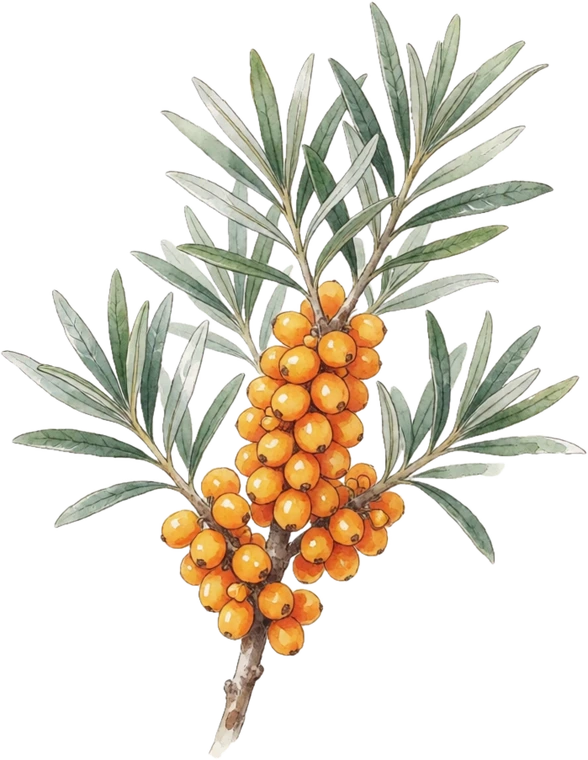
Botanical illustration of Sea Buckthorn
Shrub · Hippophae rhamnoides

Citrus-of-the-north: passionfruit-orange-juice flavor, absurd nutrition, on a nitrogen-fixing, salt-proof, -40° shrub. The freeze-and-shake harvest trick is the difference between loving and abandoning it. Windbreak + orchard fertility + superfruit in one hedge.

ShrubFull SunLow waterFast growthExcellent edibleSalt-tolerantAttracts beesNeeds a pollination partner

Where to buy the plant — 1 nursery

I

Overview

Will sea buckthorn suit your garden, and what goes wrong.

Will it fruit where you are?

Enter your ZIP — we look up your USDA hardiness zone (2023 map) and check it against what sea buckthorn actually needs.

Hardy inZones 3-7
PollinationPartner needed

Sea Buckthorn at a glance

HardinessUSDA 3–7
Mature size8-12 ft, thorny, suckering
PollinationDIOECIOUS + wind — male upwind of females
Chill requirementNot yet established
Bloom seasonApril (before leaves)
Harvest seasonSeptember - October: orange berry clusters — harvest by cutting whole fruiting twigs and FREEZING (berries then shake off; hand-picking is bloody)
Growth rateFast

Common sea buckthorn problems

  • Almost none in North America
  • Verticillium (occasional)
  • Poor pollination → low fruit set (plant a partner)

II

Growing

Light, water, soil, propagation and the season’s jobs.

How to grow sea buckthorn: light, water & soil

LightFull Sun (fruits poorly in any shade)
WaterLow — seaside/steppe constitution; fixes its own nitrogen
SoilSandy, poor, drained; salt-proof · pH 6.0 - 8.0
FertilizerNONE (nitrogen-fixer)
PruningLate Winter — Prune for picking height; expect and manage suckers (mow the perimeter).
Spacing6-8 ft; 1 male per 6-8 females

How to plant & propagate sea buckthorn

PropagateGrafted, or from cuttings/layering (seed won't come true)

The sea buckthorn growing playbook

Field-tested instructions for every job sea buckthorn asks of you, compiled from university extension guidance — in the order the season brings them.

Planting out

Plant a male: no male, no berries, ever

Sea buckthorn carries male and female flowers on entirely separate plants, so set at least one male for every 6 to 8 females when you plant the block, and put the male on the upwind side. Commercial orchards run 7 to 12 percent of the planting as males. You cannot tell sex from a seedling, so buy named, sexed nursery stock rather than seed. The flowers are pollinated by wind and gravity alone and attract no insects, so pollen has to physically blow from a male onto a female. A female with no male in the planting will flower every spring and set nothing.

Watering

Water through dry summers despite the drought reputation

Sea buckthorn wants the equivalent of 16 to 24 inches of annual precipitation. In a drier region or a dry summer, irrigate through the establishment years; on sites that reliably get that much rain, supplemental irrigation is usually unnecessary. Its deep, suckering root system earns it a drought-hardy reputation, but the plant does not actually tolerate sustained dry conditions and yields fall off on moisture-short sites.

Feeding

Skip the nitrogen: this shrub makes its own

Do not apply nitrogen fertilizer to sea buckthorn. If a soil test shows phosphorus is genuinely low, phosphorus is the one nutrient the plant does respond to; otherwise feed it nothing and let it be. Sea buckthorn fixes its own atmospheric nitrogen through root nodules, and applied nitrogen can adversely affect that nodulation, so a nitrogen feed can leave the plant worse off than no feed at all.

Pruning

Dormant pruning: hold the shrub to about six feet

While the plant is leafless and dormant, cut it back to roughly six feet and open the center so light reaches the interior. Remove the dead lower branches that the shrub sheds on its own as it fills in. Left alone, sea buckthorn shades out its own lower wood and the bottom branches die, pushing the fruit up out of reach. Holding the plant near six feet improves light penetration and makes an already brutal harvest possible.

The shrub produces long, extremely sharp spines that make a mature hedge nearly impenetrable. Wear leather gauntlets and eye protection before reaching into the canopy.

What to watch for

Scout for Japanese beetle on the summer foliage

Walk the planting through summer and check the upper foliage for skeletonized leaves and clustered adult beetles. Hand-pick or knock beetles into soapy water in the morning while they are sluggish. Also look for aphids, mites, and green fruitworm on new growth. Sea buckthorn is very resistant to pests overall, but adult Japanese beetles actively prefer it and will work an isolated planting hard because there is little else competing for their attention.

Watch young plants for Verticillium wilt

Check young plants for branches that wilt, yellow, and die back while the rest of the shrub looks fine. Pull and destroy plants that collapse, and do not replant sea buckthorn into that spot. Before planting a new block, find out whether the ground has a history of Verticillium wilt, and if it does, plant somewhere else. Verticillium dahliae is the wilt that actually kills sea buckthorn: it has caused mortality of young trees where the shrub was planted into soil with a history of the disease. Fusarium species are also recorded on the crop as damping-off and wilt agents. These fungi live in the soil for years, so site selection is the control, not a rescue treatment.

There is no effective fungicide rescue for an established soil-borne wilt. Remove and destroy affected plants rather than spraying.

Harvesting

Harvest by cutting fruiting branches and freezing them

When the berries color up, cut whole fruiting branches, freeze them solid, then knock or strip the berries off while frozen. Ripening runs anywhere from July into November depending on cultivar and site, so go by berry color, not by the calendar. Sea buckthorn berries have no abscission layer, so they never loosen from the twig and simply burst when you pull on them. Freezing makes them brittle enough to shake free intact, which is why hand-picking runs on the order of 600 hours per acre and branch-cutting does not.

Cutting fruiting branches removes next year's bearing wood and reduces the following season's yield. Alternate the harvest, taking branches from a given plant only every other year.

III

The year

What sea buckthorn asks for, month by month.

The sea buckthorn year, month by month

MonthJanFebMarAprMayJunJulAugSepOctNovDec
Bloom
Prune
Harvest

What each band means

  • Bloomflowers open — pollinators working, frost on blossoms is the danger.
  • Pruneshape it now — cuts heal cleanly and structure is visible.
  • Harvestpicking time — check ripeness every few days.

The sea buckthorn year as text

  • Jan quiet month
  • Feb pruning
  • Mar pruning
  • Apr bloom
  • May quiet month
  • Jun quiet month
  • Jul quiet month
  • Aug quiet month
  • Sep harvest
  • Oct harvest
  • Nov quiet month
  • Dec quiet month

These are the species' typical months — expect them a few weeks earlier in warm zones and later in cold ones. Watch the plant, not just the calendar.

IV

Ecology & uses

What it does for the garden, and what it is grown for.

Sea Buckthorn in the garden system

  • Shrub layer shrub
  • N-fixer
  • Nectary/insectary
AttractsBees
MoistureUpland / dry
SaltSalt-tolerant — fine near roads and coasts
DeerBrowsed — protect young plants
OriginIntroduced

What sea buckthorn is grown for

✓ Commonly eatenberries intensely tart (vitamin C ×10 oranges)

UseJuice/syrup
UseHedgerows
UseN-fixing guilds
Edible value4/5
Traditional use rating3/5 in herbal tradition

Harvesting & storing sea buckthorn

September - October: orange berry clusters — harvest by cutting whole fruiting twigs and FREEZING (berries then shake off; hand-picking is bloody).

Edibility, identification, and traditional-use notes here are general reference — not medical or veterinary advice, and not a claim that any plant treats or prevents anything. Medicinal ratings record how strongly a plant features in herbal tradition, nothing more. Never eat or dose a plant you have not positively identified. More on how to use this library.

V

Cultivars

Named varieties of sea buckthorn, ruled as a catalogue.

Best sea buckthorn varieties & cultivars

14 on file

Named varieties of sea buckthorn differ in winter-chill needs, ripening time, hardiness, and whether they set fruit on their own — pick one that fits your climate.

Titan · Titania

Needs a pollinizer
RipensLate Aug-early SeptZones3-8Diseasegood (generally pest/disease-free)Sizelarge shrub 8-12 ft
Pollinationfemale (needs a male pollinizer such as Pollmix)

large bright-orange berries, less tart, aromatic; easiest to hand-harvest — Russian selection with unusually large, easier-picked fruit, making it the best female pick for home hand-harvesting.

Where to buy ‘Titan

Story Thyme Farms may earn a small commission from these links, at no cost to you — it never changes what we recommend.
Leikora

Needs a pollinizer
RipensEarly-mid SeptZones3-8Diseasegood (generally pest/disease-free)Sizelarge upright shrub 6-10 ft
Pollinationfemale (needs a male; Pollmix 2/3/4 recommended)

intensely tart, medium tear-drop berries; heavy-bearing, best for juice/preserves — Reliable heavy-cropping German female widely sold in the US, but very tart and thorny, so plan for juicing not fresh eating.

Where to buy ‘Leikora

Story Thyme Farms may earn a small commission from these links, at no cost to you — it never changes what we recommend.

Hergo

Needs a pollinizer
RipensMid-late SeptZones3-8Diseasegood (generally pest/disease-free)Sizelarge shrub 8-12 ft
Pollinationfemale (needs a male pollinizer)

small light-orange tart berries; the most widely planted commercial female in Germany — A proven productive late-ripening female, though its small berries make hand-picking the tedious part of the harvest.

Where to buy ‘Hergo

Story Thyme Farms may earn a small commission from these links, at no cost to you — it never changes what we recommend.

Star of Altai · Altaiskaya, Zvezda Altaya

Needs a pollinizer
RipensLate July-early AugZones3-8Diseasegood (generally pest/disease-free)Sizemedium-large shrub 6-10 ft
Pollinationfemale (needs a male pollinizer)

medium-large berries, notably sweeter and milder than most selections — The earliest-ripening and one of the sweeter Russian females, the best choice if you want fruit palatable closer to fresh eating.

Where to buy ‘Star of Altai

Story Thyme Farms may earn a small commission from these links, at no cost to you — it never changes what we recommend.

Harvest Moon

Needs a pollinizer
RipensMid-AugZones2-7Diseasegood (generally pest/disease-free)Sizelarge shrub 8-12 ft
Pollinationfemale (needs a male pollinizer)

large sour-sweet reddish-orange berries on long pedicels; relatively thornless — A Canadian (AAFC) release bred for prairie hardiness and easier picking, with fewer thorns and long-stemmed berries that ease hand-harvest.

Where to buy ‘Harvest Moon

Story Thyme Farms may earn a small commission from these links, at no cost to you — it never changes what we recommend.

Orange September

Needs a pollinizer
RipensEarly-mid SeptZones2-7Diseasegood (generally pest/disease-free)Sizelarge shrub 8-12 ft
Pollinationfemale (needs a male pollinizer)

orange berries, tart; late-season for extended fresh harvest — A late-maturing Canadian release that pairs with Harvest Moon to stretch the picking season by three to four weeks.

Where to buy ‘Orange September

Story Thyme Farms may earn a small commission from these links, at no cost to you — it never changes what we recommend.

Indian Summer · Indian-Summer

Needs a pollinizer
RipensLate Aug-SeptZones2-7Diseasegood (generally pest/disease-free)Sizelarge shrub 8-12 ft
Pollinationfemale (needs a male pollinizer)

orange berries; productive over many years with few branch thorns — A hardy, nearly thornless Canadian female valued for dependable long-term yields and easier handling than European thorny types.

Where to buy ‘Indian Summer

Story Thyme Farms may earn a small commission from these links, at no cost to you — it never changes what we recommend.
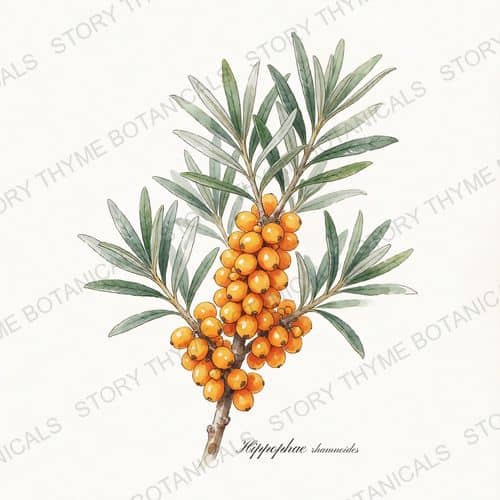
Pollmix · Pollmix 1, Pollmix 2, Pollmix 3, Pollmix 4, Lord

Needs a pollinizer
RipensNone (male, bears no fruit)Zones3-8Diseasegood (generally pest/disease-free)Sizelarge shrub 8-12 ft, silvery foliage
Pollinationmale pollinizer (produces no berries; one male pollinates 6-8 females)

not applicable (male, no fruit) — The essential wind-pollinating male every planting needs; match its numbered bloom-timing strain (1 for Orange Energy/Sirola, 2-4 for Leikora) to your females.

Where to buy ‘Pollmix

Story Thyme Farms may earn a small commission from these links, at no cost to you — it never changes what we recommend.

Orange Energy

Needs a pollinizer
Ripenslate AugustZones3-7Size6-8 ft
Pollinationfemale

pleasant acidic, good sweetened as juice — Female German cultivar bred by H.J. Albrecht in Berlin; patented. Needs a male sea berry for wind pollination. Nursery rates it hardy to minus 40 F.

Where to buy ‘Orange Energy

Story Thyme Farms may earn a small commission from these links, at no cost to you — it never changes what we recommend.

Askola

Needs a pollinizer
Ripenslate AugustZones3-7Size10-12 ft
Pollinationfemale

pleasant acidic, deep orange berries — Female German cultivar selected for high vitamin C and E content. Needs a male sea berry for wind pollination. Nursery rates it zone 3. The tallest of the common cultivars, so plan on pruning it down.

Where to buy ‘Askola

Story Thyme Farms may earn a small commission from these links, at no cost to you — it never changes what we recommend.

Klim's Prize

Needs a pollinizer
RipensJuly to AugustZones3-7Size6-10 ft
Pollinationfemale

pleasant acidic, excellent sweetened as juice — Female selection by breeder Klim Arbakov. Compact, upright growing shrub. Needs a male sea berry for wind pollination. Nursery rates it hardy to minus 40 F.

Where to buy ‘Klim's Prize

Story Thyme Farms may earn a small commission from these links, at no cost to you — it never changes what we recommend.

Golden Sweet

Needs a pollinizer
Ripenslate July to early AugustZones3-7Size6-8 ft
Pollinationfemale

sweet with pleasant acidity — Female; bright orange-yellow berries in large clusters. Needs a male sea berry for wind pollination. Nursery rates it hardy to minus 40 F. Included in the University of Wisconsin CIAS trial.

Where to buy ‘Golden Sweet

Story Thyme Farms may earn a small commission from these links, at no cost to you — it never changes what we recommend.

Sunny

Needs a pollinizer
Ripenslate July to early AugustZones3-7Size6-8 ft
Pollinationfemale

sweet, high quality, pleasant acidity — Female Siberian variety; needs a male sea berry for wind pollination. Nursery rates it hardy to minus 40 F. Included in the University of Wisconsin CIAS trial.

Where to buy ‘Sunny

Story Thyme Farms may earn a small commission from these links, at no cost to you — it never changes what we recommend.

Male Sea Berry · Male Seaberry

Needs a pollinizer
Zones3-7Size6-8 ft
Pollinationmale

Male pollinator; bears no fruit. One male pollinates up to 8 female plants. Nursery rates it hardy to minus 40 F. Set it on the upwind side of the block, since sea buckthorn pollen moves only on wind.

Where to buy ‘Male Sea Berry

Story Thyme Farms may earn a small commission from these links, at no cost to you — it never changes what we recommend.

VI

Sources & plant ID

Where the care distinctions come from, and how the plant is filed.

Research basis

Sources behind this profile

No extension citations are attached to sea buckthornyet. The care figures below come from the library's own catalogue rather than a traced primary source.

Plant ID

BinomialHippophae rhamnoides
FamilyElaeagnaceae
TypeShrub · Perennial
USDA symbolHIRH80
OriginIntroduced
Invasive riskLow

VII

Where to buy

Third-party nurseries — not Story Thyme Farms.

Third-party nurseries, not Story Thyme Farms. Prices are theirs.

Story Thyme Farms may earn a small commission from these links, at no cost to you — it never changes what we recommend.

Sea Buckthorn needs a pollination partner — plant two genetically distinct plants (two different cultivars, or a cultivar plus a seedling).

VIII

Questions

Sea Buckthorn questions, answered straight.

Why isn't my sea buckthorn fruiting?

Most often: it has no genetically distinct partner nearby. Sea Buckthorn can't pollinate itself — dioecious + wind — male upwind of females. Plant a second, unrelated one nearby; two different cultivars, or a cultivar plus a seedling, is the classic pairing.

Is sea buckthorn safe for kids and pets?

Sea Buckthorn is commonly eaten and isn't considered toxic, but "commonly eaten" isn't a guarantee for any particular person or animal — allergies, quantity, and which part you eat all matter. One caveat on this one: berries intensely tart (vitamin C ×10 oranges. Never eat a plant you haven't positively identified, and check with a vet before letting pets or livestock graze anything new.

When do you harvest sea buckthorn?

September - October: orange berry clusters — harvest by cutting whole fruiting twigs and FREEZING (berries then shake off; hand-picking is bloody).

How do you propagate sea buckthorn?

Grafted, or from cuttings/layering (seed won't come true).

IX

Elsewhere

Where sea buckthorn sits in the library.

Where sea buckthorn sits in the library

Grows in the same world