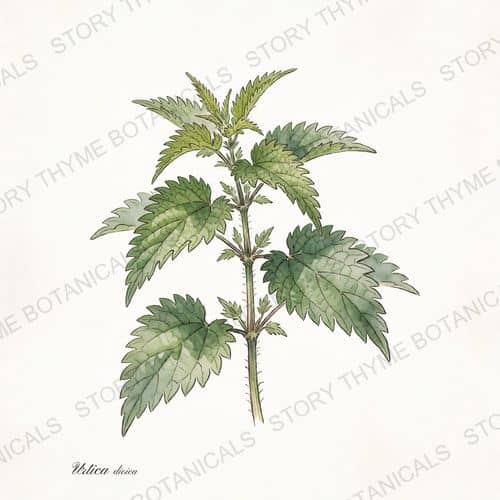
The illustrated growing guide
Stinging Nettle
Urtica dioica
Family Urticaceae
Est. zones 3-10

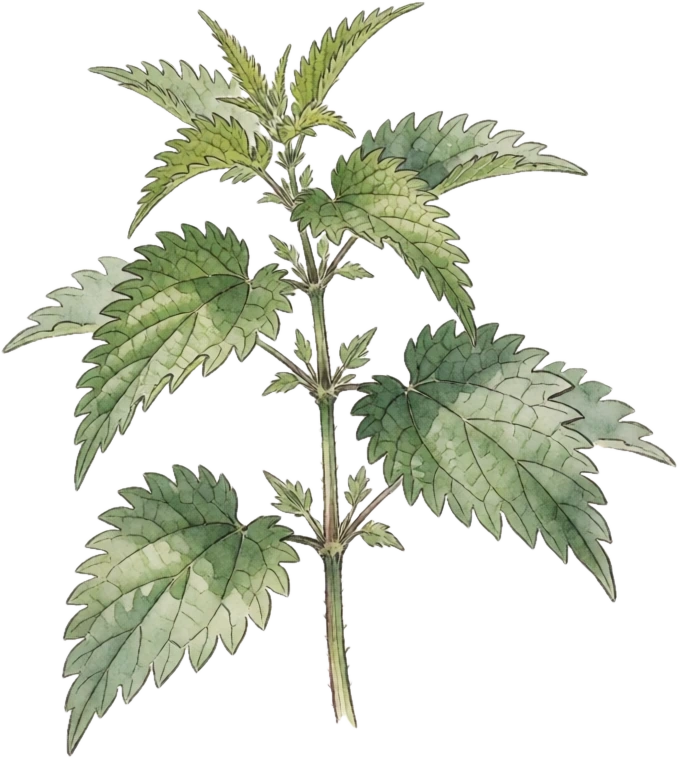
The plant that bites back — and earns its corner: cooked spring tops are a mineral-packed spinach, dried leaves a classic tonic tea, and it's a premier butterfly nursery. Grow it contained, in gloves, in the wild-and-useful edge of the food forest.

From the print shop
Growing stinging nettle? Hang it.
Our Tea Herbs collection carries stinging nettle — Urtica dioica, print Nº 11, “Nettle.”
16 designsfrom $21.99white or black groundmatte poster, unframed
I
Overview
Will stinging nettle suit your garden, and what goes wrong.
Will it fruit where you are?
Enter your ZIP — we look up your USDA hardiness zone (2023 map) and check it against what stinging nettle actually needs.
Stinging Nettle at a glance
Common stinging nettle problems
- Almost none (it IS a pest to bare skin)
- Few
II
Growing
Light, water, soil, propagation and the season’s jobs.
How to grow stinging nettle: light, water & soil
How to plant & propagate stinging nettle
The stinging nettle growing playbook
Field-tested instructions for every job stinging nettle asks of you, compiled from university extension guidance — in the order the season brings them.
Sowing
Direct-sow nettle on the soil surface in spring
In spring, scatter seed in a dense layer on the surface of moist soil and press it lightly in, or cover with only a very thin layer of soil. Expect germination in about 14 days, then thin the seedlings. To get a head start instead, seed flats in a greenhouse in late winter and set the transplants out in early spring, eight inches apart. Nettle seed is tiny and needs light and constant surface moisture to germinate, so burying it deeply is the usual reason a sowing fails.
⚠ Site the patch deliberately before you sow: nettle spreads by rhizome and a single plant can run four feet in every direction in a year. Pick a spot with a hard edge, such as existing rock, that will stop it escaping.
Watering
Keep nettle soil moist through the cutting season
Water to keep the soil moist during the harvest season rather than letting the bed swing dry between cuts. Nettle is at home on moist forest floors, streambanks and riparian edges, and it will take occasional wet feet. Nettle does not perform well in drought; dry soil checks the tender regrowth that repeat cutting depends on.
Mulching
Mulch the dormant nettle bed once a year
Mulch once a year in winter while the plants are dormant. Nettle wants soil with high organic content, around 4 to 5 percent, and a pH anywhere from 5.0 to 8.0, so an annual organic mulch is most of the feeding this crop needs. The mulch feeds the soil as it breaks down and holds moisture, which matters because nettle is a moist-ground plant that does poorly once soil dries out.
Dividing
Lift and divide nettle rhizomes in fall
Dig rhizomes in late fall once the top growth has died back. Rehydrate them, divide if you want more plants, pot up or plant out eight inches apart, cover lightly with soil, and water in. If any leafy growth is still attached, prune most of it off before replanting. A perennial like nettle establishes best while dormant, and cutting back the foliage stops the transplant from losing more water through its leaves than the disturbed roots can replace.
⚠ Wear gloves and long sleeves. Any rhizome piece left in the soil will regrow, and tilling a patch chops rhizomes into fragments that each start a new plant, so dig rather than cultivate.
Pruning
Keep cutting the tops to hold off flowering
Through the growing season, keep harvesting the tops just above a node rather than letting stems run up. Repeated cutting drives new leafy shoots and delays bloom, extending the window of tender pickable growth. Removing the growing tip prevents the plant from setting flowers and pushes it back into vegetative growth, which is the part you actually eat.
⚠ Wear gloves and long sleeves; the sting is present on stems as well as the undersides of leaves.
Cut the seed heads off before they shed
Cut the flowering seed heads in fall to keep the patch from spreading. Close mowing of a stand does the same job by preventing fruit from developing. Seeds mature in late August or early September and the dry fruits hang on the plant until frost, so there is a real window to catch them. A nettle shoot in full sun can set 10,000 to 20,000 seeds, and the seed stays viable in storage for years, so letting one season shed is how a patch becomes a colony.
⚠ Wear gloves and long sleeves. If you want to save seed instead, shake the heads into a jar or bag in early fall.
Harvesting
Cut young nettle tops in spring, before it flowers
Gather in early spring while the growth is tender, ideally early in the morning and before the plant flowers. Take leaves no wider than three inches from plants under three feet tall, clipping with sharp scissors right above a node at an angle so the cut stem does not sit waterlogged. Collect into a paper bag or basket, and take only what you need rather than digging plants up. Once flowers appear the greens turn tough and lose flavor, so the eating window is the flush of soft growth that comes before bloom.
⚠ Wear long sleeves, long pants and long rubber kitchen gloves; the stinging trichomes can burn for hours or raise blisters. Nettle must be blanched (1.5 to 2 minutes in boiling water) or dried before eating, which destroys the trichomes and makes it safe.
III
The year
What stinging nettle asks for, month by month.
The stinging nettle year, month by month
What each band means
- Bloom — flowers open — pollinators working, frost on blossoms is the danger.
- Harvest — picking time — check ripeness every few days.
The stinging nettle year as text
- Jan quiet month
- Feb quiet month
- Mar harvest
- Apr harvest
- May harvest
- Jun bloom
- Jul bloom
- Aug bloom
- Sep quiet month
- Oct quiet month
- Nov quiet month
- Dec quiet month
These are the species' typical months — expect them a few weeks earlier in warm zones and later in cold ones. Watch the plant, not just the calendar.
IV
Ecology & uses
What it does for the garden, and what it is grown for.
Stinging Nettle in the garden system
- Herbaceous layer perennial
- Dynamic accumulator
- Hosts Red admiral, question mark & comma butterflies
What stinging nettle is grown for
✓ Commonly eatenFresh plant STINGS (histamine, acetylcholine and serotonin — not formic acid, despite the old story); cooked or dried it is a nutritious food and traditional tea — nettle is safe once heated
Harvesting & storing stinging nettle
Young spring tops (cook/dry — cooking KILLS the sting) for nutritious greens + tea; a top butterfly host.
Edibility, identification, and traditional-use notes here are general reference — not medical or veterinary advice, and not a claim that any plant treats or prevents anything. Medicinal ratings record how strongly a plant features in herbal tradition, nothing more. Never eat or dose a plant you have not positively identified. More on how to use this library.
V
Cultivars
Named varieties of stinging nettle, ruled as a catalogue.
Best stinging nettle varieties & cultivars
Straight species
VI
Sources & plant ID
Where the care distinctions come from, and how the plant is filed.
Research basis
Sources behind this profile
No extension citations are attached to stinging nettleyet. The care figures below come from the library's own catalogue rather than a traced primary source.
Plant ID
VII
Where to buy
Third-party nurseries — not Story Thyme Farms.
Third-party nurseries, not Story Thyme Farms. Prices are theirs.
Story Thyme Farms may earn a small commission from these links, at no cost to you — it never changes what we recommend.
VIII
Questions
Stinging Nettle questions, answered straight.
Is stinging nettle safe for kids and pets?
Stinging Nettle is commonly eaten and isn't considered toxic, but "commonly eaten" isn't a guarantee for any particular person or animal — allergies, quantity, and which part you eat all matter. One caveat on this one: Fresh plant STINGS (histamine, acetylcholine and serotonin — not formic acid, despite the old story); cooked or dried it is a nutritious food and traditional tea — nettle is safe once heated. Never eat a plant you haven't positively identified, and check with a vet before letting pets or livestock graze anything new.
When do you harvest stinging nettle?
Young spring tops (cook/dry — cooking KILLS the sting) for nutritious greens + tea; a top butterfly host.
How do you propagate stinging nettle?
Division or seed.
IX
Elsewhere
Where stinging nettle sits in the library.
Tomato
Pepper
Squash
Corn