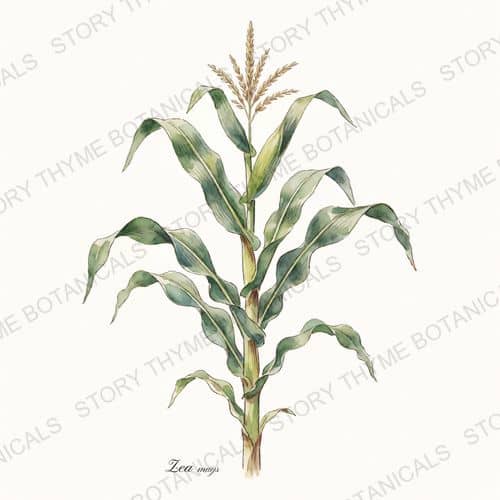
Corn

Zea mays

Family Poaceae

Annual annualZones 2-11

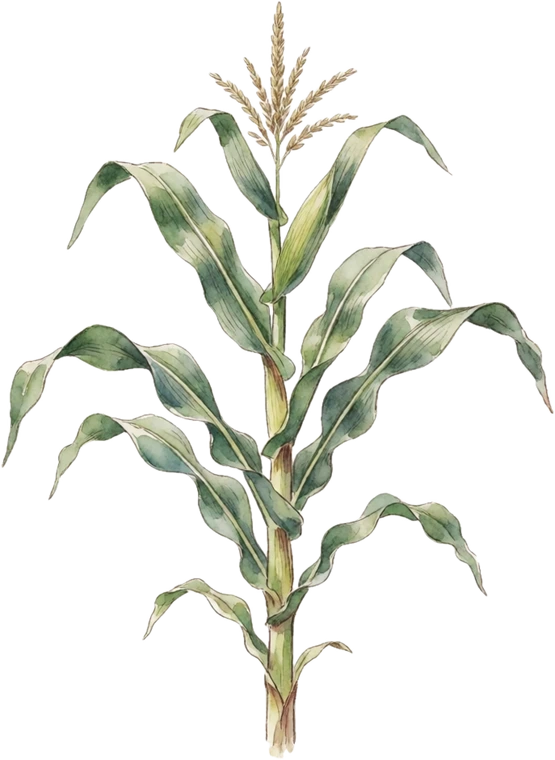
Botanical illustration of Corn

Sweet corn starts losing itself the moment it's picked — sugars turn to starch within hours — so the only truly sweet ear is one that goes from stalk to pot at a jog. Corn eaten that fresh, July through September, explains every backyard patch you've ever seen.

A block of 6-8 foot stalks turns a garden corner into green architecture all its own, rustling by August and generous by design. Corn is wind-pollinated, so it thrives planted in blocks rather than lonely rows — square up a sunny patch and give summer its centerpiece.

Where to buy corn — 5 nurseries compared

  • Full Sun
  • High water
  • Fast growth
  • Excellent edible
  • None winter chill
Sweet Corn — a print from the Plant Library collection

From the print shop

Growing corn? Hang it.

Our Plant Library collection carries corn — Zea mays, print Nº 462, “Sweet Corn.”

526 designsfrom $12.99white or black backgroundmatte poster, unframed

Shop Plant Library botanical prints →

✓

Will it fruit where you are?

Enter your ZIP — we look up your USDA hardiness zone (2023 map) and check it against what corn actually needs.

Life cycleAnnual
Winter chillNone

Corn · Common problems

Common corn problems

Pests, diseases and weather to keep an eye on.

Pests

9 problems on file

Diseases

2 problems on file

Corn · Growing & propagation

Growing corn

Light, water, soil, propagation and the season’s jobs.
What it needsThe details
Light
Full Sun
Water
High at tasseling/silking

Drought then costs the crop

Soil
Rich, Nitrogen-hungry · pH 6.0 - 6.8
Fertilizer
Heavy nitrogen feeder

Side-dress twice: knee-high and at tassel.

Pruning
None (annual) — None.
Spacing
8-12 inches, in blocks not rows

How to plant & propagate corn

Maturity
65-95 days
From seed
Direct-sow after frost, soil 60°F+

Block-plant for pollination

Propagate
From seed

Corn · Harvest & keeping

What you get from corn

How long before it bears, how much it gives, how you know it is ready, and how long it keeps once picked.
Botanical illustration of Corn
Years to first harvest
0 years
Typical yield
7–10 lbs per 10ft row
What you eat
Ears
How to tell it is ready
Harvest when silks brown and kernels are milky
How long it keeps
Best same day

Refrigerate immediately

Corn · Seasonal care & spray guidance

The corn growing playbook

Field-tested instructions for every job corn asks of you, compiled from university extension guidance — in the order the season brings them.

When to spray corn

Growing season. Earworm: 5 drops mineral oil on silks 3-5 days after they show. Raccoons know ripeness better than you — pick the day before they would.

As growth begins

early spring

2 jobs
SowingIn spring

Wait for warm soil, and sow in a block not a row

Once soil at 2 inches has reached 60F, sow seed 1 inch deep, 7-9 inches apart, in rows 24-30 inches apart. Hold supersweet (sh2) seed back until the soil hits 65F (UMN Extension, https://extension.umn.edu/vegetables/growing-sweet-corn). Plant at least three or four short rows side by side rather than one or two long ones. Corn is wind-pollinated and every kernel needs its own silk caught by a falling pollen grain, so a single long row sheds most of its pollen into the neighbours' yard and gives you gap-toothed ears. Shrunken sh2 seed carries a smaller starch reserve and rots in cold ground where standard su seed germinates fine.

SowingIn spring

Stagger the sowings, and keep the sweet corn types apart

Rather than planting the whole patch at once, sow again every 10 to 14 days, or when the previous planting has three to four leaves. If you are growing a supersweet alongside a standard or sugar-enhanced variety, separate them by about 400 yards or sow them two weeks apart so they do not shed pollen together. Each planting ripens in one week-long rush, so a single sowing means a glut and then nothing. The separation matters because pollen from a su or se plant landing on a supersweet silk turns that kernel starchy - the cross spoils this year's ears, not just next year's seed.

While it flowers

at bloom

1 job
WateringAt bloom

Do not let corn go dry at tasseling and silking

From the first tassel through silking and ear fill, keep the soil evenly moist. This is the stretch where corn must not dry out, whatever else in the garden has to wait. A silk only carries pollen down to its kernel while it is still turgid, so drought at this moment aborts kernels outright. Stress here cuts yield, kernel quality and flavour at once, and corn gets no second chance - the ear is made only once.

Just after bloom

as the fruit sets

1 job
SprayingAt petal fall

Corn earworm: one oil drop per ear, once pollination is finished

Wait until the silks have reached full length and just begun to wilt and turn brown, about 5 or 6 days after half the patch has silked. Mix 1 part Btk with 20 parts vegetable oil and place 5 drops, about half a millilitre from an eyedropper, directly on the silk channel at the tip of each ear. The earworm moth lays on fresh silks and the larva crawls straight down the silk channel into the ear tip, feeding almost not at all on the outside of the plant - which is why broadcast sprays miss it. The oil sits in the channel the larva must pass through and carries the Btk to the one spot where it will actually be eaten.

Through summer

the growing season

2 jobs
FeedingIn summer

Sidedress nitrogen when the corn is knee high

When plants are knee high with 8 to 10 leaves, work about half a pound of 21-0-0 per 100 square feet into the soil alongside the row and water it in. Add another quarter pound when the first tassels or silks appear. Corn is a grass and a heavy nitrogen feeder, and it decides ear size during the fast growth just before tasseling. Starve it in that stretch and you get short ears that no amount of later feeding will lengthen.

What to watch forIn summer

Check the whorls for corn borer before the tassel pushes out

In the late whorl stage, before the tassel emerges, examine 20 stalks at each of five spots across the patch. Look down into the whorl for tiny shot holes with a little light powdery frass beside them. Treat with a Bt product such as Dipel or XenTari if 30 or more of those 100 stalks are infested. For very early, high-value corn you may drop that threshold to 15. Borer larvae feed in the open whorl only briefly before tunnelling into the stalk, and once they are inside no spray can reach them. The late whorl is the single window where treatment still works, which is why you scout on a stage and not a date.

Harvest time

as it ripens, and picking

1 job
HarvestingAt harvest

Pick at milk stage - the thumbnail decides, not the calendar

Start checking about 17 to 24 days after the first silks appeared. The ear is ready when the silks are dry and brown, the husk is still green, and the tip kernels are plump. Pull back a little husk and puncture a kernel with your thumbnail: clear juice means wait, milky juice means pick. The 17-to-24-day window swings with temperature, so the same variety ripens on a different date every year and in every zone - the calendar cannot tell you but the thumbnail can. Past milk stage the sugars turn to starch and the kernels go doughy.

Corn · Companion plants

Corn companion plants

Good companions

Avoid

Underlined names have their own growing guide in this library.

Corn · Calculators & field guides

A little help in the garden.

Calculators for the figures. Field guides for the hands-on work.

Corn · Yearly calendar

The corn year, month by month

What corn asks for, month by month.

Jan

No calendar activity is listed for this month.

MonthJanFebMarAprMayJunJulAugSepOctNovDec
Bloom
Harvest

BloomJune to August

HarvestJuly to September

What each band means

  • Bloom — flowers open — pollinators working, frost on blossoms is the danger.
  • Harvest — picking time — check ripeness every few days.

These are the species' typical months — expect them a few weeks earlier in warm zones and later in cold ones. Watch the plant, not just the calendar.

Corn · Ecology & uses

Ecology & uses

What it does for the garden, and what it is grown for.
Botanical illustration of Corn

Zea mays

Corn in the garden system

  • Herbaceous layer annual
Moisture
Facultative / average
Deer
Browsed

Protect young plants

Origin
Introduced

What corn is grown for

✓ Commonly eaten

Use
Fresh
Use
Freezing
Use
Roasting
Edible value
4/5

Harvesting & storing corn

July - September, 18-24 days after silk. About 65-95 days from planting.

Edibility, identification, and traditional-use notes here are general reference — not medical or veterinary advice, and not a claim that any plant treats or prevents anything. Medicinal ratings record how strongly a plant features in herbal tradition, nothing more. Never eat or dose a plant you have not positively identified. More on how to use this library.

Corn · Varieties & cultivars

Best corn varieties & cultivars

There are far more than these — the ones below are the named varieties of corn people actually plant.

Named varieties of corn differ in days to maturity, disease resistance, flavor, and habit — pick one that fits your season and space.

10 varieties

Illini Xtra Sweet

Very sweet, crisp — TWO HARD RULES: isolate 500+ ft from any su/se corn tasseling at the same time or the kernels turn starchy like field corn; and do not sow until soil is about 65F, because sh2 seed is shrunken and rots in cold soil where su corn germinates fine at 55F.

Where to buy ‘Illini Xtra Sweet’

Story Thyme Farms may earn a small commission from these links, at no cost to you — it never changes what we recommend.

Sources & plant identity

Know what you’re growing.
See where the knowledge comes from.

Botanical illustration of Corn

Corn

Zea mays

The plant, at a glance.

Botanical name
Zea mays
Plant family
Poaceae
Growth habit
Annual
Origin
Introduced
USDA plant symbol
ZEMA
Invasive risk
Low
Every garden is different.

Hardiness, size and timing vary with your cultivar, soil and climate.

Rooted in research.

University extension research, brought together with hands-on growing experience at Story Thyme Farms.

Explore Corn’s sources4 reference links
for Corn

Research from these sources

Publisher marks identify sources, not sponsorship or endorsement.

Questions

Corn questions, answered straight.

Is corn safe for kids and pets?

Corn is commonly eaten and isn't considered toxic, but "commonly eaten" isn't a guarantee for any particular person or animal — allergies, quantity, and which part you eat all matter. Never eat a plant you haven't positively identified, and check with a vet before letting pets or livestock graze anything new.

When do you harvest corn?

July - September, 18-24 days after silk. From planting, expect about 65-95 days to maturity.

What grows well with corn?

Proven companions include beans, squash (three sisters), cucumber — the full companion list, and what to keep away, is in the Growing tab above.

How do you propagate corn?

From seed.

Elsewhere

Where corn sits in the library.

Where corn sits in the library

Grows in the same world