The illustrated growing guide
Wintergreen (Teaberry)
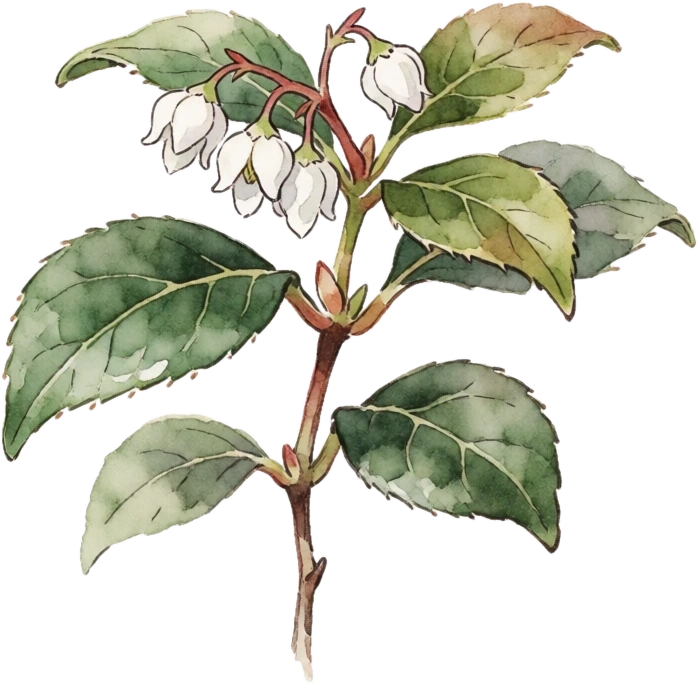
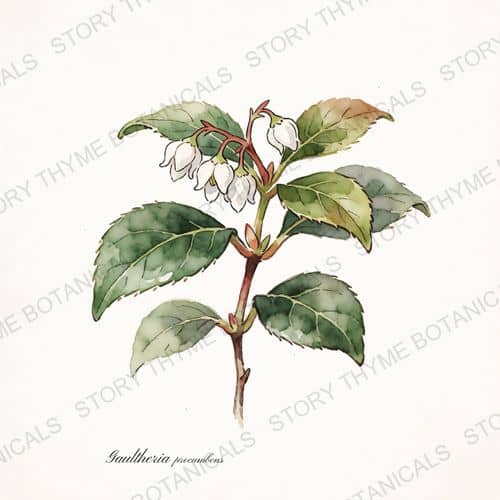
Gaultheria procumbens
Family Ericaceae
Est. zones 3-7

The forest-floor candy plant: shiny evergreen mat, red berries that taste like gum because the gum copied THEM. Under your blueberries and azaleas it's groundcover, tea, and nibble in one — textbook food-forest ground layer.
I
Overview
Will wintergreen (teaberry) suit your garden, and what goes wrong.
Will it fruit where you are?
Enter your ZIP — we look up your USDA hardiness zone (2023 map) and check it against what wintergreen (teaberry) actually needs.
Wintergreen (Teaberry) at a glance
Common wintergreen (teaberry) problems
- Almost none
- Few
II
Growing
Light, water, soil, propagation and the season’s jobs.
How to grow wintergreen (teaberry): light, water & soil
How to plant & propagate wintergreen (teaberry)
The wintergreen (teaberry) growing playbook
Field-tested instructions for every job wintergreen (teaberry) asks of you, compiled from university extension guidance — in the order the season brings them.
Planting out
Plant into acid soil in dappled shade
Set plants where they get dappled or partial shade and the soil is moist, well drained, and high in organic matter. Test pH before you plant and aim for 4.5 to 6.0; wintergreen tops out around pH 7.0 and will sulk above it. The plant survives deep shade, but site it where some light reaches the ground if you want berries rather than just foliage. This is an ericaceous woodland understory plant adapted to acidic, humus-rich forest soils, and while the evergreen mat persists in heavy shade, fruiting usually happens in canopy openings where more light gets through.
Watering
Water through the first summers while it knits in
Keep the soil evenly moist but never waterlogged through the first couple of growing seasons, particularly in dry spells. Once the mat has spread and closed, ease off - established plants handle occasional dryness on their own. Wintergreen wants moist but well-drained ground, and its rhizomes sit in the shallow organic layer that dries out first, so a young planting has almost no reserve to draw on.
Mulching
Leave the leaf litter, and keep mulch thin
Top up with a thin layer of leaf litter, pine needles, or other acidic organic matter as the leaves come down, and leave fallen leaves in place over the patch. Keep it loose and shallow. Never till, dig, or hard-rake an established colony. The rhizomes that carry the whole colony run in only the top inch of the organic layer, so stripping the litter or cultivating the surface destroys the exact tissue the plant spreads from.
What to watch for
Look the foliage over, and expect to do nothing
Glance over the leaves a few times through the season for aphids, thrips, powdery mildew, and leaf spot. All four are occasional and cosmetic here. Knock aphids off with a hose and open up air movement rather than reaching for a spray. Wintergreen has no serious pest or disease problems, so the damage almost never justifies an intervention, and a groundcover worked by bees is worth more intact than sprayed.
⚠ Do not apply insecticide while the white bell flowers are open - pollinators visit them.
Harvesting
Pick berries once they color; take leaves sparingly
The red berries color up after the summer bloom and hang on the plant through winter, sometimes into the following spring, so pick at your leisure once they are fully red rather than racing a window. Take leaves a few at a time from scattered stems instead of stripping any one plant. The fruit is persistent rather than perishable, so there is no narrow picking window; the leaves, by contrast, are evergreen and are the plant's only photosynthetic tissue through winter, so heavy stripping sets the colony back.
⚠ Leaves and berries are the traditional teaberry flavoring and are eaten in small amounts, but never distill or concentrate them into oil of wintergreen. Per MedlinePlus (medlineplus.gov/ency/article/002683.htm), methyl salicylate is the most poisonous form of the salicylate chemicals; concentrated oil of wintergreen is roughly 98% methyl salicylate, and poison-control data record child deaths from a teaspoon or less. Keep any concentrated product away from children.
III
The year
What wintergreen (teaberry) asks for, month by month.
The wintergreen (teaberry) year, month by month
What each band means
- Bloom — flowers open — pollinators working, frost on blossoms is the danger.
- Harvest — picking time — check ripeness every few days.
The wintergreen (teaberry) year as text
- Jan harvest
- Feb harvest
- Mar harvest
- Apr harvest
- May harvest
- Jun bloom, harvest
- Jul bloom, harvest
- Aug harvest
- Sep harvest
- Oct harvest
- Nov harvest
- Dec harvest
These are the species' typical months — expect them a few weeks earlier in warm zones and later in cold ones. Watch the plant, not just the calendar.
IV
Ecology & uses
What it does for the garden, and what it is grown for.
Wintergreen (Teaberry) in the garden system
- Groundcover layer shrub
- Living mulch
What wintergreen (teaberry) is grown for
! Some parts toxic — see notesLeaves/oil in QUANTITY = aspirin-family toxicity; casual tea + berries fine
Harvesting & storing wintergreen (teaberry)
Red berries (the original teaberry gum flavor) + leaves for wintergreen tea, year-round under snow.
Edibility, identification, and traditional-use notes here are general reference — not medical or veterinary advice, and not a claim that any plant treats or prevents anything. Medicinal ratings record how strongly a plant features in herbal tradition, nothing more. Never eat or dose a plant you have not positively identified. More on how to use this library.
V
Cultivars
Named varieties of wintergreen (teaberry), ruled as a catalogue.
Best wintergreen (teaberry) varieties & cultivars
'Cherry Berries' (heavy fruiting); native species
VI
Sources & plant ID
Where the care distinctions come from, and how the plant is filed.
Research basis
Sources behind this profile
No extension citations are attached to wintergreen (teaberry)yet. The care figures below come from the library's own catalogue rather than a traced primary source.
Plant ID
VII
Where to buy
Third-party nurseries — not Story Thyme Farms.
Third-party nurseries, not Story Thyme Farms. Prices are theirs.
Story Thyme Farms may earn a small commission from these links, at no cost to you — it never changes what we recommend.
VIII
Questions
Wintergreen (Teaberry) questions, answered straight.
Is wintergreen (teaberry) safe for kids and pets?
With care. Leaves/oil in QUANTITY = aspirin-family toxicity; casual tea + berries fine Site it accordingly if children or pets roam the garden. This is general reference, not medical or veterinary advice — call a vet or poison control if something has actually been eaten.
When do you harvest wintergreen (teaberry)?
Red berries (the original teaberry gum flavor) + leaves for wintergreen tea, year-round under snow.
How do you propagate wintergreen (teaberry)?
Seed (stratify), cuttings, or layering.
IX
Elsewhere
Where wintergreen (teaberry) sits in the library.
Tea Plant
Roselle (Tea Hibiscus)
American Linden (Basswood)
Arabian Jasmine