The illustrated growing guide

Flowering Crabapple

Malus hybrids

Family Rosaceae

Est. zones 3-8

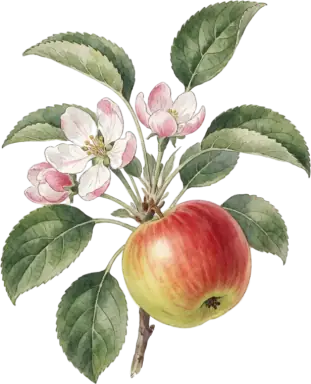
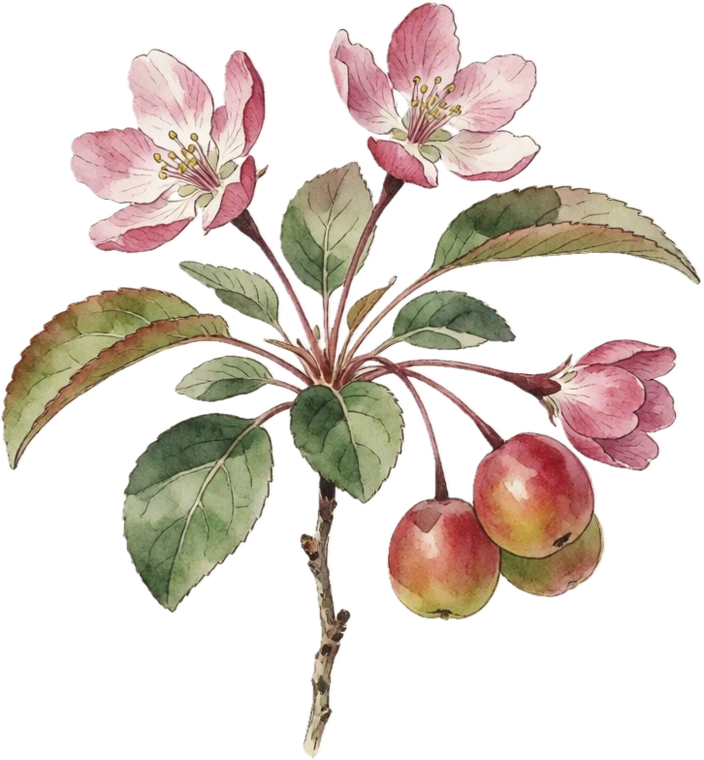
Botanical illustration of Flowering Crabapple
Tree · Malus hybrids

A smaller, tougher cousin of the eating apple grown for a spectacular spring bloom, persistent bird-feeding fruit, and — usefully — as a pollen partner that makes your eating apples fruit better. The whole game is choosing a modern disease-resistant cultivar (like 'Prairifire'); the old susceptible ones defoliate from scab and rust every summer. The tiny apples make a beautiful jelly.

TreeFull SunModerate waterModerate growthExcellent edibleAttracts beesNeeds a pollination partner

☤ Juglone-sensitiveFlowering Crabapple is sensitive to juglone — the toxin exuded by black walnut, butternut, and their relatives. Keep it 50+ ft from any walnut or hickory, or its leaves will yellow, wilt, and die back for no obvious reason.

Where to buy the plant — 1 nursery

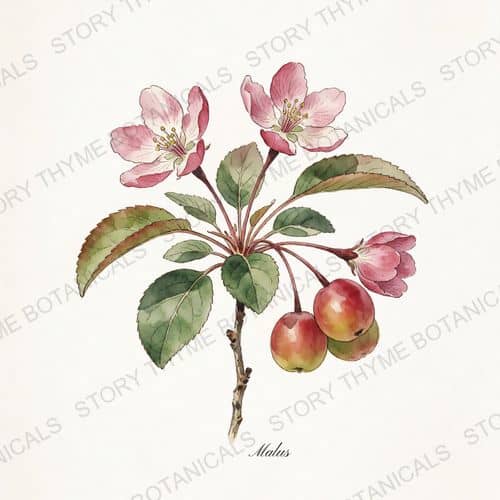
Apple Blossom Tree — a print from the Flowering Trees collection

From the print shop

The closest print we make

We don’t print Malus hybrids. The closest we have is Malus domestica (“Apple Blossom Tree”) in the Flowering Trees collection — the same genus, Malus, not the same species.

16 designsfrom $21.99white or black groundmatte poster, unframed

Shop Flowering Trees botanical prints →

I

Overview

Will flowering crabapple suit your garden, and what goes wrong.

Will it fruit where you are?

Enter your ZIP — we look up your USDA hardiness zone (2023 map) and check it against what flowering crabapple actually needs.

Hardy inZones 3-8
PollinationPartner needed

Flowering Crabapple at a glance

HardinessUSDA 3–8
Mature size10-25 ft by cultivar
PollinationA key POLLENIZER for eating apples; bees love the bloom
Chill requirementNot yet established
Bloom seasonSpring — profuse pink/white/red bloom
Harvest seasonSmall tart apples (persist into winter, feed birds; jelly-able)
Growth rateModerate

Common flowering crabapple problems

  • Aphids
  • Japanese Beetles
  • Borers
  • Apple Scab
  • Cedar-Apple Rust
  • Fireblight — CHOOSE RESISTANT CULTIVARS to skip spraying
  • Poor pollination → low fruit set (plant a partner)

II

Growing

Light, water, soil, propagation and the season’s jobs.

How to grow flowering crabapple: light, water & soil

LightFull Sun
WaterModerate; adaptable
SoilAny well-drained · pH 6.0 - 7.0
FertilizerLight spring feed
PruningLate Winter — Remove suckers, water sprouts, and crossing branches; choose disease-resistant cultivars to avoid spraying.
Spacing15-20 ft

How to plant & propagate flowering crabapple

PropagateGrafted, or from cuttings/layering (seed won't come true)

When to spray flowering crabapple

Dormant season. Dormant oil optional.

Growing season. Resistant cultivars are the disease program.

The flowering crabapple growing playbook

Field-tested instructions for every job flowering crabapple asks of you, compiled from university extension guidance — in the order the season brings them.

Mulching

Rake the fallen leaves and take away next spring's scab

After leaf drop, rake up and remove the fallen leaves from under the canopy, or shred them and bury them under fresh mulch so they rot down before spring. The scab fungus overwinters in that leaf litter and nowhere else, and the spores it releases next spring are the entire source of early infection. Removing the leaves removes the inoculum before it can be launched.

Feeding

Feed by soil test, and keep nitrogen low

Send a soil sample to your extension lab and fertilize only to the rate it calls for. An established crabapple in decent soil often needs nothing. Resist the urge to push a slow tree with a heavy nitrogen feed. Excess nitrogen stimulates a flush of succulent leaves and shoots, and that soft new growth is exactly the tissue fire blight infects most easily. A modestly fed crabapple is a more disease-resistant crabapple.

Pruning

Prune in late winter, while the tree and the bacteria are both asleepFeb – Mar

In late winter before growth resumes, take out dead, crossing, and rubbing branches, thin the interior to open the canopy, and cut off the suckers rising from the base and the water sprouts standing straight up in the limbs. Aim for a canopy that lets air move through it. Pruning now reduces sucker regrowth from wounds and eliminates the chance of spreading infection between cuts, because the fire blight bacterium is dormant and not moving in the sap. An open canopy also dries the leaves quickly after rain, and apple scab and fire blight both need wet tissue to infect.

Do not prune hard enough to force a flush of succulent shoots, which are the tissue most susceptible to fire blight. Some crabapple cultivars sucker profusely and need this every year.

Fire blight: cut out strikes the week you see them

Watch for shoots whose tips wilt, blacken, and curl into a shepherd's crook. Cut through healthy wood at least 8 inches below the discolored bark of the canker, and further, 12 to 18 inches, on an actively running strike. Remove the prunings from the orchard. Erwinia amylovora enters through blossoms during warm wet spring weather and then runs down inside the shoot ahead of any symptom you can see, so a cut close to the visible damage leaves live bacteria in the tree.

Sanitize the pruners between every single cut with a 10 percent bleach solution, one part bleach to nine parts water, or 70 percent rubbing alcohol, or you will inoculate each new wound. Rinse and oil tools afterward. Sprays cannot reach bacteria inside a branch canker.

Spraying

Delayed-dormant horticultural oil at green tip

When the buds crack and the first green leaf tissue shows, spray horticultural oil at the 2 percent delayed-dormant rate — your product's label gives the dilution that reaches it — covering twigs and branches to the point of drip. Green tip through half-inch green is the window on apple and crabapple. Overwintering aphid eggs, San Jose scale nymphs, and mites are resuming metabolic activity as temperatures moderate, so they are breathing hard enough for the oil film to suffocate them. Earlier, they are too dormant for it to work; later, the leaf tissue is too tender to take the oil.

Spray on a clear, still day between 50 and 70F, and only when temperatures will stay above freezing, ideally above 40F, for 24 hours afterward or the oil will injure tissue. Do not apply captan or sulfur close to an oil spray: the oil carries them into the leaf and burns it. Extension guidance ranges from a minimum of 3 to 5 days to a safer two weeks between oil and captan or sulfur (MSU Extension), so leave two weeks if you can.

Apple scab: first fungicide as the leaves unfold, on susceptible cultivars only

If your tree is a scab-susceptible cultivar and defoliated last summer, start captan once leaves reach a half to three-quarters of an inch, and continue through pre-pink and pink. On a resistant cultivar, skip this entirely. Venturia inaequalis overwinters in last year's fallen leaves and fires its spores at the youngest expanding leaves during spring rains. The fungicide is protective, not curative, so it must be on the leaf before the rain lands, and once the earliest lesions form they seed the rest of the season.

This is a fungicide, not an insecticide. Never add an insecticide to a spray aimed at a blooming crabapple, since the tree is full of bees. Captan carries a 0-day pre-harvest interval per Clemson, but follow the label on your own product. Choosing a scab-resistant cultivar greatly reduces the need for this spray program, which is why cultivar choice is the real control.

Scab and cedar-apple rust: cover sprays from petal fall

As the petals drop, continue on a susceptible tree by rotating captan, sulfur, and myclobutanil through the cover-spray period. Myclobutanil covers cedar-apple rust and powdery mildew as well as scab, so one rotation handles all three. Petal fall is when the bees leave and the young leaves and fruitlets are still expanding and still infectable. Cedar-apple rust needs eastern red cedar as its alternate host and moves cedar to apple in mid to late spring, so rust pressure is real only if junipers are nearby.

Wait until the petals are actually off before spraying, so the bloom-time pollinators are gone. If you intend to eat the fruit or make jelly, mind the pre-harvest intervals Clemson gives: myclobutanil 14 days, captan 0 days, sulfur 0 days. The label on your own product is the legal authority. Rotating active ingredients rather than repeating one slows fungicide resistance. Do not tank-mix sulfur close behind an oil spray.

Harvesting

Pick for jelly when the fruit colors fully

Harvest when the small apples have taken full color and come away easily. Large-fruited jelly types like Dolgo ripen in midsummer and are tart enough to eat raw; most ornamental crabapples are best cooked into jelly or cider. Leave what you do not want on the tree, since persistent-fruited cultivars hold their fruit into winter and feed birds. Crabapple fruit is edible but too tart and firm to be palatable raw on most ornamental cultivars, so it is cooked. Fruit left on a persistent-fruited cultivar hangs into winter and feeds birds, which is the reason to pick only what you want.

Fruits are edible but must be cooked to be palatable. Eat the flowers only in moderation, as they contain cyanide precursors.

III

The year

What flowering crabapple asks for, month by month.

The flowering crabapple year, month by month

MonthJanFebMarAprMayJunJulAugSepOctNovDec
Bloom
Prune
Harvest

What each band means

  • Bloomflowers open — pollinators working, frost on blossoms is the danger.
  • Pruneshape it now — cuts heal cleanly and structure is visible.
  • Harvestpicking time — check ripeness every few days.

The flowering crabapple year as text

  • Jan harvest
  • Feb pruning, harvest
  • Mar bloom, pruning
  • Apr bloom
  • May bloom
  • Jun quiet month
  • Jul quiet month
  • Aug quiet month
  • Sep quiet month
  • Oct quiet month
  • Nov quiet month
  • Dec harvest

These are the species' typical months — expect them a few weeks earlier in warm zones and later in cold ones. Watch the plant, not just the calendar.

IV

Ecology & uses

What it does for the garden, and what it is grown for.

Flowering Crabapple in the garden system

  • Understory layer tree
  • Nectary/insectary
  • Keystone: Keystone — hosts 300+ caterpillar species
AttractsBees, Birds
MoistureFacultative / average
DeerBrowsed — protect young plants

What flowering crabapple is grown for

! Some parts toxic — see notesSeeds toxic in quantity (as apples)

UseSpring bloom
UseApple pollenizer
UseBird food
UseJelly
Edible value4/5

Harvesting & storing flowering crabapple

Small tart apples (persist into winter, feed birds; jelly-able).

Edibility, identification, and traditional-use notes here are general reference — not medical or veterinary advice, and not a claim that any plant treats or prevents anything. Medicinal ratings record how strongly a plant features in herbal tradition, nothing more. Never eat or dose a plant you have not positively identified. More on how to use this library.

V

Cultivars

Named varieties of flowering crabapple, ruled as a catalogue.

Best flowering crabapple varieties & cultivars

9 on file

Named varieties of flowering crabapple differ in winter-chill needs, ripening time, hardiness, and whether they set fruit on their own — pick one that fits your climate.

Prairifire · Prairie Fire

Ripensfall, persisting into winterZones4-7Diseasescab excellent, fire blight excellent, cedar-apple rust excellent, powdery mildew excellent (Morton Arboretum ratings; USU rates it more generally as good resistance to diseases and still notes some scab)Size20 ft tall by 20-25 ft wide

tart, ornamental fruit best cooked — Bright magenta flowers whose color does not fade, followed by 3/8 inch dark red fruit that persists into winter. Drought tolerant once established and adaptable across soil types.

Where to buy ‘Prairifireverified

Story Thyme Farms may earn a small commission from these links, at no cost to you — it never changes what we recommend.

Royal Raindrops · JFS-KW5

Ripenslate summer, persisting into winterZones4-8Diseasegood resistance to scab, fire blight, rust, leaf spot and powdery mildewSize15-20 ft tall by 12-16 ft wide

tart, ornamental fruit best cooked — Magenta pink single flowers with five petals, deeply cut purple foliage, and 1/4 inch maroon pomes that mature in late summer and persist into winter as bird food.

Where to buy ‘Royal Raindrops

Story Thyme Farms may earn a small commission from these links, at no cost to you — it never changes what we recommend.

Dolgo

Ripensmidsummer, ripening in JulyZones4-7Diseasefairly resistant to diseaseSize30 ft tall by 30-40 ft wide

tart, bright, good raw and superb cooked — Fragrant white flowers with a pink center over a large tree. Bears roughly 1 inch tart crimson fruit that ripens in July and makes excellent jelly and cider. Tends to flower on an alternate-year cycle, and the fruit drop gets messy in August.

Where to buy ‘Dolgo

Story Thyme Farms may earn a small commission from these links, at no cost to you — it never changes what we recommend.

Adirondack

RipensfallZones4-7Diseasescab excellent, fire blight excellent, rust excellent, mildew excellentSize12-18 ft tall by 6-10 ft wide, narrow upright

tart, ornamental fruit best cooked — White flowers and orange-red fruit on a distinctly narrow, upright frame. Fruit is not strongly persistent.

Where to buy ‘Adirondackverified

Story Thyme Farms may earn a small commission from these links, at no cost to you — it never changes what we recommend.

Sugar Tyme · Sutyzam

Ripensfall, persisting into winterZones4-7Diseasescab excellent, fire blight good, rust good, mildew goodSize18 ft tall by 15 ft wide, upright spreading

tart, ornamental fruit best cooked — White flowers followed by red fruit that persists on the tree through fall and winter.

Where to buy ‘Sugar Tymeverified

Story Thyme Farms may earn a small commission from these links, at no cost to you — it never changes what we recommend.

Donald Wyman

Ripensfall, persisting into winterZones4-7Diseasescab good, fire blight excellent, rust excellent, mildew goodSize20 ft tall by 20 ft wide, rounded

tart, ornamental fruit best cooked — Rounded habit with white flowers and abundant glossy red fruit that persists into winter.

Where to buy ‘Donald Wyman

Story Thyme Farms may earn a small commission from these links, at no cost to you — it never changes what we recommend.

Harvest Gold · Hargozam

Ripensfall, persisting into winterZones4-7Diseasescab excellent, fire blight fair, rust excellent, mildew excellentSize20 ft tall by 15 ft wide, upright

tart, ornamental fruit best cooked — White flowers and golden-yellow fruit that holds late into winter, a yellow-fruited alternative to the usual red. Fire blight resistance is only fair, so watch for strikes.

Where to buy ‘Harvest Gold

Story Thyme Farms may earn a small commission from these links, at no cost to you — it never changes what we recommend.

Tina · Malus sargentii Tina, Sargent crabapple Tina

RipensfallZones4-7Diseasescab excellent, fire blight good, rust excellent, mildew excellentSize3-6 ft tall by 5-8 ft wide, spreading dwarf

tart, ornamental fruit best cooked — A true dwarf Sargent crabapple. Red buds open to white flowers, followed by small red fruit.

Where to buy ‘Tina

Story Thyme Farms may earn a small commission from these links, at no cost to you — it never changes what we recommend.

Spring Snow

Zones4-7Diseasescab fair, fire blight fair, rust good, mildew goodSize25 ft tall by 20 ft wide, upright oval

White flowers on a nearly sterile tree that sets little to no fruit, so there is nothing to drop on a patio or walk. Only fair scab resistance, so expect some leaf spotting in humid regions.

Where to buy ‘Spring Snow

Story Thyme Farms may earn a small commission from these links, at no cost to you — it never changes what we recommend.

VI

Sources & plant ID

Where the care distinctions come from, and how the plant is filed.

Research basis

Sources behind this profile

No extension citations are attached to flowering crabappleyet. The care figures below come from the library's own catalogue rather than a traced primary source.

Plant ID

BinomialMalus hybrids
FamilyRosaceae
TypeTree · Perennial
USDA symbolMALUS
Invasive riskLow

VII

Where to buy

Third-party nurseries — not Story Thyme Farms.

Third-party nurseries, not Story Thyme Farms. Prices are theirs.

Story Thyme Farms may earn a small commission from these links, at no cost to you — it never changes what we recommend.

Flowering Crabapple needs a pollination partner — plant two genetically distinct trees (two different cultivars, or a cultivar plus a seedling).

VIII

Questions

Flowering Crabapple questions, answered straight.

Why isn't my flowering crabapple fruiting?

Most often: it has no genetically distinct partner nearby. Flowering Crabapple can't pollinate itself — a key pollenizer for eating apples; bees love the bloom. Plant a second, unrelated one nearby; two different cultivars, or a cultivar plus a seedling, is the classic pairing.

Is flowering crabapple safe for kids and pets?

With care. Seeds toxic in quantity (as apples) Site it accordingly if children or pets roam the garden. This is general reference, not medical or veterinary advice — call a vet or poison control if something has actually been eaten.

When do you harvest flowering crabapple?

Small tart apples (persist into winter, feed birds; jelly-able).

How do you propagate flowering crabapple?

Grafted, or from cuttings/layering (seed won't come true).

IX

Elsewhere

Where flowering crabapple sits in the library.