The illustrated growing guide

Okra

Abelmoschus esculentus

Family Malvaceae

Grown as an annual

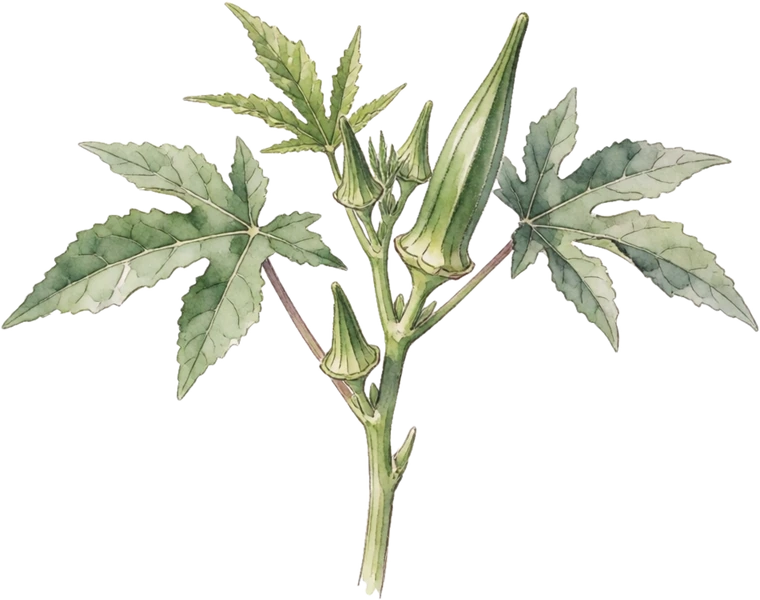
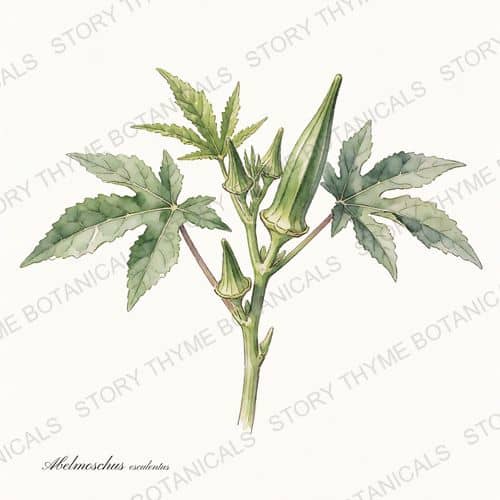
Botanical illustration of Okra
Annual · Abelmoschus esculentus

The crop that loves the weather everything else hates — July heat that wilts tomatoes makes okra double daily. Miss two picking days and you get lumber.

AnnualFull Sun — thrives in brutal heatLow waterFast in heat growthExcellent edibleAttracts beesNone winter chill

Where to buy the plant — 3 nurseries

I

Overview

Will okra suit your garden, and what goes wrong.

Will it fruit where you are?

Enter your ZIP — we look up your USDA hardiness zone (2023 map) and check it against what okra actually needs.

Life cycleAnnual
Winter chillNone
PollinationSelf-fertile

Okra at a glance

Life cycleAnnual
Mature size4-8 ft
PollinationSelf-fertile (hibiscus-family blooms are gorgeous)
Chill requirementNone (not chill-dependent)
Bloom seasonSummer
Harvest seasonJuly - Frost — pick pods at 2-4 in DAILY; a 6-inch pod is a wooden fencepost
Growth rateFast in heat

Common okra problems

II

Growing

Light, water, soil, propagation and the season’s jobs.

How to grow okra: light, water & soil

LightFull Sun — thrives in brutal heat
WaterLow once going — deep taproot
SoilAny well-drained; laughs at poor soil · pH 6.0 - 7.0
FertilizerLight — excess nitrogen = 8 ft plants, no pods
PruningNone — Cut, don't pull, pods (wear sleeves — the spines itch); topping at 5 ft forces side branching.
Spacing12-18 in

How to plant & propagate okra

Maturity50-65 days
From seedDirect-sow in warm soil (75°F+); soak seed overnight
PropagateFrom seed

The okra growing playbook

Field-tested instructions for every job okra asks of you, compiled from university extension guidance — in the order the season brings them.

Sowing

Direct sow only once the soil hits 65-70F

Check the soil temperature at 4 inches deep before you sow. Below 65F, wait. Sow about 3/4 inch deep in rows 3 to 6 feet apart, with 9 to 12 inches between seeds in the row. Sow several seeds per hole to insure the stand, then thin back to one plant per hole. Germination is best between 70F and 95F. Okra is a tropical mallow, and root-decay diseases that kill young seedlings are its single most serious problem in cold, wet soil. Seed sown into a chilly seedbed sits there and rots instead of germinating, so sowing early buys you nothing and often costs you the stand.

Planting out

Short season? Start okra indoors and set it out warm

If your frost-free window is tight, start seed indoors 4 to 5 weeks before you plan to set plants out, and transplant only after soil temperatures reach about 75F. Choose a compact early hybrid such as Annie Oakley II, which does well in cool, short-season gardens. Okra needs roughly 90 days to mature, which is more warm weather than a northern garden hands out for free. Starting indoors moves the clock forward without asking cold soil to germinate the seed.

Mulching

Lay black plastic mulch to warm the bed

In cooler gardens, lay black plastic mulch over the bed before planting and set or sow through it. It suppresses weeds and raises soil temperature. Okra's whole season is governed by soil warmth, and black plastic buys back several degrees at root level, which is often the difference between a crop and a shrug in a short-summer zone.

Feeding

Sidedress nitrogen after the first pods come off

Once you have picked the first pods, scatter about 1 cup of garden fertilizer per 10 feet of row evenly between the rows, mix it lightly into the soil, and water it in. Okra fruits continuously until frost, and every pod is a fresh draw on the plant's nitrogen. Waiting until pods are actually coming off matters, because heavy nitrogen on young plants pushes leaf growth and reduces pod set.

Pruning

Ratoon tall, tired plants for a second flush

When plants have grown too tall to pick and production is falling off, mow or prune the stems to 6 to 12 inches above the soil line and fertilize with a 1:2 nitrogen-to-potassium fertilizer (4-0-8, 5-0-10, or 10-0-20) at 2 to 3 pounds per 100 feet of row. Expect renewed pod production in about 4 to 6 weeks, continuing until first frost. Count back from YOUR first frost date before you cut: if there is not comfortably more than 6 weeks of frost-free weather left, the regrowth will never bear and you have thrown the crop away. Cutting back forces new branches from the base, and those young shoots flower far more freely than the exhausted top of a leggy plant. The 4 to 6 week regrowth lag is the whole gamble, which is why your first fall frost date, not the calendar month, decides whether it is worth doing.

Prolonging production by topping plants can build up pest populations, so keep scouting the regrowth. If frost is too close, pull the crop instead and destroy the residue, which helps knock down pest numbers for next season.

What to watch for

Check pods for the twist that means stink bugs

While you pick, look for pods that are twisted, kinked, or warty rather than straight, and check leaf undersides and growing tips for aphids. Stink bugs and leaffooted bugs are the culprits behind distorted pods. Hand-pick the bugs, keep weedy borders down, and protect the natural enemies already working the planting. Stink bugs and leaffooted bugs pierce the developing pod wall and their feeding sites deform the pod as it elongates, so by the time you see the twist the insect has usually moved on. Distortion is the symptom that tells you they are present at all.

Do not answer stink bugs with a broad-spectrum insecticide. Okra is in flower every day it is fruiting, and the stink bug materials for this crop are hazardous to the bees working those blooms -- UF/IFAS flags pyrethrins as harmful to bees, and carbaryl and bifenthrin are likewise acutely toxic to foraging bees. Chemical options for stink bug on okra are very limited; hand-picking and border management are the realistic answer.

Spraying

Caterpillars in the pods: Bt while the larvae are small

If corn earworm or armyworms are chewing leaves or boring into pods, spray a Bacillus thuringiensis product such as DiPel DF or Xentari DF. Treat while the larvae are still young and cover the plant thoroughly, including the growing tips where eggs are laid. Bt has to be eaten to work, so it only reaches larvae that are still actively feeding on treated tissue. Large caterpillars shrug it off and an earworm that has already bored into a pod is beyond reach of any spray, which is why the size of the larva decides whether this works.

Bt has a 0-day pre-harvest interval on okra (Javelin WG is 1 day) and a 4-hour restricted entry interval, and DiPel and Xentari are OMRI-listed for organic production. Bt is the right choice here specifically because okra blooms continuously during harvest: it kills only caterpillars that eat it and spares the bees on the flowers, unlike carbaryl or pyrethrins.

Harvesting

Pick every 1 to 2 days at 2 to 3 inches, and strip the misses

Pods are ready about 4 to 6 days after the flower opens. Cut them at the base with a knife or clippers while they are 2 to 3 inches long and still tender; 4 inches is the outside limit on the larger-podded varieties. Harvest at least every other day. Cut off and discard any pod that got away from you -- it is woody and inedible, but leaving it on costs you the rest of the season. A pod left to mature is a seed the plant reads as mission accomplished, and it throttles back flowering and further pod set. Removing the overgrown pods is what keeps the plant blooming into fall, and the oversized ones are woody anyway.

Most okra varieties carry spines on the pods and stems that irritate skin, so wear gloves and long sleeves and cut rather than tug.

III

The year

What okra asks for, month by month.

The okra year, month by month

MonthJanFebMarAprMayJunJulAugSepOctNovDec
Bloom
Harvest

What each band means

  • Bloomflowers open — pollinators working, frost on blossoms is the danger.
  • Harvestpicking time — check ripeness every few days.

The okra year as text

  • Jan quiet month
  • Feb quiet month
  • Mar quiet month
  • Apr quiet month
  • May quiet month
  • Jun bloom
  • Jul bloom, harvest
  • Aug bloom
  • Sep quiet month
  • Oct quiet month
  • Nov quiet month
  • Dec quiet month

These are the species' typical months — expect them a few weeks earlier in warm zones and later in cold ones. Watch the plant, not just the calendar.

IV

Ecology & uses

What it does for the garden, and what it is grown for.

Okra in the garden system

  • Herbaceous layer annual
AttractsBees
MoistureUpland / dry
DeerBrowsed — protect young plants
OriginIntroduced

What okra is grown for

✓ Commonly eaten

UseFrying
UseGumbo
UsePickling
Edible value4/5

Harvesting & storing okra

July - Frost — pick pods at 2-4 in DAILY; a 6-inch pod is a wooden fencepost. About 50-65 days from planting.

Edibility, identification, and traditional-use notes here are general reference — not medical or veterinary advice, and not a claim that any plant treats or prevents anything. Medicinal ratings record how strongly a plant features in herbal tradition, nothing more. Never eat or dose a plant you have not positively identified. More on how to use this library.

V

Cultivars

Named varieties of okra, ruled as a catalogue.

Best okra varieties & cultivars

11 on file

Named varieties of okra differ in days to maturity, disease resistance, flavor, and habit — pick one that fits your season and space.

Burgundy · Red Burgundy

Classic okra — Red pods are far easier to spot against green foliage, which helps you catch them before they go woody. The colour cooks off to green. Open-pollinated.

Where to buy ‘Burgundyverified

Story Thyme Farms may earn a small commission from these links, at no cost to you — it never changes what we recommend.

Clemson Spineless · Clemson Spineless 80

RipensMidseasonZones2-11

The 1939 All-America Selections winner and still the benchmark home-garden okra. Straight, tapered, ridged bright green pods, spineless, with high yields and good quality. Carries less foliage than the Perkins types.

Where to buy ‘Clemson Spinelessverified

Story Thyme Farms may earn a small commission from these links, at no cost to you — it never changes what we recommend.

Annie Oakley II · Annie Oakley II Hybrid

RipensEarlyZones2-11SizeDwarf

A compact spineless hybrid whose bright green pods stay tender up to about 4.5 inches, giving you more margin on the every-other-day pick. Extension specifically recommends it for cool, short-season gardens.

Where to buy ‘Annie Oakley II

Story Thyme Farms may earn a small commission from these links, at no cost to you — it never changes what we recommend.

Cajun Delight

RipensMidseasonZones2-11

Less fibrous than standard types — An All-America Selections winner with vigorous plants and huge yields. Five-sided dark green pods that start earlier and keep going longer than the open-pollinated standards, and stay less fibrous.

Where to buy ‘Cajun Delight

Story Thyme Farms may earn a small commission from these links, at no cost to you — it never changes what we recommend.

Red Burgundy · Burgundy

RipensMidseasonZones2-11Size4-5 ft

An All-America Selections winner carrying 6- to 8-inch red pods on 4- to 5-foot plants. The red is ornamental only, since the pods turn green once cooked.

Where to buy ‘Red Burgundyverified

Story Thyme Farms may earn a small commission from these links, at no cost to you — it never changes what we recommend.

Jambalaya · Jambalaya Hybrid

RipensEarlyZones2-11SizeDwarf

A very early dwarf hybrid that yields well and is the variety Arkansas extension calls out as good for containers.

Where to buy ‘Jambalaya

Story Thyme Farms may earn a small commission from these links, at no cost to you — it never changes what we recommend.

Emerald

RipensMidseasonZones2-11

Dark green, round, smooth pods rather than the usual ridged ones, and they stay tender at a larger size than most. Long used as a canning variety.

Where to buy ‘Emerald

Story Thyme Farms may earn a small commission from these links, at no cost to you — it never changes what we recommend.

JadeAR · Jade

RipensEarlyZones2-11

An early, tender, dark green okra from the Arkansas Agricultural Experiment Station, with fewer branches than most, which makes the plant quicker to pick over.

Where to buy ‘JadeAR

Story Thyme Farms may earn a small commission from these links, at no cost to you — it never changes what we recommend.

Cow's Horn · Cow Horn

RipensMidseasonZones2-11Size8 ft

An heirloom dating to the 1800s, growing to 8 feet with pods reaching up to 14 inches. The height is real, so give it room and expect to be reaching. Unlike most okra, this one is best picked at about 6 inches rather than 2 to 3 -- the pods stay tender longer than the standard types.

Where to buy ‘Cow's Horn

Story Thyme Farms may earn a small commission from these links, at no cost to you — it never changes what we recommend.

Louisiana Green Velvet · Louisiana Green

RipensMidseasonZones2-11

Grown commercially as a freezing variety, and listed by Georgia extension for that use.

Where to buy ‘Louisiana Green Velvet

Story Thyme Farms may earn a small commission from these links, at no cost to you — it never changes what we recommend.

Dwarf Green Long Pod

RipensEarlyZones2-11SizeDwarf

A short-statured fresh-market variety and one of the quicker types Georgia extension lists for commercial production.

Where to buy ‘Dwarf Green Long Pod

Story Thyme Farms may earn a small commission from these links, at no cost to you — it never changes what we recommend.

VI

Sources & plant ID

Where the care distinctions come from, and how the plant is filed.

Research basis

Sources behind this profile

No extension citations are attached to okrayet. The care figures below come from the library's own catalogue rather than a traced primary source.

Plant ID

BinomialAbelmoschus esculentus
FamilyMalvaceae
TypeAnnual
USDA symbolABES
OriginIntroduced
Invasive riskLow

VII

Where to buy

Third-party nurseries — not Story Thyme Farms.

Third-party nurseries, not Story Thyme Farms. Prices are theirs.

Story Thyme Farms may earn a small commission from these links, at no cost to you — it never changes what we recommend.

VIII

Questions

Okra questions, answered straight.

Do I need two okra plants to get fruit?

No — okra is self-fertile, so a single plant will set a crop. A second one usually improves yields, but it isn't required.

Is okra safe for kids and pets?

Okra is commonly eaten and isn't considered toxic, but "commonly eaten" isn't a guarantee for any particular person or animal — allergies, quantity, and which part you eat all matter. Never eat a plant you haven't positively identified, and check with a vet before letting pets or livestock graze anything new.

When do you harvest okra?

July - Frost — pick pods at 2-4 in DAILY; a 6-inch pod is a wooden fencepost. From planting, expect about 50-65 days to maturity.

How do you propagate okra?

From seed.

IX

Elsewhere

Where okra sits in the library.

Where okra sits in the library

Grows in the same world