The illustrated growing guide

Sea Kale

Crambe maritima

Family Brassicaceae

Est. zones 4-9

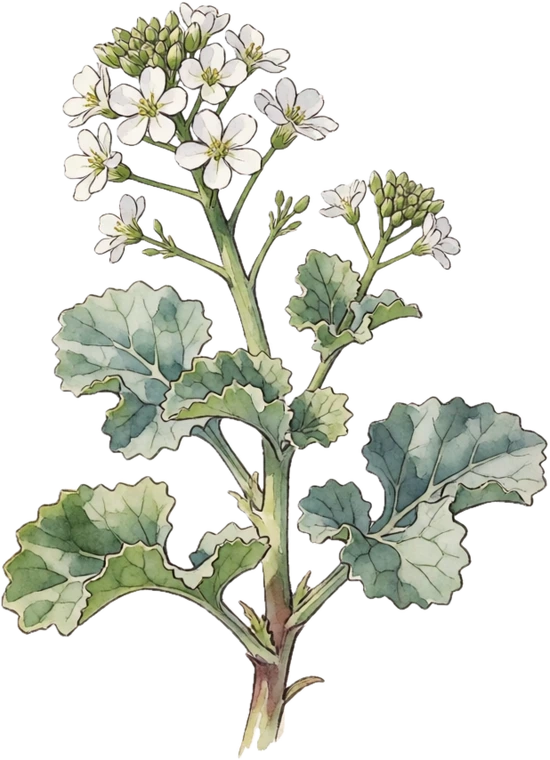
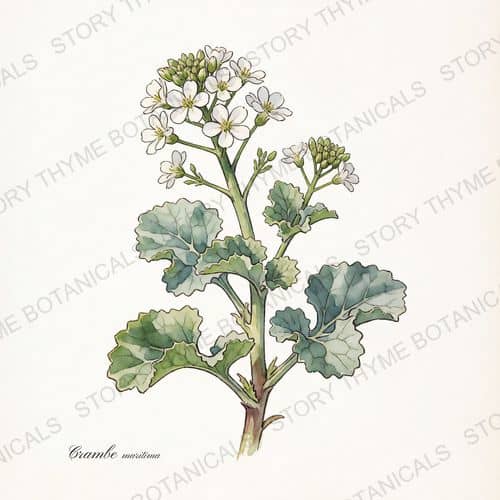
Botanical illustration of Sea Kale
Perennial · Crambe maritima

A perennial vegetable the Victorians prized and we forgot — blanched spring shoots that eat like nutty asparagus, from a handsome blue-leaved, honey-blooming plant that lives for decades in sandy soil. The ultimate permaculture vegetable: plant once, harvest for 20 years.

PerennialFull SunDrought-tolerant · low waterSlow to establish growthExcellent edibleAttracts bees

Where to buy the plant — 1 nursery

I

Overview

Will sea kale suit your garden, and what goes wrong.

Will it fruit where you are?

Enter your ZIP — we look up your USDA hardiness zone (2023 map) and check it against what sea kale actually needs.

Hardy inZones 4-9

Sea Kale at a glance

HardinessUSDA 4–9
Mature size2-3 ft blue-green mound
PollinationHoney-scented white clouds mob with bees
Chill requirementNot yet established
Bloom seasonLate Spring (white honey-scented domes)
Harvest seasonBlanched spring shoots (like asparagus); young leaves cooked; flower buds like broccoli
Growth rateSlow to establish, then decades

Common sea kale problems

II

Growing

Light, water, soil, propagation and the season’s jobs.

How to grow sea kale: light, water & soil

LightFull Sun
WaterLow — a seaside plant, salt- and drought-proof
SoilSandy, sharp drainage · pH 6.0 - 7.5
FertilizerLight compost yearly
PruningCut back in fall — Force tender white shoots by covering the crown in early spring with a pot (traditional 'sea kale forcing').
Spacing2-3 ft

How to plant & propagate sea kale

Maturityperennial (crop year 2-3)
From seedSow or plant thongs; slow to establish, then decades
PropagateFrom seed or division

When to spray sea kale

Growing season. Row cover the edible shoots.

The sea kale growing playbook

Field-tested instructions for every job sea kale asks of you, compiled from university extension guidance — in the order the season brings them.

Sowing

Sow sea kale seed in pots in a cold frame

Sow seed into pots in a cold frame in spring, then grow the seedlings on before setting them into their permanent bed. Autumn sowing in a cold frame works equally well if you missed spring. Choose a site in full sun with well-drained soil and shelter from strong winds. Sea kale is a coastal shingle and sand plant, so it wants sharp drainage and sun; raising it in pots under a cold frame gets you even germination and a root system worth transplanting instead of losing small seedlings in open ground.

Feeding

Lime the bed to pH 7.0-7.2 before you ever plant sea kale

The autumn before planting, test the soil and lime to pH 7.0-7.2, incorporating it thoroughly rather than leaving it on the surface. Lime reacts slowly, so getting it in months ahead of planting is the point. If you raise pH substantially, watch boron levels afterward. Sea kale is a brassica and susceptible to club root, whose resting spores persist in soil for years and germinate poorly in alkaline conditions. This is a perennial crop that sits in one bed for a decade, so you cannot rotate your way out of trouble later - pre-plant pH is the only lever you get.

Lime well ahead of planting and incorporate thoroughly; monitor boron when pH is raised. If club root is already confirmed in a bed, rotate out of brassicas for 7 years rather than planting a perennial into it.

Dividing

Take root cuttings (thongs) while the plants are dormant

In winter, lift and cut 8-10 cm sections from the side roots and hold them cool and at high humidity until you plant them out. Root cuttings are the most efficient way to propagate sea kale and give you plants true to the parent. Sea kale regenerates readily from root pieces, and a cutting carries enough stored energy to throw up new sprouts on its own. Seedlings vary; a thong is a clone of a plant you already know cropped well.

Cuttings dry out fast once lifted - keep them cool and humid until planting or they will fail.

Divide established sea kale crowns in early spring

In early spring, lift a crowded old crown and split it, replanting divisions with healthy root attached. This is the simplest way to increase a planting if you did not take root cuttings over winter. Division in early spring catches the plant as it breaks dormancy, so the pieces re-root while the crown is already pushing new growth rather than sitting cut and idle.

Pruning

Cut sea kale down to ground level in autumn

Once the leaves yellow and abscise in autumn, cut the whole plant down to ground level and clear the debris away from the crown. Growth stops and the foliage drops on its own as the season closes, so the top is finished doing anything useful. Clearing it removes the damp cover slugs overwinter in and leaves you a clean crown to find and cover when you force it in spring.

What to watch for

Check for slugs on emerging shoots after rain

Go out in the evening with a flashlight after cloudy or rainy weather and look for irregular holes and slime trails around the crowns and under nearby debris. Handpick and drown them in soapy water, or set a board out overnight and kill what gathers underneath each morning. Water in the morning so the bed dries by dusk, and clear excess leaf mulch in spring. If you bait, iron phosphate or ferric sodium EDTA pellets go on the soil near the plants in late afternoon. Slugs and caterpillars are the pests sea kale actually gets, and emerging shoots are the vulnerable stage - a mature plant shrugs off chewing but young growth can be destroyed outright. Slugs shelter in exactly the cool shaded damp a blanching pot creates.

Metaldehyde baits are highly toxic to dogs - do not use where pets have access. Iron phosphate and ferric sodium EDTA are the safer choices around children and pets. Scatter bait on the soil, never on open flowers.

Protection

Blanch the crown in total darkness as the first shoots stir

As the first spring shoots begin to move at the crown, cover the plant with a lightproof pot, bucket or traditional forcing pot to exclude light completely. Allow roughly four weeks under cover - sprouts take about 28 to 30 days to reach harvest size in the dark. Keep the cover fully lightproof; any leak defeats the purpose. Excluding light stops chlorophyll forming, so the shoots come up pale, sweet and tender instead of green and bitter. This is not a garnish step - unblanched sea kale shoots are the reason most people who try the crop once never eat it twice.

Harvesting

Cut the blanched shoots, then uncover and let the plant feed itself

About 28 to 30 days after covering, lift the pot and cut the pale shoots at the crown while they are still crisp and tender. Take your cut, then remove the cover for the rest of the season and let the plant leaf out fully. Cook the shoots like asparagus; the young leaves and the flowering shoots are also edible. Yield per crown runs anywhere from 30 to 120 g depending on how much root biomass the plant has built, so the foliage it makes after harvest is literally next spring's crop. Keep cutting or keep it covered and you are eating the root reserves that would have fed the following year.

III

The year

What sea kale asks for, month by month.

The sea kale year, month by month

MonthJanFebMarAprMayJunJulAugSepOctNovDec
Bloom
Prune
Harvest

What each band means

  • Bloomflowers open — pollinators working, frost on blossoms is the danger.
  • Pruneshape it now — cuts heal cleanly and structure is visible.
  • Harvestpicking time — check ripeness every few days.

The sea kale year as text

  • Jan quiet month
  • Feb quiet month
  • Mar harvest
  • Apr harvest
  • May bloom, harvest
  • Jun quiet month
  • Jul quiet month
  • Aug quiet month
  • Sep pruning
  • Oct pruning
  • Nov pruning
  • Dec quiet month

These are the species' typical months — expect them a few weeks earlier in warm zones and later in cold ones. Watch the plant, not just the calendar.

IV

Ecology & uses

What it does for the garden, and what it is grown for.

Sea Kale in the garden system

  • Herbaceous layer perennial
AttractsBees
MoistureUpland / dry
DeerBrowsed — protect young plants
OriginIntroduced

What sea kale is grown for

✓ Commonly eatencooked

UseBlanched spring shoots
UsePerennial veg
UseEdible ornamental
Edible value4/5

Harvesting & storing sea kale

Blanched spring shoots (like asparagus); young leaves cooked; flower buds like broccoli. About perennial (crop year 2-3) from planting.

Edibility, identification, and traditional-use notes here are general reference — not medical or veterinary advice, and not a claim that any plant treats or prevents anything. Medicinal ratings record how strongly a plant features in herbal tradition, nothing more. Never eat or dose a plant you have not positively identified. More on how to use this library.

V

Cultivars

Named varieties of sea kale, ruled as a catalogue.

Best sea kale varieties & cultivars

1 on file

Named varieties of sea kale differ in winter-chill needs, ripening time, hardiness, and whether they set fruit on their own — pick one that fits your climate.

Improved Lilywhite · Improved Lily White; Lilywhite

RipensBlanched shoots in early springZones5-7SizeLow mound of thick succulent leaf rosettes held close to the ground; ultimate height to about 0.5-1 m (roughly 1.5-3 ft) when the flowering stems rise, per RHS for 'Lilywhite'

Mild shoots, finer than wild seakale; pods sweet and crunchy with a slight radish note — A reselection of the old Victorian Lilywhite by Chris Homanics of Head, Hands, Heart Nursery in Washington, made over several cycles of selection for vigor and drought resistance. Named for the pale blue-green ('lily white') color of the foliage. Wants neutral to slightly alkaline soil and consistent moisture in full sun to part shade; dislikes excessive heat or drought. Honey-scented flowers draw pollinators and beneficial insects. Zone floor is the seed source's 'hardy to Zone 5 with mulching'; the upper end reflects nursery listings of the straight species at 5b-7b and the vendor's own note that it dislikes excessive heat - not a figure taken from an extension source. Size is from the RHS profile for the parent cultivar 'Lilywhite' (https://www.rhs.org.uk/plants/81197/crambe-maritima-lilywhite/details), not from the seed vendor, which gives no height.

Where to buy ‘Improved Lilywhite

Story Thyme Farms may earn a small commission from these links, at no cost to you — it never changes what we recommend.

VI

Sources & plant ID

Where the care distinctions come from, and how the plant is filed.

Research basis

Sources behind this profile

No extension citations are attached to sea kaleyet. The care figures below come from the library's own catalogue rather than a traced primary source.

Plant ID

BinomialCrambe maritima
FamilyBrassicaceae
TypePerennial
USDA symbolCRMA
OriginIntroduced
Invasive riskLow

VII

Where to buy

Third-party nurseries — not Story Thyme Farms.

Third-party nurseries, not Story Thyme Farms. Prices are theirs.

Story Thyme Farms may earn a small commission from these links, at no cost to you — it never changes what we recommend.

VIII

Questions

Sea Kale questions, answered straight.

Is sea kale safe for kids and pets?

Sea Kale is commonly eaten and isn't considered toxic, but "commonly eaten" isn't a guarantee for any particular person or animal — allergies, quantity, and which part you eat all matter. One caveat on this one: cooked. Never eat a plant you haven't positively identified, and check with a vet before letting pets or livestock graze anything new.

When do you harvest sea kale?

Blanched spring shoots (like asparagus); young leaves cooked; flower buds like broccoli. From planting, expect about perennial (crop year 2-3) to maturity.

How do you propagate sea kale?

From seed or division.

IX

Elsewhere

Where sea kale sits in the library.

Where sea kale sits in the library

Grows in the same world