The illustrated growing guide

Pumpkin

Cucurbita pepo / maxima

Family Cucurbitaceae

Grown as an annual

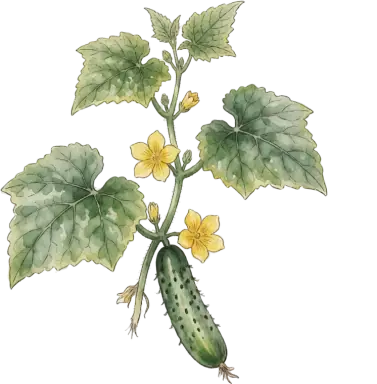
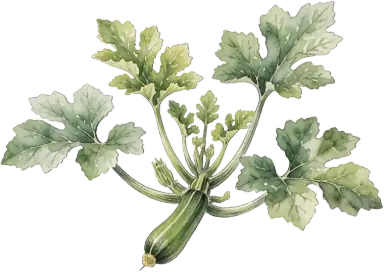
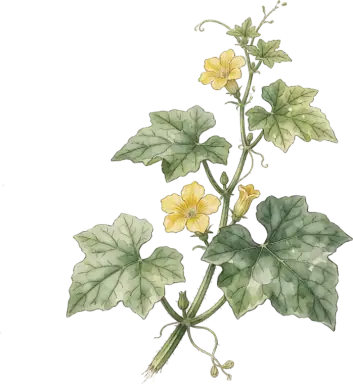
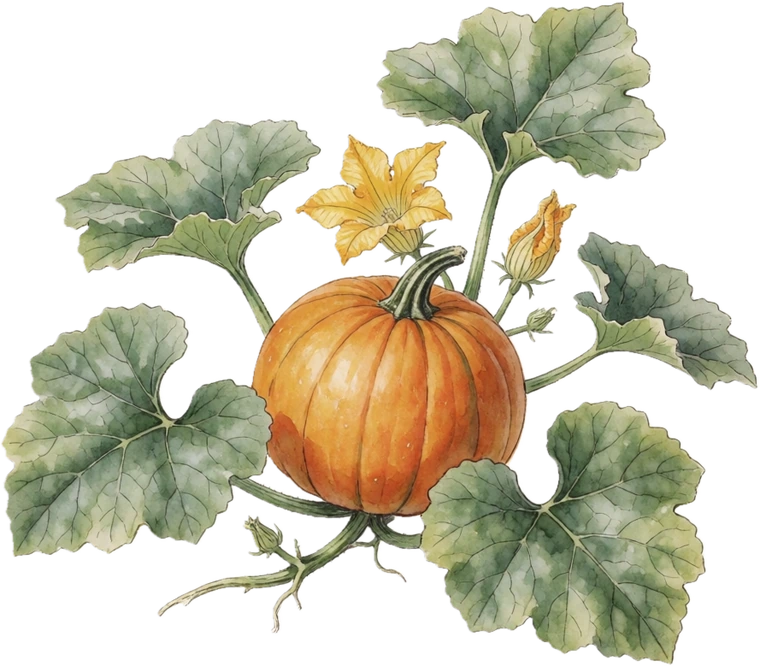
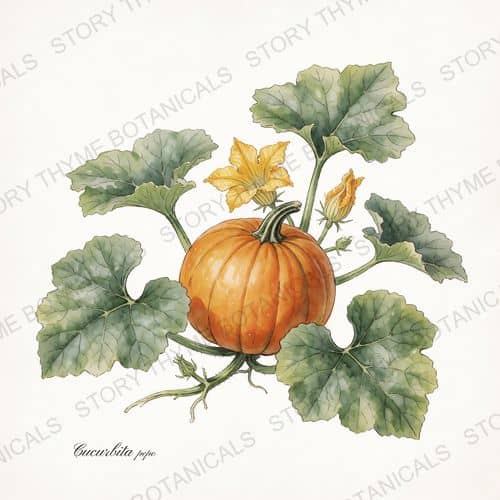
Botanical illustration of Pumpkin
Annual · Cucurbita pepo / maxima

Sow the first week of June for Halloween timing. Pie and carving are different vegetables: 'Winter Luxury' makes silk custard, 'Howden' makes walls.

AnnualFull SunModerate waterFast growthExcellent edibleAttracts beesNone winter chill

Where to buy the plant — 3 nurseries

Delicata — a print from the Heirloom Pumpkins collection

From the print shop

The closest print we make

Our Heirloom Pumpkins collection carries Cucurbita pepo — the same species as pumpkin — but the print shows “Delicata,” a different cultivar of it, not pumpkin itself.

16 designsfrom $21.99white or black groundmatte poster, unframed

Shop Heirloom Pumpkins botanical prints →

I

Overview

Will pumpkin suit your garden, and what goes wrong.

Will it fruit where you are?

Enter your ZIP — we look up your USDA hardiness zone (2023 map) and check it against what pumpkin actually needs.

Life cycleAnnual
Winter chillNone

Pumpkin at a glance

Life cycleAnnual
Mature sizeVines 10-20 ft
PollinationMonoecious — bees (hand-pollinate for guaranteed jack-o'-lanterns)
Chill requirementNone (not chill-dependent)
Bloom seasonSummer
Harvest seasonSeptember - October: rind deep-colored, stem corked; cure 10 days warm
Growth rateFast

Common pumpkin problems

II

Growing

Light, water, soil, propagation and the season’s jobs.

How to grow pumpkin: light, water & soil

LightFull Sun
WaterModerate-High at fruit set; taper at ripening
SoilRich hills, lots of compost · pH 6.0 - 6.8
FertilizerHeavy feeder — compost + monthly feed until fruit set
PruningNone — Set young fruit upright on cardboard; pinch vine tips after 3-4 fruit; leave 3-4 in of stem at cut (no stem = fast rot).
Spacing4-6 ft, vines to 20

How to plant & propagate pumpkin

Maturity90-120 days
From seedDirect-sow early June, soil 70°F+
PropagateFrom seed

When to spray pumpkin

Growing season. Same battle plan as squash: crush egg clusters weekly, milk-spray mildew, resistant types.

The pumpkin growing playbook

Field-tested instructions for every job pumpkin asks of you, compiled from university extension guidance — in the order the season brings them.

Sowing

Direct-sow pumpkin once the soil is truly warm

Wait until all frost danger has passed and soil temperature is consistently above 70F, then sow 3 to 5 seeds 1 to 2 inches deep per hill. Space hills 4 to 6 feet apart for smaller varieties and 6 to 8 feet apart for larger ones. Pumpkins resent root disturbance and are normally direct-sown; where the frost-free season is too short, start them indoors only in plantable pots so the rootball is never broken. Pumpkin seed is a warm-soil germinator that rots rather than sprouts in cold wet ground, and the crop needs 75 to 100 frost-free days to color up, so the sowing date has to buy the whole season at once.

Feeding

Side-dress nitrogen when the first fruits set

Side-dress alongside the rows when fruits first begin to develop. Scratch the fertilizer in shallowly a few inches out from the crown and water it in. Fruit set is when the plant's demand swings from building vine to filling fruit, and nitrogen delivered earlier mostly grows leaves. Feeding at set puts the nutrients where the pumpkin is actually being made.

Keep dry fertilizer off the leaves and away from the crown, and water it in.

Thinning

Thin each hill to two or three plants

Once seedlings have their first true leaves, cut the weakest ones off at soil level and leave 2 to 3 vigorous, well-spaced plants per hill. Every seed in the hill was insurance against poor germination. Left standing, they crowd each other into shaded, humid growth that yields small fruit and holds leaf moisture for disease.

Cut rather than pull, so you don't tear the roots of the seedlings you are keeping.

What to watch for

Count cucumber beetles and squash bug egg masses

Walk the field borders first, where beetles congregate. On pumpkin the action threshold is 5 cucumber beetles per plant. For squash bug, check leaf undersides during early flowering and treat 1 egg mass per plant as the threshold. In a garden, crushing the bronze egg masses by hand is the most effective control. Cucumber beetles transmit bacterial wilt, but that disease takes hold in muskmelon and cucumber rather than squash and pumpkin, so pumpkin tolerates far more beetles before feeding damage alone justifies acting.

Do not spray an insecticide onto open pumpkin flowers. The crop depends entirely on bees, and a fruit set lost to a poorly timed spray costs more than the beetles would have.

Scout leaf undersides for powdery mildew at the 1-in-50 threshold

Starting when the first female flowers open, examine the upper and lower surfaces of five older leaves at each of 10 sites. The action threshold is one leaf with symptoms out of 50 older leaves examined. Check your most susceptible and earliest-fruiting varieties first. The fungus develops best on the lower leaf surface, where you will not see it from standing height, and finding it there is the only way to begin treatment while it can still be held. Waiting past this threshold compromises control and promotes fungicide resistance.

Spraying

Powdery mildew: spray at threshold, and rotate FRAC groups

Once scouting hits one symptomatic leaf in 50, spray a targeted mobile fungicide tank-mixed with a contact protectant such as chlorothalonil, maximizing spray coverage on the leaf undersurfaces. Rotate among unrelated chemistries by FRAC code across sprays, for example a DMI (FRAC 3) such as Procure, then Vivando (FRAC 50), then Gatten (FRAC U13). Where you use a DMI, the highest label rate is recommended, because the pathogen has become less sensitive to that chemistry. A contact fungicide alone cannot reach the lower leaf surface where the fungus actually colonizes, which is why weekly protectant-only programs still end in severe mildew. Losing the leaves early leaves the fruit with soft handles, poor rind color, and sunscald.

Strains resistant to these fungicides are present throughout the United States, including New York, so never make back-to-back applications from the same FRAC group. Observe the pre-harvest interval on the product you use: Cornell lists Vivando at 0 days, Procure at 0 days, Quintec at 3 days and Proline at 7 days. PHIs and rates are legal limits set by the label of the product in your hand, which supersedes any list here.

Protection

Row-cover against squash vine borer, then pull the cover at flowering

Float row cover over the plants when the vines start to run or when you first see the moths, and seal the edges so adults cannot crawl under. Keep it on until about two weeks after the first borer is seen. Remove the cover as soon as the plants flower. Timing is regional: in the northern US there is one generation and adults emerge from cocoons in the ground in late June or early July, while southern growers see adults much earlier and a second generation, so confirm local emergence timing with your state extension rather than working from a date. There is a narrow window to act. Once a larva chews into the stem it is sealed inside where nothing sprayed on the outside reaches it, so the whole game is keeping the moth from laying on the stem base.

Never leave row cover on a flowering pumpkin. The flowers are bee-pollinated and a covered plant sets no fruit. If borers were bad last year, rotate the planting well away from that ground.

Harvesting

Cut when the rind is hard, then cure warm for ten days

Harvest when the fruit has a uniform orange color and a rind hard enough to resist a thumbnail. Cut, don't tear, leaving a 3- to 4-inch handle of stem. Cure at 80 to 85F and 80 to 85 percent relative humidity for about 10 days, then store at 50 to 55F in a cool, dry, well-ventilated place. Curing hardens the rind and heals cuts and scratches that would otherwise be the entry wound for the rots that hollow a pumpkin out in storage. Cured and stored properly, fruit holds 2 to 3 months.

Get the fruit in before a hard freeze. A light frost destroys the vines without harming the pumpkins, but never carry a pumpkin by its handle, as a snapped stem is an open wound and the fruit will not keep.

Pumpkin companion plants

Good companions

Underlined names have their own growing guide in this library.

III

The year

What pumpkin asks for, month by month.

The pumpkin year, month by month

MonthJanFebMarAprMayJunJulAugSepOctNovDec
Bloom
Harvest

What each band means

  • Bloomflowers open — pollinators working, frost on blossoms is the danger.
  • Harvestpicking time — check ripeness every few days.

The pumpkin year as text

  • Jan quiet month
  • Feb quiet month
  • Mar quiet month
  • Apr quiet month
  • May quiet month
  • Jun bloom
  • Jul bloom
  • Aug bloom
  • Sep harvest
  • Oct harvest
  • Nov quiet month
  • Dec quiet month

These are the species' typical months — expect them a few weeks earlier in warm zones and later in cold ones. Watch the plant, not just the calendar.

IV

Ecology & uses

What it does for the garden, and what it is grown for.

Pumpkin in the garden system

  • Vine layer annual
AttractsBees
MoistureFacultative / average
DeerBrowsed — protect young plants
OriginIntroduced

What pumpkin is grown for

✓ Commonly eaten

UseJack-o'-lanterns
UsePie
UseFall decor
UseSeeds
Edible value4/5

Harvesting & storing pumpkin

September - October: rind deep-colored, stem corked; cure 10 days warm. About 90-120 days from planting.

Edibility, identification, and traditional-use notes here are general reference — not medical or veterinary advice, and not a claim that any plant treats or prevents anything. Medicinal ratings record how strongly a plant features in herbal tradition, nothing more. Never eat or dose a plant you have not positively identified. More on how to use this library.

V

Cultivars

Named varieties of pumpkin, ruled as a catalogue.

Best pumpkin varieties & cultivars

12 on file

Named varieties of pumpkin differ in days to maturity, disease resistance, flavor, and habit — pick one that fits your season and space.

Howden · Howden Field

Self-fertile
Zones2-11Diseasesusceptible to powdery mildewSize15-25 lb

The standard large jack-o-lantern and the benchmark carving pumpkin. It has no powdery mildew resistance, so it needs a real mildew program to hold its handle. Listed by Illinois Extension among large standard orange types at 100-110 days, though seed sources commonly rate it nearer 115, so treat it as a long-season variety.

Where to buy ‘Howdenverified

Story Thyme Farms may earn a small commission from these links, at no cost to you — it never changes what we recommend.

Connecticut Field

Self-fertile
Zones2-11Size15-25 lb

An old open-pollinated large orange field type, so you can save seed from it, unlike the F1 carving hybrids.

Where to buy ‘Connecticut Field

Story Thyme Farms may earn a small commission from these links, at no cost to you — it never changes what we recommend.

Small Sugar · New England Pie

Self-fertile
Zones2-11Size2-5 lb

sweet, fine-grained — The classic pie pumpkin, small enough that a single fruit is one baking session.

Where to buy ‘Small Sugar

Story Thyme Farms may earn a small commission from these links, at no cost to you — it never changes what we recommend.

Baby Pam

Self-fertile
Zones2-11Size2-5 lb

sweet — A compact pie type in the same 2 to 5 pound class as Small Sugar.

Where to buy ‘Baby Pam

Story Thyme Farms may earn a small commission from these links, at no cost to you — it never changes what we recommend.

Winter Luxury

Self-fertile
Zones2-11Size2-5 lb

smooth, prized for pie — A netted-skin heirloom pie pumpkin in the small standard-orange class.

Where to buy ‘Winter Luxury

Story Thyme Farms may earn a small commission from these links, at no cost to you — it never changes what we recommend.

Autumn Gold

Self-fertile
Zones2-11Size8-15 lb

Intermediate-size standard orange type, a manageable carving pumpkin for a small garden. Widely grown for turning gold early, so it is often listed at the short end of the 100-110 day class range.

Where to buy ‘Autumn Gold

Story Thyme Farms may earn a small commission from these links, at no cost to you — it never changes what we recommend.

Jack Be Little · Jack-Be-Little

Self-fertile
Zones2-11Sizeminiature, under 1 lb

Miniature ornamental, listed by Illinois Extension among the miniature pumpkin group.

Where to buy ‘Jack Be Littleverified

Story Thyme Farms may earn a small commission from these links, at no cost to you — it never changes what we recommend.

Atlantic Giant · Dill's Atlantic Giant

Self-fertile
Zones2-11Size50-100+ lb

coarse, not for eating — The competition giant, and the one variety here that genuinely needs a long season: about 120 days, versus 100 to 110 for standard orange types.

Where to buy ‘Atlantic Giantverified

Story Thyme Farms may earn a small commission from these links, at no cost to you — it never changes what we recommend.

Lumina

Self-fertile
Zones2-11

White-skinned specialty pumpkin grown for painting and display rather than carving.

Where to buy ‘Lumina

Story Thyme Farms may earn a small commission from these links, at no cost to you — it never changes what we recommend.

Triple Treat

Self-fertile
Zones2-11

Naked-seeded, meaning the seeds have no hull and can be roasted straight from the fruit. Listed by Illinois Extension among the naked-seeded group, and it carves as well as it seeds.

Where to buy ‘Triple Treat

Story Thyme Farms may earn a small commission from these links, at no cost to you — it never changes what we recommend.

Progress

Self-fertile
Zones2-11Diseasehomozygous resistant to powdery mildewSize10.6 lb average

In a 2017 Cornell trial Progress was the only variety able to significantly suppress powdery mildew on both leaf surfaces unsprayed, and kept the best handle quality at 49 percent good handles by mid-October. Resistance is a component of a program, not a replacement for one.

Where to buy ‘Progress

Story Thyme Farms may earn a small commission from these links, at no cost to you — it never changes what we recommend.

Eureka · Eureka F1

Self-fertile
Zones2-11Diseasehomozygous resistant to powdery mildew

One of the homozygous powdery-mildew-resistant Halloween types in Cornell's 2017 trial, alongside Magnum and Millionaire. Resistant varieties still needed a fungicide program to reach top handle quality.

Where to buy ‘Eureka

Story Thyme Farms may earn a small commission from these links, at no cost to you — it never changes what we recommend.

VI

Sources & plant ID

Where the care distinctions come from, and how the plant is filed.

Research basis

Sources behind this profile

No extension citations are attached to pumpkinyet. The care figures below come from the library's own catalogue rather than a traced primary source.

Plant ID

BinomialCucurbita pepo / maxima
FamilyCucurbitaceae
TypeAnnual
USDA symbolCUPE
OriginIntroduced
Invasive riskLow

VII

Where to buy

Third-party nurseries — not Story Thyme Farms.

Third-party nurseries, not Story Thyme Farms. Prices are theirs.

Story Thyme Farms may earn a small commission from these links, at no cost to you — it never changes what we recommend.

VIII

Questions

Pumpkin questions, answered straight.

Is pumpkin safe for kids and pets?

Pumpkin is commonly eaten and isn't considered toxic, but "commonly eaten" isn't a guarantee for any particular person or animal — allergies, quantity, and which part you eat all matter. Never eat a plant you haven't positively identified, and check with a vet before letting pets or livestock graze anything new.

When do you harvest pumpkin?

September - October: rind deep-colored, stem corked; cure 10 days warm. From planting, expect about 90-120 days to maturity.

What grows well with pumpkin?

Proven companions include corn, beans, nasturtium — the full companion list, and what to keep away, is in the Growing tab above.

How do you propagate pumpkin?

From seed.

IX

Elsewhere

Where pumpkin sits in the library.

Where pumpkin sits in the library

Grows in the same world