The illustrated growing guide

Tatsoi

Brassica rapa subsp. narinosa

Family Brassicaceae

Grown as an annual

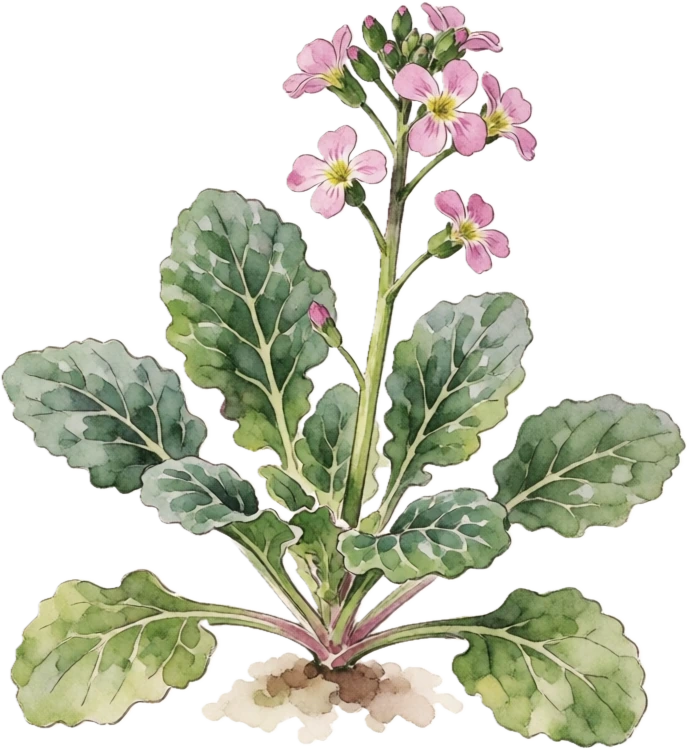
Botanical illustration of Tatsoi
Annual · Brassica rapa subsp. narinosa

A gorgeous, super-hardy little cabbage relative that forms flat rosettes of glossy dark-green spoons, sweetening in cold and standing through frosts that flatten other greens. Mild and mustardy — baby leaves in salad, whole heads in the wok. One of the best winter greens for a cold frame.

AnnualFull Sun to Part ShadeModerate waterFast growthExcellent edibleAttracts beesNone winter chill

Where to buy the plant — 1 nursery

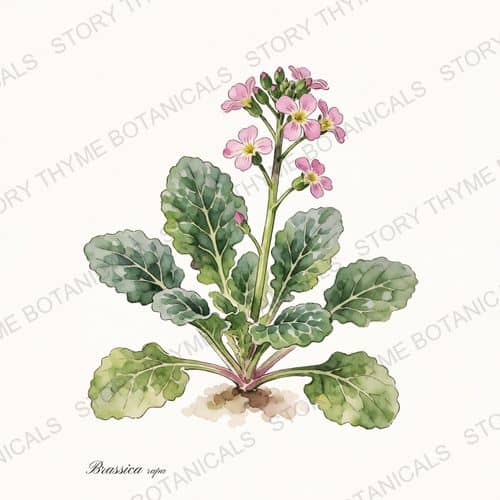
Turnip — a print from the Roots & Alliums collection

From the print shop

The closest print we make

Our Roots & Alliums collection carries Brassica rapa subsp. rapa — the same species as tatsoi — but the print shows “Turnip,” a different cultivar of it, not tatsoi itself.

16 designsfrom $21.99white or black groundmatte poster, unframed

Shop Roots & Alliums botanical prints →

I

Overview

Will tatsoi suit your garden, and what goes wrong.

Will it fruit where you are?

Enter your ZIP — we look up your USDA hardiness zone (2023 map) and check it against what tatsoi actually needs.

Life cycleAnnual
Winter chillNone

Tatsoi at a glance

Life cycleAnnual
Mature size6-10 in rosettes
PollinationBolting flowers feed bees
Chill requirementNone (not chill-dependent)
Bloom seasonBolts in heat
Harvest seasonFall & winter: flat dark-green spoon-leaf rosettes, very COLD-hardy (harvest under frost); mild and mustardy
Growth rateFast

Common tatsoi problems

II

Growing

Light, water, soil, propagation and the season’s jobs.

How to grow tatsoi: light, water & soil

LightFull Sun to Part Shade
WaterModerate
SoilRich, moist · pH 6.0 - 7.0
FertilizerLight
PruningNone — An exceptionally cold-hardy Asian green that presses flat to the ground in a beautiful dark-green rosette and keeps producing through hard frosts (to around 15°F). Baby leaves for salad, whole rosettes for stir-fry. A star of the winter cold frame.
Spacing6-8 in

How to plant & propagate tatsoi

Maturity45 days
From seedSow late summer for fall; very cold-hardy
PropagateFrom seed

When to spray tatsoi

Growing season. Row cover for flea beetle.

The tatsoi growing playbook

Field-tested instructions for every job tatsoi asks of you, compiled from university extension guidance — in the order the season brings them.

Sowing

Main crop: direct-seed for fall and winter cutting

Direct-seed tatsoi a quarter to a half inch deep in late summer to early fall, timing sowings so the stand matures as temperatures fall, and repeat every couple of weeks for a continuous supply. Sow thickly rather than in careful stations, then thin as you cut - the crowded stand smothers weeds and the thinnings are salad. Cut leaves about an inch above the ground for cut-and-come-again. Expect baby leaf in roughly three to four weeks and full 8-inch rosettes in six to seven, depending on variety and how cold it is running. Tatsoi is a cool-season brassica that builds its sweet, tight rosette in falling temperatures, and fall sowings run into cold as they mature, which is the direction that suppresses bolting. It is normally direct-seeded: brassica greens establish easily from seed, and transplant stress is itself one of the triggers that sends the plant to seed.

Spring sowing: get it in and out before heat

You can sow a spring crop as soon as the soil can be worked, but plan to cut it at baby-leaf size rather than waiting for full rosettes. Do not rush seed into cold soil to gain a week, and do not let a spring stand sit once warm weather arrives. Asian brassica greens bolt in response to cold temperatures in spring as well as to transplant stress - a seedling chilled early reads it as a completed winter and runs to seed. Spring plantings then finish into rising heat, which pushes the same result, so the spring window is genuinely narrower than the fall one.

Feeding

Band nitrogen at seeding, and do not overdo it

Work fertilizer into a band near the seed row at sowing rather than broadcasting it wide. Leafy greens as a class want the equivalent of 75 to 150 pounds of nitrogen per acre over the crop, with soil pH held at 6.5 to 7.5. Cut the rate back if the bed got manure or compost, or if it follows a legume cover crop. Tatsoi has a shallow root system living mostly in the top foot of soil, so it responds to banded fertilizer it can actually reach and wastes broadcast nitrogen. Excess nitrogen is not free yield either - it produces soft, watery growth that invites aphids and tipburn.

What to watch for

Flea beetles: check young plants, treat at one beetle per plant

Walk the bed and look at seedlings for shot-hole feeding. On young plants, treat when you average about one beetle per plant or roughly 10 percent leaf damage. If you need a material, spinosad (sold as Entrust in the organic formulation) gave the best control in UMass trials; kaolin clay (Surround WP) is the non-toxic alternative but needs constant agitation to stay in suspension. Tatsoi is susceptible from emergence right through to harvest, not just at one stage, and because you eat the leaf there is no cosmetic slack. Seedlings are where the damage compounds - beetle feeding that stunts a cotyledon costs you the whole plant, while the same beetles on an established rosette cost you a few holes.

Follow the label's days-to-harvest interval; systemic insecticides carry noticeably longer intervals than contact products, and tatsoi is often cut within days of a spray, so time the application to the next cutting and not to your convenience. Do not spray any insecticide on a stand that has bolted into flower - bees work brassica bloom hard.

Spraying

Cabbageworms and diamondback moth: Bt while the caterpillars are small

Scout for green larvae, frass and chewed leaves, and spray Bacillus thuringiensis while the caterpillars are still small. Bt is the right call when diamondback moth is the species you are finding, or when any of them are caught young. Spinosad works on larger larvae that Bt will no longer touch, but it is less selective. Bt has to be eaten to work and it kills small larvae far more reliably than large ones, so a late spray simply fails - the pesticides are less effective once the caterpillars have size on them. Bt also spares the parasitoid wasps and predators that carry the rest of your season, which a broad-spectrum material would remove along with the pest.

Always follow the label and observe the stated number of days between application and harvest. Never spray an insecticide on plants in flower.

Protection

Row cover over the bed the day you seed it

Lay spun-bonded row cover or insect mesh over the bed immediately after seeding, and secure every edge with soil or sandbags - a gap anywhere is an open door. If you need to cultivate, pull the cover and put it back the same day. Also site this planting as far as you can from where you grew brassicas last season. Tatsoi has glossy, unwaxed leaves, which puts it in the group of brassicas flea beetles find most attractive, and unlike a cabbage the whole damaged leaf is the product you are selling or eating. Flea beetles overwinter in and near last year's brassica ground, so distance plus an intact barrier beats spraying them after they arrive.

Row cover on hoops for winter standing

For winter harvest, hold tatsoi under a medium-weight row cover supported on hoops rather than laid on the leaves. Under an unheated tunnel this combination carries tatsoi through the dead of winter. Add a second layer if you are trying to keep the greens from freezing outright on the coldest nights. Tatsoi is one of the short list of greens - with spinach, mache, claytonia and minutina - that actually survives the dead of winter under cover rather than merely finishing a fall crop. A medium-weight cover on hoops buys 5 to 10 degrees F, and more on the coldest nights, which is the margin that decides whether the crown lives.

Harvesting

Cut only after the leaves have thawed

Harvest with a sharp knife, cutting the rosette about an inch above the ground so it regrows, or take outer leaves and leave the center. In cold weather, wait for the plants to thaw before you cut - after a hard night that often means mid-morning. Frozen tatsoi leaves are brittle and rupture when cut or handled, so the cells collapse as they thaw and the harvest turns to slime in the box. Frost itself is not the problem - tatsoi sweetens under it - the problem is only cutting the tissue while it is still frozen.

III

The year

What tatsoi asks for, month by month.

The tatsoi year, month by month

MonthJanFebMarAprMayJunJulAugSepOctNovDec
Harvest

What each band means

  • Harvestpicking time — check ripeness every few days.

The tatsoi year as text

  • Jan harvest
  • Feb harvest
  • Mar quiet month
  • Apr quiet month
  • May quiet month
  • Jun quiet month
  • Jul quiet month
  • Aug quiet month
  • Sep harvest
  • Oct harvest
  • Nov harvest
  • Dec harvest

These are the species' typical months — expect them a few weeks earlier in warm zones and later in cold ones. Watch the plant, not just the calendar.

IV

Ecology & uses

What it does for the garden, and what it is grown for.

Tatsoi in the garden system

  • Herbaceous layer annual
AttractsBees
MoistureFacultative / average
DeerBrowsed — protect young plants
OriginIntroduced

What tatsoi is grown for

✓ Commonly eaten

UseWinter greens
UseSalad
UseStir-fry
UseCold frames
Edible value4/5

Harvesting & storing tatsoi

Fall & winter: flat dark-green spoon-leaf rosettes, very COLD-hardy (harvest under frost); mild and mustardy. About 45 days from planting.

Edibility, identification, and traditional-use notes here are general reference — not medical or veterinary advice, and not a claim that any plant treats or prevents anything. Medicinal ratings record how strongly a plant features in herbal tradition, nothing more. Never eat or dose a plant you have not positively identified. More on how to use this library.

V

Cultivars

Named varieties of tatsoi, ruled as a catalogue.

Best tatsoi varieties & cultivars

5 on file

Named varieties of tatsoi differ in days to maturity, disease resistance, flavor, and habit — pick one that fits your season and space.

Tatsoi · Rosette Bok Choy;Spoon Cabbage

RipensFall through winterZones2-11SizeRosette about 8 inches across

Mild, sweet, faintly mustardy; crunchy juicy stems — The open-pollinated standard: round, gently cupped green leaves on light green and white stems. Cold tolerant enough for cool greenhouses and tunnels from late summer and early fall sowings. It is also the fastest tatsoi to bolt, so it is a fall variety first and a spring variety only if you cut it small.

Where to buy ‘Tatsoiverified

Story Thyme Farms may earn a small commission from these links, at no cost to you — it never changes what we recommend.

Koji · Koji F1

RipensSpring through fall, and winter under coverZones2-11SizeFull size on long stems; 25 days to baby leaf

Mild, crunchy — Cupped, heavy, beautifully savoyed leaves on long elegant stems. Listed as both heat and cold tolerant for all-season production, which makes it the one tatsoi worth trusting outside the narrow fall window.

Where to buy ‘Koji

Story Thyme Farms may earn a small commission from these links, at no cost to you — it never changes what we recommend.

Red Cloud · Red Cloud F1;Red Tatsoi

RipensFall through winterZones2-11SizeUniform and upright; 8-12 inch spacing for full size; 28 days to baby leaf

Mild, juicy, crunchy — Rich burgundy, beautifully cupped and rounded leaves that hold their color through the baby-leaf window. Cold tolerant for cool greenhouses and tunnels from late summer and early fall sowings.

Where to buy ‘Red Cloud

Story Thyme Farms may earn a small commission from these links, at no cost to you — it never changes what we recommend.

Rosette · Rosette Tatsoi

RipensFall into winter, harvestable under snowZones2-11SizeFlat rosette; sow 3 seeds every 6 inches, thin to one every 6 inches

Mild, slightly mustard-like — Open-pollinated, with spoon-shaped dark green leaves evenly spaced in a flat rosette. Rated to withstand temperatures down to 15 F and can be cut with snow on the ground. Sow a quarter inch deep in soil at least 60 F.

Where to buy ‘Rosetteverified

Story Thyme Farms may earn a small commission from these links, at no cost to you — it never changes what we recommend.

Yukina Savoy · Yukina

RipensFall, through early freezesZones2-11SizeLarge - to 16 inches across; 21 days to baby leaf

Mild young as salad; fuller for braising when mature — A tatsoi look-alike that grows in the same rosette but roughly twice the size, with more textured and less glossy foliage on pale stems. Survives early fall freezes. Cut young as a salad green or let it size up for braising.

Where to buy ‘Yukina Savoy

Story Thyme Farms may earn a small commission from these links, at no cost to you — it never changes what we recommend.

VI

Sources & plant ID

Where the care distinctions come from, and how the plant is filed.

Research basis

Sources behind this profile

No extension citations are attached to tatsoiyet. The care figures below come from the library's own catalogue rather than a traced primary source.

Plant ID

BinomialBrassica rapa subsp. narinosa
FamilyBrassicaceae
TypeAnnual
USDA symbolBRRA
OriginIntroduced
Invasive riskLow

VII

Where to buy

Third-party nurseries — not Story Thyme Farms.

Third-party nurseries, not Story Thyme Farms. Prices are theirs.

Story Thyme Farms may earn a small commission from these links, at no cost to you — it never changes what we recommend.

VIII

Questions

Tatsoi questions, answered straight.

Is tatsoi safe for kids and pets?

Tatsoi is commonly eaten and isn't considered toxic, but "commonly eaten" isn't a guarantee for any particular person or animal — allergies, quantity, and which part you eat all matter. Never eat a plant you haven't positively identified, and check with a vet before letting pets or livestock graze anything new.

When do you harvest tatsoi?

Fall & winter: flat dark-green spoon-leaf rosettes, very COLD-hardy (harvest under frost); mild and mustardy. From planting, expect about 45 days to maturity.

How do you propagate tatsoi?

From seed.

IX

Elsewhere

Where tatsoi sits in the library.

Where tatsoi sits in the library

Grows in the same world