Carrot

Daucus carota

Family Apiaceae

BiennialZones 2-11

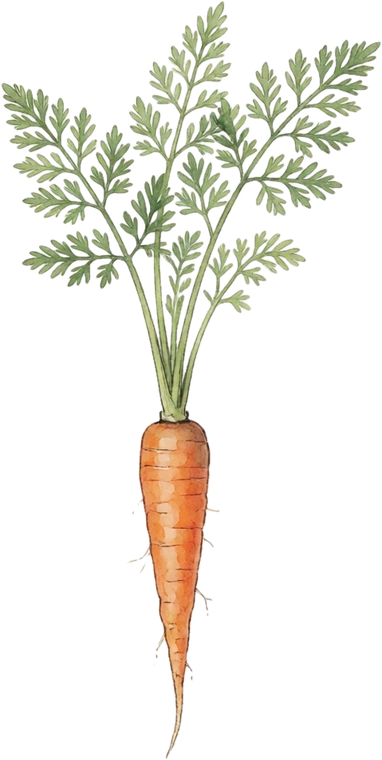
Botanical illustration of Carrot

Carrots pulled after the first frosts are candy — cold turns their starch to sugar, and the June-through-November harvest window means you can eat them at every stage from slim and tender to deep and sweet. Store roots never get to play that trick.

A carrot bed is the quietest plot in the garden — a foot of feathery green above, the actual crop biding its time below. The ferny tops feed bees and butterflies if any bolt to bloom. Sow a ribbon of seed in deep, loose ground and practice patience.

Where to buy carrot — 8 nurseries compared

  • Full Sun
  • Moderate water
  • Slow growth
  • Excellent edible
  • Attracts bees
  • Attracts butterflies
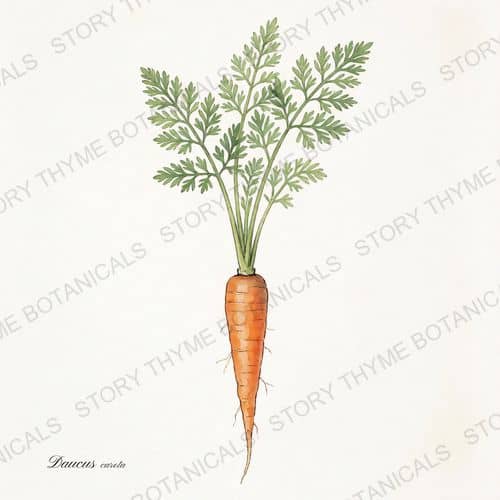
Carrot — a print from the Plant Library collection

From the print shop

Growing carrot? Hang it.

Our Plant Library collection carries carrot — Daucus carota, print Nº 95, “Carrot.”

526 designsfrom $12.99white or black backgroundmatte poster, unframed

Shop Plant Library botanical prints →

✓

Will it fruit where you are?

Enter your ZIP — we look up your USDA hardiness zone (2023 map) and check it against what carrot actually needs.

Life cycleBiennial, grown as an annual

Carrot · Common problems

Common carrot problems

Pests, diseases and weather to keep an eye on.

Pests

4 problems on file

Diseases

7 problems on file

Carrot · Growing & propagation

Growing carrot

Light, water, soil, propagation and the season’s jobs.
What it needsThe details
Light
Full Sun
Water
Even moisture for germination (10-21 days!), then moderate
Soil
Deep, Loose, Stone-free Sandy Loam · pH 6.0 - 6.8
Fertilizer
Light

Fresh manure = forked freak-show carrots.

Pruning
None — None.
Spacing
2-3 inches after thinning

How to plant & propagate carrot

Maturity
60-80 days
From seed
Direct-sow (never transplant)

Slow to germinate; keep surface moist

Propagate
From seed

Carrot · Harvest & keeping

What you get from carrot

How long before it bears, how much it gives, how you know it is ready, and how long it keeps once picked.
Botanical illustration of Carrot
Years to first harvest
0 years
Typical yield
7–10 lbs per 10ft row
What you eat
Roots
How to tell it is ready
Harvest when roots reach usable size and good color

Loosen soil before pulling

How long it keeps
Weeks refrigerated

Longer in moist cold storage

Carrot · Seasonal care & spray guidance

The carrot growing playbook

Field-tested instructions for every job carrot asks of you, compiled from university extension guidance — in the order the season brings them.

When to spray carrot

Growing season. Row cover at sowing blocks rust fly completely.

As growth begins

early spring

2 jobs
SowingIn spring

Direct-sow carrots once the soil hits 40F

Sow seed 1/4 inch deep directly where the carrots will grow, in rows 12 to 18 inches apart, starting about 2 to 3 weeks before your last frost once soil has reached 40F. Cover the row with 1/8 inch of vermiculite, sifted compost or sawdust rather than crusting soil, and keep the surface damp for the full 14 to 21 days it takes to emerge. Never start carrots in cells and transplant them. Carrot seed is tiny and sown shallow, so the top quarter-inch is its whole world - if that layer dries or crusts over during the two to three weeks it needs to germinate, the stand fails. Seed germinates best at 55 to 65F, which is why it goes in while the soil is still cool. Transplanting bends the taproot and every disturbed root forks.

ThinningIn spring

Thin seedlings to 2-3 inches, and do it early

When seedlings are 1 to 2 inches tall with 3 to 4 true leaves, pull the extras so the survivors stand 2 to 3 inches apart in the row. Snip crowded ones at the soil line rather than yanking if neighbors are tangled. Do it in one pass while the roots are still threads. A carrot root can only fill the space it is given - crowded plants trade root for top and give you a mat of hairy, twisted fingers instead of clean roots. Thinning late means every pull tears the neighbor's taproot, and a torn taproot forks.

Through summer

the growing season

4 jobs
WateringThrough summer

Steady water: about an inch a week, no swings

Give roughly 1 inch of water per week, enough to wet the soil 6 inches deep, and aim for even moisture rather than a drought-then-flood cycle. Water in the morning with drip or a low hose so the foliage dries fast, and do not overwater. The root is mostly water, and it grows by steady expansion - let the soil dry hard and the carrot turns bitter and misshapen, then soak it and the swelling root splits its own skin. Overwatering does its own damage, pushing out hairy feeder roots and forking. Morning watering matters because the leaf blight fungi need 8 to 12 hours of continuous leaf wetness to infect, and evening water hands them exactly that.

FeedingThrough summer

One nitrogen sidedress about six weeks after emergence

About 6 weeks after the seedlings emerge, or once tops are about 4 inches tall, sidedress 1/4 cup of 21-0-0 per 10 feet of row and water it in. That is the whole nitrogen program - do not repeat it. Work any pre-plant fertilizer or compost into the top 6 inches before sowing, and hold compost to no more than 1 inch per 100 square feet. Carrots want a fertile, deep, loose soil but they punish excess nitrogen: it goes into leaf, not root, and rough or fresh amendments in the root zone are what produce forked and hairy carrots. One well-timed feed as the root starts sizing gets the growth without the tops taking over.

What to watch forThrough summer

Sweep for aster leafhoppers before yellows takes the crop

Once the tops are up, sweep the planting weekly: a 15-inch net swung in a 180-degree arc through the top 6 to 8 inches of foliage, 20 sweeps in each of 5 spots (100 sweeps total). Twenty aster leafhoppers per 100 sweeps is the threshold on aster-yellows-susceptible carrots. Pull and bin any plant showing yellowed, bunched multiple tops with a woolly mat of hairy rootlets, and cut down flowering broadleaf weeds nearby, which are where the leafhoppers pick the phytoplasma up. Aster yellows is a phytoplasma, not a fungus - the leafhopper injects it while feeding, and once a plant is infected the root goes bitter, hairy and worthless. Nothing sprayed on the leaf cures it, so the only lever is the insect and the weed reservoir it feeds on, and only counting tells you whether the population is anywhere near the level that matters.

SprayingThrough summer

Leaf blight: start at the first lesions, not before

Starting a few weeks after emergence, check 50 leaves a week from across the planting. When about 25 percent of them (roughly 12 of 50) carry dark, yellow-haloed lesions on leaflet margins or petioles, begin a fungicide labeled for carrot leaf blight, alternating it with a copper material, and repeat on a roughly two-week interval while warm, wet weather holds. Skip the spray entirely in a dry year - most home plantings never reach threshold. Alternaria dauci and Cercospora carotae both need long leaf wetness to infect - 8 to 12 hours at 61-77F for Alternaria, 12 hours at 68-86F for Cercospora - and both build from lesions already on the crop. Threshold spraying works because the first lesions are the spore source for everything after; spraying on a calendar before they appear just protects leaves nothing is attacking.

Harvest time

as it ripens, and picking

1 job
HarvestingAt harvest

Pull at 3/4 inch shoulders, and beat the heat on spring carrots

Roots are generally mature 70 to 100 days from seeding, though the fast Nantes types listed here can be ready sooner - check your variety's days to maturity, then scrape the soil at the crown and pull once shoulders reach about 3/4 inch across rather than guessing from the tops. Pull spring-sown carrots before real summer heat arrives. Trim tops to 1/2 inch, wash, and hold at 32 to 40F and 90 to 95 percent humidity, where they keep 2 to 4 months. A fall crop can stay in the ground under a heavy mulch and be dug through the winter instead. Carrots hold quality in cool soil and lose it in hot - a spring crop left past the heat turns coarse and off-flavored, which is why the cue here is heat, not a date. The tops tell you nothing about root size, so the shoulder is the only honest gauge. Cold, humid storage works because it slows respiration while stopping the root from shriveling.

After harvest

autumn, and putting it to bed

1 job
HarvestingAfter harvest

Clear every last root when the bed is done

When the bed is done, dig out the culls and forgotten roots as well as the keepers, and chop or turn the old tops into the soil promptly instead of leaving them lying. Harvest in blocks rather than picking over a bed for weeks. Then keep carrots and their relatives off that ground for 2 to 3 years. Both leaf blight fungi ride out the winter on undecomposed carrot debris, and Alternaria dauci dies as that debris breaks down - so turning it under is what ends the inoculum. Roots left in the ground are worse: carrot rust fly overwinters as pupae in the soil and sometimes as larvae inside those very roots, so every carrot you abandon is next year's first generation.

Carrot · Companion plants

Carrot companion plants

Good companions

Underlined names have their own growing guide in this library.

Carrot · Calculators & field guides

A little help in the garden.

Calculators for the figures. Field guides for the hands-on work.

Carrot · Yearly calendar

The carrot year, month by month

What carrot asks for, month by month.

Jan

No calendar activity is listed for this month.

MonthJanFebMarAprMayJunJulAugSepOctNovDec
Harvest

HarvestJune to November

What each band means

  • Harvest — picking time — check ripeness every few days.

These are the species' typical months — expect them a few weeks earlier in warm zones and later in cold ones. Watch the plant, not just the calendar.

Carrot · Ecology & uses

Ecology & uses

What it does for the garden, and what it is grown for.
Botanical illustration of Carrot

Daucus carota

Carrot in the garden system

  • Root layer biennial
  • Hosts Black swallowtail butterfly (foliage)
Attracts
Bees, Butterflies
Moisture
Facultative / average
Deer
Browsed

Protect young plants

Origin
Introduced

What carrot is grown for

✓ Commonly eaten

Use
Fresh
Use
Storage
Use
Roasting
Edible value
4/5

Harvesting & storing carrot

June - November, sweeter after frost. About 60-80 days from planting.

Edibility, identification, and traditional-use notes here are general reference — not medical or veterinary advice, and not a claim that any plant treats or prevents anything. Medicinal ratings record how strongly a plant features in herbal tradition, nothing more. Never eat or dose a plant you have not positively identified. More on how to use this library.

Carrot · Varieties & cultivars

Best carrot varieties & cultivars

There are far more than these — the ones below are the named varieties of carrot people actually plant.

Named varieties of carrot differ in winter-chill needs, ripening time, hardiness, and whether they set fruit on their own — pick one that fits your climate.

11 varieties

Imperator 58

Only plant where soil is deep and sandy. Illinois recommends extremely long-rooted types ONLY for such gardens; in heavy, shallow, or container ground the roots fork and stub - use a Chantenay or ball type instead. Days to maturity not found on an extension source.

Where to buy ‘Imperator 58’

Story Thyme Farms may earn a small commission from these links, at no cost to you — it never changes what we recommend.

Sources & plant identity

Know what you’re growing.
See where the knowledge comes from.

Botanical illustration of Carrot

Carrot

Daucus carota

The plant, at a glance.

Botanical name
Daucus carota
Plant family
Apiaceae
Growth habit
Biennial
Origin
Introduced
USDA plant symbol
DACA6
Invasive risk
Low
Every garden is different.

Hardiness, size and timing vary with your cultivar, soil and climate.

Rooted in research.

University extension research, brought together with hands-on growing experience at Story Thyme Farms.

Explore Carrot’s sources7 reference links
for Carrot

Research from these sources

Publisher marks identify sources, not sponsorship or endorsement.

Questions

Carrot questions, answered straight.

Is carrot safe for kids and pets?

Carrot is commonly eaten and isn't considered toxic, but "commonly eaten" isn't a guarantee for any particular person or animal — allergies, quantity, and which part you eat all matter. Never eat a plant you haven't positively identified, and check with a vet before letting pets or livestock graze anything new.

When do you harvest carrot?

June - November, sweeter after frost. From planting, expect about 60-80 days to maturity.

What grows well with carrot?

Proven companions include onions/leeks (deter carrot fly), tomatoes, peas — the full companion list, and what to keep away, is in the Growing tab above.

How do you propagate carrot?

From seed.

Elsewhere

Where carrot sits in the library.

Where carrot sits in the library

Grows in the same world