The illustrated growing guide

Dill

Anethum graveolens

Family Apiaceae

Grown as an annual

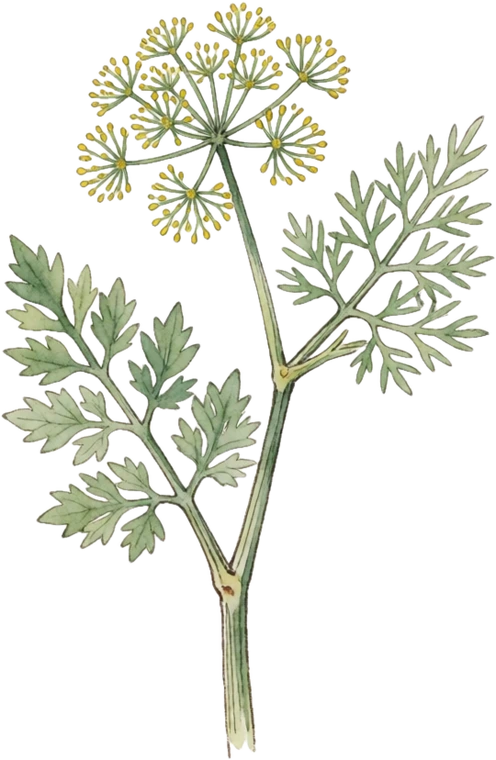
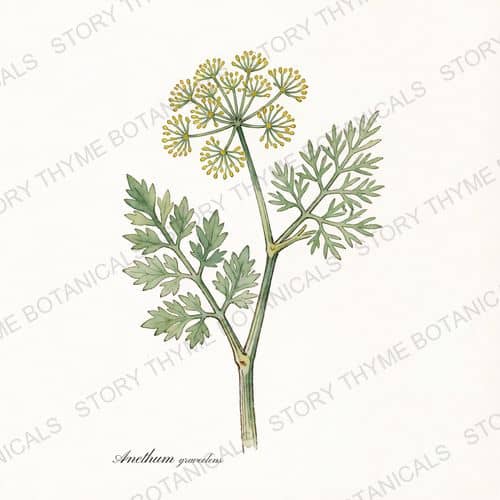
Botanical illustration of Dill
Annual · Anethum graveolens

Taproot hates transplanting — direct sow every 3 weeks from April. Let some self-seed and you'll never sow again. Time a July sowing to hit cucumber-pickling season.

AnnualFull SunModerate waterFast growthAttracts butterfliesAttracts beesNone winter chill

Where to buy the plant — 3 nurseries

Dill — a print from the Herbs, Greenery & Desert collection

From the print shop

Growing dill? Hang it.

Our Herbs, Greenery & Desert collection carries dillAnethum graveolens, print Nº 1, “Dill.”

16 designsfrom $21.99white or black groundmatte poster, unframed

Shop Herbs, Greenery & Desert botanical prints →

I

Overview

Will dill suit your garden, and what goes wrong.

Will it fruit where you are?

Enter your ZIP — we look up your USDA hardiness zone (2023 map) and check it against what dill actually needs.

Life cycleAnnual
Winter chillNone

Dill at a glance

Life cycleAnnual
Mature size2-4 ft
PollinationUmbels feed tiny beneficial wasps — leave some blooming always
Chill requirementNone (not chill-dependent)
Bloom seasonSummer
Harvest seasonLeaves anytime, heads for pickling in July - August
Growth rateFast

Common dill problems

  • Swallowtail Caterpillars (GIFT not pest — plant extra)
  • Powdery Mildew late

II

Growing

Light, water, soil, propagation and the season’s jobs.

How to grow dill: light, water & soil

LightFull Sun
WaterModerate
SoilAverage, Well-drained · pH 5.5 - 6.5
FertilizerNone needed.
PruningNone (annual) — None.
Spacing6-10 inches

How to plant & propagate dill

Maturity60-90 days
From seedDirect-sow; self-sows; swallowtail host
PropagateFrom seed

The dill growing playbook

Field-tested instructions for every job dill asks of you, compiled from university extension guidance — in the order the season brings them.

Sowing

Direct sow in spring where the plants will stand

Sow seed right where the plants will stand, about a quarter inch deep, in rows two feet apart, starting a week or two before your last hard frost. Barely cover the seed - dill needs light to germinate. Expect emergence in 10 to 14 days depending on soil temperature. Transplants can be used, but dill develops so quickly from seed that they are rarely worth the trouble. Dill germinates and grows fast enough that a direct-sown row catches up to a transplant, so there is no reason to raise it in cells. The seed needs light, which is why it gets only the barest cover.

Resow every two to three weeks for a steady leaf supply

Plant a fresh short row every two to three weeks through midsummer. Each sowing takes roughly six weeks to reach cutting size, so a new row started now replaces the one that is about to flower. Dill is an annual that declines once it flowers, and the leaves coarsen and thin as the plant pours its energy into seed. Overlapping sowings are what keep young foliage coming, because cutting will not hold a bolting plant in leaf.

Feeding

One light feeding is all dill wants

Apply a light feeding of 5-10-5 once in late spring, at about three ounces per ten feet of row. For dill in containers, use a liquid fertilizer at half the label strength every four to six weeks instead. Dill evolved on lean, well-drained ground and does its best work in moderately fertile soil. Heavy nitrogen buys soft, floppy growth and a weaker aroma, because the essential oils that carry the flavor are diluted by fast watery cell expansion.

Thinning

Thin seedlings once they reach two inches

When the seedlings are about two inches high, thin them to stand 10 to 12 inches apart. Snip the extras at soil level rather than pulling them, and eat the thinnings. Dill grows fast and tall, and a crowded stand shades itself, produces thin weak stems that lodge in wind, and holds humid air in the canopy that invites powdery mildew - one of the few diseases dill gets.

What to watch for

Check for aphids, and leave the caterpillars alone

Look over the umbels for aphids as the plant flowers and sets seed, and knock any colonies off with a jet of water. If you find fat green caterpillars banded with black and yellow, those are black swallowtail larvae - leave them be, or move them to a spare plant. Dill is a larval host for the black swallowtail butterfly and a strong nectar source for parasitic wasps and hoverflies, and those same beneficials are what keep the aphids in check. The flowering plant you are scouting is feeding the predators that solve the problem.

Do not spray an insecticide on flowering dill. The open umbels are actively worked by bees and beneficial insects, and dill is picked and eaten fresh, often the same day - a jet of water or hand removal is the appropriate control here.

Harvesting

Cut leafy dill as the flowers begin to open

Take green foliage any time the plant has a few inches of growth, but make your main cutting as the flower umbels start to open - the flavor peaks right there. Cut leaves at the stem, or take the whole stem within a few inches of the ground. Leaf aroma tracks the essential oil concentration, which climbs as the plant moves into flower and then falls away once the umbels are fully open and seed is setting. Wait past that window and you get stems and a flatter, more caraway-like taste.

Cut seed heads just before they turn tan

For pickling heads and dill seed, cut the flower stalks just before the seeds begin to ripen and turn tan, roughly two to three weeks after the blossoms appear. Finish them upside down in a paper bag so the seed drops as it dries. Ripe dill seed shatters off the umbel at a touch, so a head left until it is fully brown scatters the crop on the ground. Cutting a shade early lets the seed finish on the stalk inside the bag where you can still catch it.

Dill companion plants

Good companions

Underlined names have their own growing guide in this library.

III

The year

What dill asks for, month by month.

The dill year, month by month

MonthJanFebMarAprMayJunJulAugSepOctNovDec
Bloom
Harvest

What each band means

  • Bloomflowers open — pollinators working, frost on blossoms is the danger.
  • Harvestpicking time — check ripeness every few days.

The dill year as text

  • Jan harvest
  • Feb harvest
  • Mar harvest
  • Apr harvest
  • May harvest
  • Jun bloom, harvest
  • Jul bloom, harvest
  • Aug bloom, harvest
  • Sep harvest
  • Oct harvest
  • Nov harvest
  • Dec harvest

These are the species' typical months — expect them a few weeks earlier in warm zones and later in cold ones. Watch the plant, not just the calendar.

IV

Ecology & uses

What it does for the garden, and what it is grown for.

Dill in the garden system

  • Herbaceous layer annual
  • Nectary/insectary
  • Hosts Black swallowtail butterfly
AttractsButterflies, Bees
MoistureFacultative / average
DeerBrowsed — protect young plants
OriginIntroduced

What dill is grown for

✓ Commonly eaten

UsePickling
UseCulinary
UseBeneficials
UseButterflies
Edible value3/5

Harvesting & storing dill

Leaves anytime, heads for pickling in July - August. About 60-90 days from planting.

Edibility, identification, and traditional-use notes here are general reference — not medical or veterinary advice, and not a claim that any plant treats or prevents anything. Medicinal ratings record how strongly a plant features in herbal tradition, nothing more. Never eat or dose a plant you have not positively identified. More on how to use this library.

V

Cultivars

Named varieties of dill, ruled as a catalogue.

Best dill varieties & cultivars

8 on file

Named varieties of dill differ in days to maturity, disease resistance, flavor, and habit — pick one that fits your season and space.

Fernleaf

RipensLeaves through the seasonZones2-11SizeAbout 18 inches tall, dwarf and bushy

Classic dill, fine dark green foliage — The standard choice for pots and window boxes, and the one to grow if you want leaves rather than pickling heads. Slow to run to seed, so a single planting holds in leaf noticeably longer than Mammoth.

Where to buy ‘Fernleaf

Story Thyme Farms may earn a small commission from these links, at no cost to you — it never changes what we recommend.

Long Island Mammoth · Mammoth

RipensSeed heads in mid to late summerZones2-11SizeTall, standard full-size dill

Strong seed and head flavor for brine — The pickling dill and the old standard for fresh use. It bolts readily, which is the point when you are growing for heads, but it means you need succession sowings if you also want a steady leaf supply.

Where to buy ‘Long Island Mammoth

Story Thyme Farms may earn a small commission from these links, at no cost to you — it never changes what we recommend.

Bouquet

RipensHeads and leaves in summerZones2-11Size2 to 3 feet, a more compact form of Mammoth

Standard dill, aromatic foliage — A compact, dwarf form of Mammoth that carries large seed heads on a shorter frame, which makes it the practical compromise when you want pickling heads but do not have room for a four-foot plant. Also grown for cut flowers.

Where to buy ‘Bouquetverified

Story Thyme Farms may earn a small commission from these links, at no cost to you — it never changes what we recommend.

Dukat · Tetra; Superdukat

RipensLeaves through the seasonZones2-11SizeSimilar to Bouquet but with heavier foliage

Very strong, fine textured foliage — A leaf dill bred for oil content rather than heads, and slow to bolt, so it stays productive well into the season. Sold as Tetra and Superdukat as well.

Where to buy ‘Dukatverified

Story Thyme Farms may earn a small commission from these links, at no cost to you — it never changes what we recommend.

Hercules

RipensLeaves through the seasonZones2-11SizeUp to 5 feet tall

Standard dill, heavy foliage yield — The market-grower's leaf dill: very slow to bolt and very large, so one planting yields repeatedly. Needs room and may want staking in a windy spot at full height.

Where to buy ‘Hercules

Story Thyme Farms may earn a small commission from these links, at no cost to you — it never changes what we recommend.

Green Sleeves

RipensLeaves through the seasonZones2-11SizeFull size leaf type

Clean fresh dill flavor — Selected specifically for bolt resistance and fresh leaf production, so it holds in leaf through summer heat that would push Mammoth straight into flower.

Where to buy ‘Green Sleeves

Story Thyme Farms may earn a small commission from these links, at no cost to you — it never changes what we recommend.

Vierling

RipensSummer, cut when umbels openZones2-11SizeTall with notably strong stems

Standard dill — Grown as a cut flower as much as a herb - the stems are stiff enough to hold up in an arrangement, and the blue-green foliage lasts. Late to flower relative to Mammoth.

Where to buy ‘Vierling

Story Thyme Farms may earn a small commission from these links, at no cost to you — it never changes what we recommend.

Ella

RipensLeaves through the seasonZones2-11SizeShort and dense

Standard dill — A compact container variety in the same role as Fernleaf. Give it a deep pot regardless of its height - dill's taproot needs the depth even when the top stays short.

Where to buy ‘Ella

Story Thyme Farms may earn a small commission from these links, at no cost to you — it never changes what we recommend.

VI

Sources & plant ID

Where the care distinctions come from, and how the plant is filed.

Research basis

Sources behind this profile

No extension citations are attached to dillyet. The care figures below come from the library's own catalogue rather than a traced primary source.

Plant ID

BinomialAnethum graveolens
FamilyApiaceae
TypeAnnual
USDA symbolANGR2
OriginIntroduced
Invasive riskLow

VII

Where to buy

Third-party nurseries — not Story Thyme Farms.

Third-party nurseries, not Story Thyme Farms. Prices are theirs.

Story Thyme Farms may earn a small commission from these links, at no cost to you — it never changes what we recommend.

VIII

Questions

Dill questions, answered straight.

Is dill safe for kids and pets?

Dill is commonly eaten and isn't considered toxic, but "commonly eaten" isn't a guarantee for any particular person or animal — allergies, quantity, and which part you eat all matter. Never eat a plant you haven't positively identified, and check with a vet before letting pets or livestock graze anything new.

When do you harvest dill?

Leaves anytime, heads for pickling in July - August. From planting, expect about 60-90 days to maturity.

What grows well with dill?

Proven companions include brassicas, cucumber, onions; attracts beneficials — the full companion list, and what to keep away, is in the Growing tab above.

How do you propagate dill?

From seed.

IX

Elsewhere

Where dill sits in the library.

Where dill sits in the library

Grows in the same world