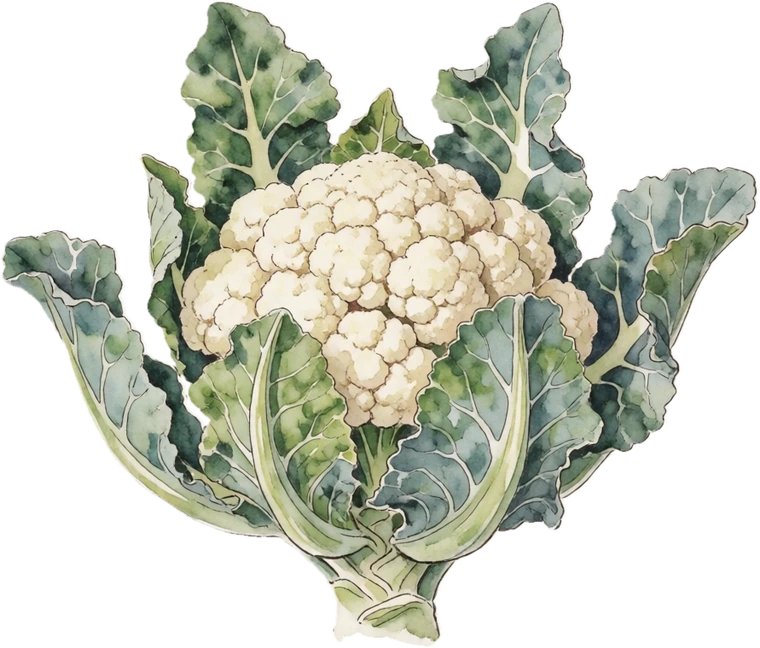
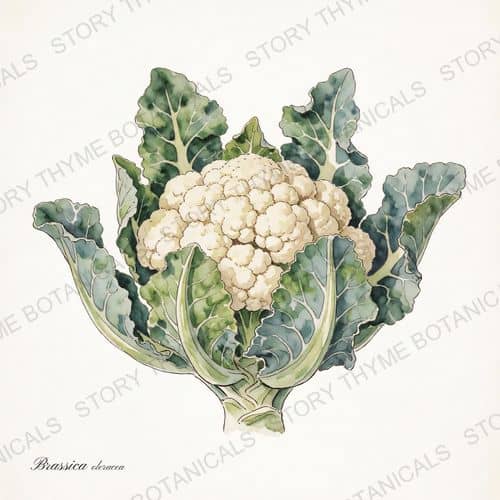
Snow Crown
Must be tied for best quality.
Where to buy ‘Snow Crown’
Story Thyme Farms may earn a small commission from these links, at no cost to you — it never changes what we recommend.
The illustrated growing guide
Brassica oleracea var. botrytis
Family Brassicaceae
Grown as an annual

The fussiest brassica — one hot week makes rice-grain 'buttons' instead of heads. Treat it as a fall crop, pamper it, and it rewards; spring attempts are gambling.

From the print shop
Our Vegetables Vol. 1 collection carries Brassica oleracea — the same species as cauliflower — but the print shows “Kale,” a different cultivar of it, not cauliflower itself.
16 designsfrom $21.99white or black groundmatte poster, unframed
I
Will cauliflower suit your garden, and what goes wrong.
Will it fruit where you are?
Enter your ZIP — we look up your USDA hardiness zone (2023 map) and check it against what cauliflower actually needs.

II
Light, water, soil, propagation and the season’s jobs.
Growing season. Bt program as for cabbage; row cover from transplant.
Field-tested instructions for every job cauliflower asks of you, compiled from university extension guidance — in the order the season brings them.
Start the spring crop indoors, 4 to 6 weeks before it goes out
Sow seed indoors 4 to 6 weeks before your intended transplant date, and count that date back from your own last frost rather than a calendar month. Direct seeding is difficult, so start under cover. After emergence hold the seedlings around 60 degrees F, and move them to the garden once they have four true leaves and a well-developed root system. Cauliflower forms its curd on a schedule set by the transplant, so the sowing date is really a countback from frost. An overgrown, root-bound transplant is one of the classic causes of buttoning, where the plant throws a tiny useless curd instead of a head.
Sow the fall crop in midsummer - it is the more reliable one
Sow seed in midsummer, indoors or direct in the garden, and set transplants out roughly 5 to 7 weeks later. Work backwards from your own first fall frost using the variety's days to maturity so the curd forms in cooling weather rather than in heat. A spring crop races the arriving heat and often loses; a fall crop matures into cooling weather, which is exactly what cauliflower wants for a tight white curd. Heat and drought stress during head formation is what stunts curds into buttons.
Set transplants out 3 to 4 weeks before your frost-free date
Harden the seedlings off, then set 5- to 7-week-old transplants out 3 to 4 weeks before your frost-free date, spacing them 18 to 24 inches apart in rows 24 to 36 inches apart. Water them in with a liquid starter fertilizer to help them establish. Cauliflower needs to finish its head while the weather is still cool, so it goes out before the last frost rather than after it. Spacing is not cosmetic here: crowded plants compete and stress, and stressed plants button.
⚠ Do not rush this earlier than 3 weeks before your frost-free date. A hard cold snap on a young transplant is itself a buttoning trigger, and a plant that has buttoned will never make a head.
Keep water even - at least an inch a week, without gaps
If the planting does not get an inch of rain in a week, soak the soil thoroughly at least once that week, deeply rather than in light sprinklings, and keep the soil evenly moist rather than swinging between dry and soaked. Sandy soil needs it more often than once a week. Mulching with weed-free straw or herbicide-free grass clippings 3 to 4 inches deep helps hold the moisture steady. Inconsistent water does not just shrink the head - it changes the eating quality. Plants that do not get consistent rainfall or irrigation have poor texture and can develop strong off flavors.
Side-dress with nitrogen about four weeks after transplanting
About four weeks after transplanting, band roughly 1/2 cup of a nitrogen fertilizer such as 21-0-0 per 10 feet of row, placed about 6 inches to the side of the plants rather than against the stems, and water it in. Cauliflower builds its whole frame of leaves before it starts a curd, and curd size is set by how much leaf the plant made first. Nitrogen that arrives after the curd has started is too late to change the outcome.
⚠ Keep the band 6 inches off the plants - fertilizer laid against the stems burns them.
Cabbageworms and loopers: check both sides of the leaves weekly
Check both sides of the leaves at least once a week starting right after planting, and more often as the season goes on. Imported cabbageworm and looper leave large ragged holes with the big veins intact; diamondback moth leaves a windowpane look where the upper leaf layer survives. Floating row cover laid at seeding or transplanting keeps the adult moths from laying eggs at all. If you do treat, Bacillus thuringiensis or spinosad while the caterpillars are still small are the low-risk choices - both fail on large caterpillars, which is the whole reason for weekly scouting. All three caterpillars feed as small larvae on the leaf undersides where you will not see them from above, and by the time frass is piling up in the plant's centre the caterpillars are too big for a spray to work. Once they tunnel into a forming curd, no spray reaches them and the head is unsellable.
⚠ Per UC IPM Cole Crops (https://ipm.ucanr.edu/agriculture/cole-crops/imported-cabbageworm/): PHI on cole crops is 0 days for Bacillus thuringiensis and 1 day for spinosad, both with a 4-hour restricted entry interval. Always follow the label on your own product. Do not treat on sight - UC IPM thresholds are about 1 caterpillar per 5 plants during early crop development, and from heading to harvest more than 10% of sampled plants infested with at least 1 caterpillar. Spinosad is toxic to some natural enemies (predatory beetles, syrphid fly larvae and predatory thrips) when sprayed and for 5 to 7 days after, so reach for Bt first.
Blanch white varieties once the curd is 2 to 3 inches across
When the curd first shows and is about 2 to 3 inches across (up to roughly baseball size), pull three or four large outer leaves up over it and fasten with soft twine, tape or a rubber band, or break them over the top and tuck them in the far side. Blanching normally takes 4 to 8 days, and longer in the fall. Self-blanching cultivars whose leaves already grow up over the head may not need it. Do not tie the coloured types: UGA C1023 says Cheddar's yellow and Graffiti's purple curds should be left untied, since the colour needs the sun. Sunlight on an exposed white curd turns it yellow, rough and off-flavoured. The leaves are simply a sunshade, which is why coloured varieties want the opposite treatment.
⚠ As a general precaution, tie when the curd is dry rather than wet - closing wet leaves over a wet curd traps moisture against it and invites rot.
Cut at 6 to 8 inches, before the curd starts to separate
Check under the tied leaves every couple of days once blanching starts - a head is usually ready within about 7 to 12 days after blanching begins, though warm weather can pull that in and cool autumn weather can stretch it well past two weeks, so go by the head and not the count. Cut when the curd is 6 to 8 inches across, compact, firm and fairly smooth, and leave a ruffle of leaves around the head to protect it. Use it within about a week from the refrigerator. The curd is an arrested flower head, and it does not wait. Once the buds begin to loosen and separate it goes ricey and coarse in a matter of days, so the window is decided by the head's appearance and never by a date.
III
What cauliflower asks for, month by month.
What each band means
The cauliflower year as text
These are the species' typical months — expect them a few weeks earlier in warm zones and later in cold ones. Watch the plant, not just the calendar.
IV
What it does for the garden, and what it is grown for.
✓ Commonly eaten
Fall crop is far more reliable: October - November. About 70-90 days from planting.
Edibility, identification, and traditional-use notes here are general reference — not medical or veterinary advice, and not a claim that any plant treats or prevents anything. Medicinal ratings record how strongly a plant features in herbal tradition, nothing more. Never eat or dose a plant you have not positively identified. More on how to use this library.
V
Named varieties of cauliflower, ruled as a catalogue.
5 on file
Named varieties of cauliflower differ in days to maturity, disease resistance, flavor, and habit — pick one that fits your season and space.
Must be tied for best quality.
Story Thyme Farms may earn a small commission from these links, at no cost to you — it never changes what we recommend.
Must be tied to produce the white head.
Story Thyme Farms may earn a small commission from these links, at no cost to you — it never changes what we recommend.
Yellow head. For maximum colour intensity, do not tie the head.
Story Thyme Farms may earn a small commission from these links, at no cost to you — it never changes what we recommend.
Dense head; thick leaves are easy to tie for the best results.
Story Thyme Farms may earn a small commission from these links, at no cost to you — it never changes what we recommend.
Intensely purple head. Leaves are dark green and do not need to be tied.
Story Thyme Farms may earn a small commission from these links, at no cost to you — it never changes what we recommend.
VI
Where the care distinctions come from, and how the plant is filed.
Research basis
No extension citations are attached to caulifloweryet. The care figures below come from the library's own catalogue rather than a traced primary source.
VII
Third-party nurseries — not Story Thyme Farms.
Third-party nurseries, not Story Thyme Farms. Prices are theirs.
Story Thyme Farms may earn a small commission from these links, at no cost to you — it never changes what we recommend.
VIII
Cauliflower questions, answered straight.
Cauliflower is commonly eaten and isn't considered toxic, but "commonly eaten" isn't a guarantee for any particular person or animal — allergies, quantity, and which part you eat all matter. Never eat a plant you haven't positively identified, and check with a vet before letting pets or livestock graze anything new.
Fall crop is far more reliable: October - November. From planting, expect about 70-90 days to maturity.
From seed.
IX
Where cauliflower sits in the library.