The illustrated growing guide

Pawpaw

Asimina triloba

Family Annonaceae

Est. zones 5-8

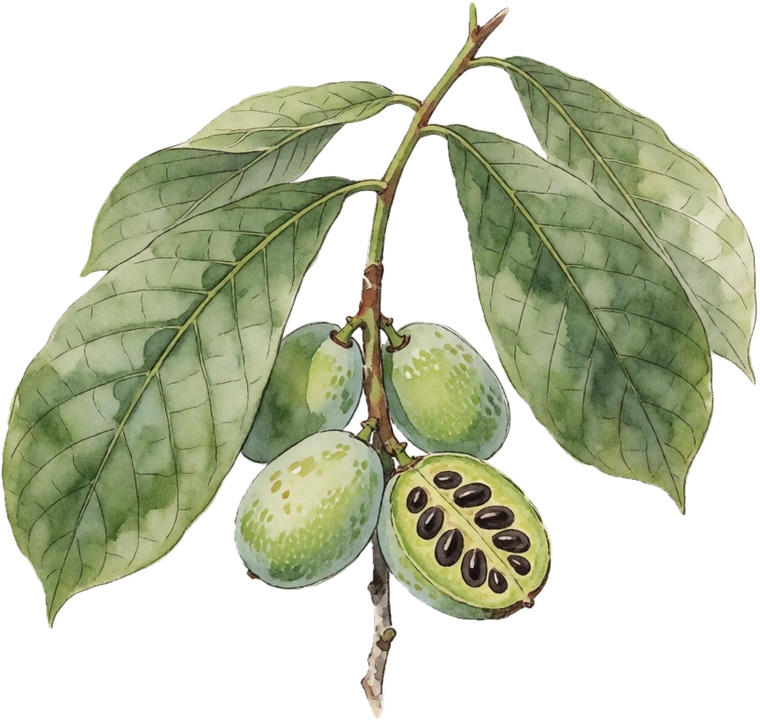
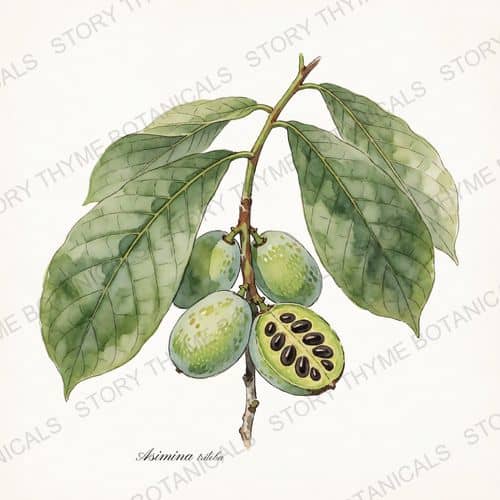
Botanical illustration of Pawpaw
Tree · Asimina triloba

Fruit is like banana/mango custard. Very short shelf life (2-3 days). Hang decaying meat/fruit during bloom to attract fly pollinators.

Tree · NativeShade when youngHigh waterModerate growthNative to North AmericaExcellent edibleAttracts butterflies400-1000 winter chillNeeds a pollination partner

Where to buy the plant — 2 nurseries

Pawpaw — a print from the Native Missouri Plants collection

From the print shop

Growing pawpaw? Hang it.

Our Native Missouri Plants collection carries pawpawAsimina triloba, print Nº 16, “Pawpaw.”

16 designsfrom $21.99white or black groundmatte poster, unframed

Shop Native Missouri Plants botanical prints →

I

Overview

Will pawpaw suit your garden, and what goes wrong.

Will it fruit where you are?

Enter your ZIP — we look up your USDA hardiness zone (2023 map) and check it against what pawpaw actually needs.

Hardy inZones 5-8
Winter chill400-1000
PollinationPartner needed

Pawpaw at a glance

HardinessUSDA 5–8
Mature size15-25 ft
PollinationCross-Pollination Required (Genetically distinct trees). Pollinated by Flies/Beetles (not bees).
Chill requirement400-1000
Bloom seasonMid Spring (Maroon flowers)
Harvest seasonSeptember - October
Growth rateModerate

Common pawpaw problems

  • Pawpaw Peduncle Borer
  • Zebra Swallowtail Caterpillar (Host plant)
  • Few. Fungal leaf spot usually minor.
  • Poor pollination → low fruit set (plant a partner)

II

Growing

Light, water, soil, propagation and the season’s jobs.

How to grow pawpaw: light, water & soil

LightShade when young (<2 years), Full Sun for fruit
WaterHigh, likes moist soil
SoilRich, Humus-heavy, Moist, Acidic to Neutral · pH 5.5 - 7.0
FertilizerHigh Nitrogen / Organic Matter
PruningLate Winter — Minimal. Remove suckers (unless creating a patch).
Spacing8-15 ft

How to plant & propagate pawpaw

PropagateGrafted, or from cuttings/layering (seed won't come true)

The pawpaw growing playbook

Field-tested instructions for every job pawpaw asks of you, compiled from university extension guidance — in the order the season brings them.

Watering

Keep water steady for the first two years

Water deeply whenever the top few inches of soil dry out, from planting through the second growing season. Pawpaw wants the equivalent of at least 32 inches of rain a year spread evenly, so make up the gap in any dry stretch rather than waiting for the tree to wilt. Pawpaw comes from moist bottomland soils and transplants carry a fleshy, brittle root system that regenerates slowly, so a young tree cannot mine dry soil for water the way a drought-adapted fruit tree can.

Feeding

Feed in spring, and stop by midsummer

Once the tree is established, broadcast a balanced granular fertilizer such as 10-10-10 once in spring, from the trunk out to the outermost branches. Do not fertilize after midsummer. Keep soil pH between 5.5 and 6.5, and soil test before adding calcium once the tree starts fruiting. Nitrogen applied late in the season pushes soft new growth that has not hardened off by the first freeze, and pawpaw is fussy about pH: outside roughly 5.5 to 6.5 it cannot take up iron and other micronutrients even when they are present in the soil.

Avoid fertilizing after midsummer.

Pruning

Dormant prune to a central leader

While the tree is dormant and still leafless, keep one central trunk with well spaced scaffold branches and remove crossing or rubbing limbs. Spread narrow crotches to widen the angles. Pull root suckers off at the base to hold a single trunk. If a transplant lost a lot of root, cut the top back to match what the roots can still supply. Work in the leafless window before buds begin to swell, which falls later in the north than in the south. Pawpaw wood is weak and its leaves are large and heavy, so narrow crotch angles split under a fruit load. Pruning while dormant also lets you see the framework, and the cuts are made when the tree is not pushing sap.

What to watch for

Hand pollinate between two different trees at bloom

Check the maroon flowers daily through bloom. Take pollen from a flower whose anthers are brown, loose, and shedding yellow dust, and dab it with a small artist's brush onto the stigma of a flower on a genetically different tree while the stigma tips are still green, glossy, and sticky. Two grafted trees of the same cultivar will not work, they are the same plant. Pawpaw flowers are self-incompatible and protogynous, so the stigma is receptive before that same flower's own pollen is ripe. Their natural pollinators are flies and beetles rather than bees, and they visit erratically, which is why a healthy tree covered in bloom so often sets nothing.

Pull webworm nests by hand through summer

Walk the tree through summer looking for Asimina webworm nests, which tie leaves together into a shelter at the shoot tips, and for peduncle borer damage. Prune out and destroy the nests by hand and keep fallen leaves and fruit cleaned up. Trapping, manual removal, and orchard sanitation are the recommended controls. Pawpaw foliage carries its own natural insecticidal compounds, so it has very few serious pests and almost nothing reaches a threshold that a spray would fix. The webworm is the one that concentrates enough to matter, and it is easy to remove while nests are small and few.

There are no labeled fungicides for pawpaw, and it is a minor crop with very few labeled pesticides of any kind, so do not reach for an orchard spray meant for apple or peach. Bacillus thuringiensis is sometimes used for webworm, but it kills any caterpillar that eats treated leaves, including the zebra swallowtail, whose larvae feed on pawpaw and nothing else. Confirm any product's label lists pawpaw before use.

Protection

Shade the tree through its first summer

For any seedling or grafted tree under about 24 inches tall, suspend 33 percent shade cloth above it for the whole establishment year. Remove the shade the following spring once the tree is rooted in and taller. Pawpaw evolved as a forest understory tree, and its seedlings lack the light-shock protection of a sun species: full sun in year one scorches the leaves and stalls or kills a transplant that would otherwise thrive.

Harvesting

Pick by feel and smell, never by color

Start checking when the skin shifts from dark green toward lighter green and yellow, but judge by touch. Pick as soon as flesh softening is first evident: a ripe pawpaw gives when squeezed gently, the way a ripe peach does, gives off a strong fruity aroma, and separates from the stem with a gentle tug. Color alone is unreliable, so squeeze every fruit before you pick it. Fruit picked at first softening finishes ripening indoors within a few days, so do not wait for full softness on the tree. Pawpaw is climacteric, so a fruit that has begun to soften will complete ripening off the tree. A fully immature fruit will not, and no ethylene treatment rescues it. Once softening starts the fruit is too soft to handle within three to five days, which is why feel beats any calendar date.

Underripe pawpaws can cause gastrointestinal distress. The seeds and bark contain acetogenins and are toxic; do not eat the seeds, and do not eat the skin.

Refrigerate the same day you pick

Get fruit into a refrigerator at 32 to 40 degrees F and 90 to 95 percent humidity as soon as possible after picking. Expect only a few days at room temperature and a few weeks refrigerated. For longer keeping, scoop the pulp, discard the seeds, and freeze the pulp. Pawpaw has a thin skin, no wax layer, and soft custard flesh that bruises on contact, and it keeps respiring hard after picking. Cold slows that metabolism, which is the only thing standing between a ripe pawpaw and fermentation.

Cold storage is limited to about four weeks even at correct temperature: past roughly four weeks refrigerated, pawpaw loses the capacity to ripen and develops chilling injury, showing as internal black discoloration and off-flavors. Do not try to stretch storage by freezing whole fruit; freeze scooped pulp instead.

III

The year

What pawpaw asks for, month by month.

The pawpaw year, month by month

MonthJanFebMarAprMayJunJulAugSepOctNovDec
Bloom
Prune
Harvest

What each band means

  • Bloomflowers open — pollinators working, frost on blossoms is the danger.
  • Pruneshape it now — cuts heal cleanly and structure is visible.
  • Harvestpicking time — check ripeness every few days.

The pawpaw year as text

  • Jan quiet month
  • Feb pruning
  • Mar pruning
  • Apr bloom
  • May quiet month
  • Jun quiet month
  • Jul quiet month
  • Aug quiet month
  • Sep harvest
  • Oct harvest
  • Nov quiet month
  • Dec quiet month

These are the species' typical months — expect them a few weeks earlier in warm zones and later in cold ones. Watch the plant, not just the calendar.

IV

Ecology & uses

What it does for the garden, and what it is grown for.

Pawpaw in the garden system

  • Understory layer tree
  • Hosts Zebra swallowtail butterfly (its only host)
AttractsBirds, Butterflies
MoistureWetland / wet-tolerant
DeerBrowsed — protect young plants
OriginNative to North America

What pawpaw is grown for

✓ Commonly eatendon't eat skin or seeds

UseFresh eating
UseBaking (use like banana)
Edible value5/5

Harvesting & storing pawpaw

September - October.

Edibility, identification, and traditional-use notes here are general reference — not medical or veterinary advice, and not a claim that any plant treats or prevents anything. Medicinal ratings record how strongly a plant features in herbal tradition, nothing more. Never eat or dose a plant you have not positively identified. More on how to use this library.

V

Cultivars

Named varieties of pawpaw, ruled as a catalogue.

Best pawpaw varieties & cultivars

14 on file

Named varieties of pawpaw differ in winter-chill needs, ripening time, hardiness, and whether they set fruit on their own — pick one that fits your climate.

Shenandoah · Peterson Shenandoah; selection PPF 1-7-1; USPP 14,452

Needs a pollinizer
RipensMid SeptZones5-8Diseaseexcellent (few pests or diseases)Size15-25 ft tree
Pollinationneeds a second variety

mild, sweet, custard-like; low seed — A flagship Peterson cultivar and a good beginner pick: large, firm, few-seeded fruit with a mild flavor that wins over newcomers. Like nearly all pawpaws it is self-incompatible and needs a genetically different pawpaw nearby to set fruit.

Where to buy ‘Shenandoah

Story Thyme Farms may earn a small commission from these links, at no cost to you — it never changes what we recommend.
Susquehanna · Peterson Susquehanna; selection PPF 11-5

Needs a pollinizer
RipensLate Sept-OctZones5-8Diseaseexcellent (few pests or diseases)Size15-25 ft tree
Pollinationneeds a second variety

very rich, sweet, buttery; thick flesh, few seeds — Produces some of the largest fruit (often near or over 1 lb) with thick, rich flesh and a low seed count, making it a top choice for eating quality where the season is long enough to ripen it. Self-incompatible; requires a separate pollinizer.

Where to buy ‘Susquehanna

Story Thyme Farms may earn a small commission from these links, at no cost to you — it never changes what we recommend.

Wabash · Peterson Wabash

Needs a pollinizer
RipensLate Sept-OctZones5-8Diseaseexcellent (few pests or diseases)Size15-25 ft tree
Pollinationneeds a second variety

rich, creamy, complex; firm texture — A late-ripening Peterson cultivar prized by enthusiasts for creamy, richly flavored pulp; requires a full growing season and, being self-incompatible, a separate pollinizer.

Where to buy ‘Wabash

Story Thyme Farms may earn a small commission from these links, at no cost to you — it never changes what we recommend.

Allegheny · Peterson Allegheny

Needs a pollinizer
RipensEarly-mid SeptZones5-8Diseaseexcellent (few pests or diseases)Size15-25 ft tree
Pollinationneeds a second variety

sweet, rich; medium-small fruit — A productive earlier-ripening Peterson selection, so it pairs well as a pollinizer for a later variety. Self-incompatible; plant with another cultivar.

Where to buy ‘Allegheny

Story Thyme Farms may earn a small commission from these links, at no cost to you — it never changes what we recommend.

Rappahannock · Peterson Rappahannock; selection PPF 8-58

Needs a pollinizer
RipensEarly-mid SeptZones5-8Diseaseexcellent (few pests or diseases)Size12-18 ft, compact symmetrical habit
Pollinationneeds a second variety

sweet, buttery; few seeds — Its tidy, symmetrical form with horizontally held leaves makes it one of the more ornamental and space-friendly Peterson varieties for small yards. Self-incompatible; needs a pollen partner.

Where to buy ‘Rappahannock

Story Thyme Farms may earn a small commission from these links, at no cost to you — it never changes what we recommend.

Sunflower

Partly self-fertile
RipensMid-late SeptZones5-8Diseaseexcellent (few pests or diseases)Size15-25 ft tree
Pollinationreported partially self-fertile (unverified); a second variety greatly improves set

sweet, mild; butter-yellow flesh, few seeds — Often recommended for single-tree yards because it is widely reported as partially self-fertile, but KSU notes this self-compatibility has never been scientifically verified. Treat a second variety as strongly advisable for reliable cropping.

Where to buy ‘Sunflower

Story Thyme Farms may earn a small commission from these links, at no cost to you — it never changes what we recommend.

Overleese

Needs a pollinizer
RipensMid-late SeptZones5-8Diseaseexcellent (few pests or diseases)Size15-25 ft tree
Pollinationneeds a second variety

rich, aromatic; large fruit, few large seeds — An old, reliable Indiana selection producing big, richly flavored fruit in heavy clusters; a proven benchmark variety. Self-incompatible; requires a separate pollinizer.

Where to buy ‘Overleese

Story Thyme Farms may earn a small commission from these links, at no cost to you — it never changes what we recommend.

NC-1 · Campbell's NC-1

Needs a pollinizer
RipensEarly-mid SeptZones4-8Diseaseexcellent (few pests or diseases)Size15-25 ft tree
Pollinationneeds a second variety

sweet, mild; large fruit, thin yellow skin, few seeds — A cold-hardy Canadian-bred cultivar (Doug Campbell, Ontario, 1976; a Davis x Overleese cross) that ripens early and reliably, a strong choice for northern or short-season gardens. Self-incompatible; still needs cross-pollination. As a northern selection its true chilling requirement may exceed the listed range.

Where to buy ‘NC-1

Story Thyme Farms may earn a small commission from these links, at no cost to you — it never changes what we recommend.

PA-Golden · Pennsylvania Golden

Needs a pollinizer
RipensLate Aug-early SeptZones4-8Diseaseexcellent (few pests or diseases)Size15-25 ft tree
Pollinationneeds a second variety

sweet, mild; yellow skin and flesh — One of the earliest-ripening and most cold-tolerant cultivars, valuable for northern growers who need fruit to mature before frost. Self-incompatible; requires a second variety to fruit. As a northern selection its true chilling requirement may exceed the listed range.

Where to buy ‘PA-Golden

Story Thyme Farms may earn a small commission from these links, at no cost to you — it never changes what we recommend.
KSU-Atwood · Atwood

Needs a pollinizer
RipensMid SeptZones5-8Diseaseexcellent (few pests or diseases)Size15-25 ft tree
Pollinationneeds a second variety

sweet, complex, mango-like; smooth texture, few seeds — The first named cultivar released from Kentucky State University's pawpaw breeding program (2009), selected for consistent productivity and eating quality. Self-incompatible; plant with another variety for pollination.

Where to buy ‘KSU-Atwood

Story Thyme Farms may earn a small commission from these links, at no cost to you — it never changes what we recommend.

Potomac · Peterson Potomac

Needs a pollinizer
RipensMid-late SeptZones5-8Diseaseexcellent (few pests or diseases)Size15-25 ft tree
Pollinationneeds a second variety

sweet, rich flavor with a smooth texture — A Peterson release carrying very large fruit with very good yields, listed by Clemson among the varieties suited to the Southeast. Self-incompatible, so it needs a genetically different pawpaw nearby. for the species-level value.

Where to buy ‘Potomac

Story Thyme Farms may earn a small commission from these links, at no cost to you — it never changes what we recommend.

KSU-Benson · Benson

Needs a pollinizer
RipensEarly seasonZones5-8Diseaseexcellent (few pests or diseases)Size15-25 ft tree
Pollinationneeds a second variety

mango, banana and pineapple notes; orange flesh — Kentucky State University's second named release (2016), a round, medium-sized, early-ripening fruit with orange flesh and few seeds. Early ripening makes it a useful pick where autumn closes in before the late Peterson varieties finish. Self-incompatible; plant a second variety. for the species-level value.

Where to buy ‘KSU-Benson

Story Thyme Farms may earn a small commission from these links, at no cost to you — it never changes what we recommend.

KSU-Chappell · Chappell

Needs a pollinizer
RipensMid seasonZones5-8Diseaseexcellent (few pests or diseases)Size15-25 ft tree
Pollinationneeds a second variety

creamy, sweet, mild banana-pineapple with floral notes — Kentucky State University's third release (2018), described by the breeding program as extremely vigorous and high yielding. Averaged 214 grams per fruit against Susquehanna's 180 grams over 2016-2018, at 5.9 percent seed by weight. Named for Tuskegee Airman Roy Chappell. Self-incompatible; needs a pollen partner. for the species-level value.

Where to buy ‘KSU-Chappell

Story Thyme Farms may earn a small commission from these links, at no cost to you — it never changes what we recommend.

421 · Highway 421

Needs a pollinizer
RipensSept-OctZones5-8Diseaseexcellent (few pests or diseases)Size15-25 ft tree
Pollinationneeds a second variety

sweet, typical pawpaw custard — A wild selection found along Highway 421 near Bristol, Tennessee. In Alabama A&M's cultivar planting it was the most productive cultivar of the nine trialed, and Alabama Extension names it and Sunflower as the high-yield choices for north Alabama, which makes it a strong pick for growers in the warmer end of pawpaw's range. Trees in that trial took five years to first production. Self-incompatible. for the species-level value.

Where to buy ‘421

Story Thyme Farms may earn a small commission from these links, at no cost to you — it never changes what we recommend.

VI

Sources & plant ID

Where the care distinctions come from, and how the plant is filed.

Research basis

Sources behind this profile

No extension citations are attached to pawpawyet. The care figures below come from the library's own catalogue rather than a traced primary source.

Plant ID

BinomialAsimina triloba
FamilyAnnonaceae
TypeTree · Perennial
USDA symbolASTR
OriginNative to North America
Invasive riskLow

VII

Where to buy

Third-party nurseries — not Story Thyme Farms.

Third-party nurseries, not Story Thyme Farms. Prices are theirs.

Story Thyme Farms may earn a small commission from these links, at no cost to you — it never changes what we recommend.

Pawpaw needs a pollination partner — plant two genetically distinct trees (two different cultivars, or a cultivar plus a seedling).

VIII

Questions

Pawpaw questions, answered straight.

Why isn't my pawpaw fruiting?

Most often: it has no genetically distinct partner nearby. Pawpaw can't pollinate itself — cross-pollination required (genetically distinct trees). Plant a second, unrelated one nearby; two different cultivars, or a cultivar plus a seedling, is the classic pairing.

Will pawpaw fruit in a warm-winter climate?

Pawpaw needs roughly 400-1000 hours of winter chill (hours between 32–45°F) to break dormancy and set fruit. Mild-winter growers should count their chill hours before planting.

Is pawpaw safe for kids and pets?

Pawpaw is commonly eaten and isn't considered toxic, but "commonly eaten" isn't a guarantee for any particular person or animal — allergies, quantity, and which part you eat all matter. One caveat on this one: don't eat skin or seeds. Never eat a plant you haven't positively identified, and check with a vet before letting pets or livestock graze anything new.

When do you harvest pawpaw?

September - October.

IX

Elsewhere

Where pawpaw sits in the library.