The illustrated growing guide

Basil

Ocimum basilicum

Family Lamiaceae

Grown as an annual

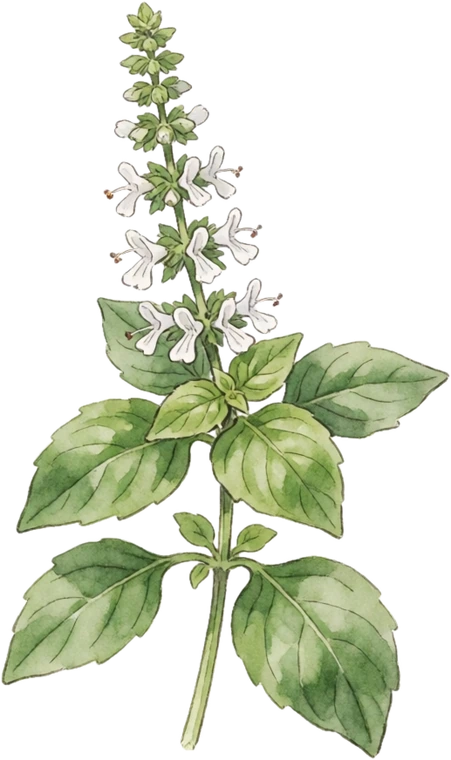
Botanical illustration of Basil
Annual · Ocimum basilicum

Basil dies at 38°F — plant well after tomatoes. Harvest whole stems not single leaves. One 'African Blue' plant feeds every bee in the county.

AnnualFull SunModerate waterFast growthAttracts beesNone winter chill

Where to buy the plant — 3 nurseries

Basil — a print from the Kitchen & Orchard collection

From the print shop

Growing basil? Hang it.

Our Kitchen & Orchard collection carries basilOcimum basilicum, print Nº 10, “Basil.”

16 designsfrom $21.99white or black groundmatte poster, unframed

Shop Kitchen & Orchard botanical prints →

I

Overview

Will basil suit your garden, and what goes wrong.

Will it fruit where you are?

Enter your ZIP — we look up your USDA hardiness zone (2023 map) and check it against what basil actually needs.

Life cycleAnnual
Winter chillNone

Basil at a glance

Life cycleAnnual
Mature size18-24 inches
PollinationBee favorite if allowed to flower
Chill requirementNone (not chill-dependent)
Bloom seasonSummer (pinch them off)
Harvest seasonJune - Frost (leaves)
Growth rateFast

Common basil problems

II

Growing

Light, water, soil, propagation and the season’s jobs.

How to grow basil: light, water & soil

LightFull Sun
WaterModerate, even. Morning water, dry leaves by night
SoilRich, Well-drained · pH 6.0 - 7.0
FertilizerLight liquid feed every 3-4 weeks; overfed basil loses flavor.
PruningContinuous — Pinch above a leaf pair every 2 weeks — every pinch doubles the stems.
Spacing10-12 inches

How to plant & propagate basil

Maturity60-90 days (ongoing)
From seedStart indoors or direct-sow after frost; loves warmth (70°F+)
PropagateFrom seed

When to spray basil

Growing season. DM-resistant vars ('Prospera', 'Rutgers') beat any spray. Water at soil level only.

The basil growing playbook

Field-tested instructions for every job basil asks of you, compiled from university extension guidance — in the order the season brings them.

Sowing

Start basil indoors three to four weeks before your last frost

Sow seed in flats three to four weeks before your frost-free date and hold the mix at 70 degrees F or above. At that warmth seed germinates in about five to seven days, and the seedlings reach plantable size right about when the garden is warm enough to take them. Field basil runs 60 to 85 days from seeding or transplant to first cut (Rutgers FS1279), so in short-season zones a direct-sown plant spends its best weeks as a seedling. Started early, it goes out already branching. Basil also germinates and grows poorly below 70 degrees, which a spring seedbed rarely offers.

Planting out

Wait for 60 degree soil and 50 degree nights before planting out

Set plants out well after your frost-free date, once soil is at least 60 degrees F and nights stay above 50 degrees F. Space plants 6 to 12 inches apart in the row (Rutgers FS1279). If a cold night is forecast, wait - a week in the flat costs less than a check in the field. Basil is tropical and takes cold injury far above freezing: Illinois Extension reports cold soil and air stunt growth and blacken leaves at 50 degrees F. A plant chilled at transplant sulks for weeks and never catches the one set out warm.

Watering

Water the soil, not the leaves, and do it early

Give about 1 1/2 inches of water per week (Utah State Extension). Use drip or a wand at the base of the plant, and water deeply and infrequently early on a sunny day so any splashed foliage dries quickly. Never leave basil going into evening with wet leaves. Downy mildew needs liquid water sitting on the leaf to infect, and it sporulates in overnight humidity. Dry leaves at nightfall break the cycle, which is why airflow and drip do more for basil than any product a home gardener can buy.

Feeding

Feed lightly once you start cutting, and no more

If a soil test shows fertilizer is warranted, work it into the top 6 inches before planting; if using compost, apply no more than 1 inch of well-composted organic matter per 100 square feet. Once plants reach the harvestable stage, sidedress with an organic or all-purpose liquid nitrogen source at 1 to 2 tablespoons every 2 to 3 weeks per 10 feet of row. Basil in pots needs feeding weekly, because watering flushes the nutrients out. Each cut removes leaf the plant has to rebuild, and basil responds to nitrogen. Keep it to a light, repeated feed rather than one heavy push - and site the plant in full sun, which Utah State notes gives more essential oils and better flavor than shade.

Pruning

Pinch flower buds the day you see them

As soon as flower buds form at the stem tips, pinch them out along with the top set of leaves. Keep doing it through the season. Pinching stem tips on young plants the same way builds a bushy plant with more leaf. Once basil turns to flowering it stops putting energy into leaves, and the leaves it has already made turn bitter and the stems go woody. The bud is the switch, so you catch it at the bud.

What to watch for

Downy mildew: turn the lower leaves over every week

Through warm humid weather, check the undersides of the lowest leaves weekly, in the early morning. You are looking for pale yellow blocks between the veins on top and velvety purple-grey fuzz underneath. Pull and bag infected plants immediately, and harvest heavily off healthy ones while you still can. Peronospora belbahrii is a water mold whose spores blow in on summer wind and sporulate on wet leaf undersides overnight. It moves from the bottom of the plant upward and can take the whole planting, so the only cheap moment is the first leaf.

Do not reach for a spray here: extension testing finds the fungicides available to home gardeners are not effective against this pathogen, because it is a water mold rather than a true fungus. Resistant varieties, spacing and dry leaves are the real controls.

Harvesting

Leave four sets of leaves standing on every cut

Harvest by pinching branches or leaves, or cut with sharp scissors or a knife, taking stems back to just above a pair of leaves. Always leave at least four sets of true leaves on the plant. Field basil runs 60 to 85 days from seeding or transplant to first cut, then re-cuts through the season. New shoots break from the buds in the leaf axils you leave behind, so the stub you leave is the next harvest. Cut too low and there are no buds left to regrow from.

Basil companion plants

Good companions

Avoid

Underlined names have their own growing guide in this library.

III

The year

What basil asks for, month by month.

The basil year, month by month

MonthJanFebMarAprMayJunJulAugSepOctNovDec
Bloom
Harvest

What each band means

  • Bloomflowers open — pollinators working, frost on blossoms is the danger.
  • Harvestpicking time — check ripeness every few days.

The basil year as text

  • Jan quiet month
  • Feb quiet month
  • Mar quiet month
  • Apr quiet month
  • May quiet month
  • Jun bloom, harvest
  • Jul bloom
  • Aug bloom
  • Sep quiet month
  • Oct quiet month
  • Nov quiet month
  • Dec quiet month

These are the species' typical months — expect them a few weeks earlier in warm zones and later in cold ones. Watch the plant, not just the calendar.

IV

Ecology & uses

What it does for the garden, and what it is grown for.

Basil in the garden system

  • Herbaceous layer annual
AttractsBees
MoistureFacultative / average
DeerBrowsed — protect young plants
OriginIntroduced

What basil is grown for

✓ Commonly eaten

UsePesto
UseCulinary
UseTea
Edible value3/5

Harvesting & storing basil

June - Frost (leaves). About 60-90 days (ongoing) from planting.

Edibility, identification, and traditional-use notes here are general reference — not medical or veterinary advice, and not a claim that any plant treats or prevents anything. Medicinal ratings record how strongly a plant features in herbal tradition, nothing more. Never eat or dose a plant you have not positively identified. More on how to use this library.

V

Cultivars

Named varieties of basil, ruled as a catalogue.

Best basil varieties & cultivars

11 on file

Named varieties of basil differ in days to maturity, disease resistance, flavor, and habit — pick one that fits your season and space.

Rutgers Devotion DMR · Devotion

Zones2-11DiseaseDowny mildewSizeUniform upright

Genovese sweet basil — A Genovese-type sweet basil with uniform upright growth and dark green flat to cup-shaped leaves. This is the one to grow if you want true pesto basil in a region where downy mildew arrives every summer.

Where to buy ‘Rutgers Devotion DMR

Story Thyme Farms may earn a small commission from these links, at no cost to you — it never changes what we recommend.

Rutgers Obsession DMR · Obsession

Zones2-11DiseaseDowny mildew, Fusarium wiltSizeCompact

Sweet basil — More compact and slower growing than Devotion or Thunderstruck, with a high leaf-to-stem ratio and dark green thick glossy leaves. Highly resistant to both downy mildew and Fusarium wilt, which makes it the safest choice on ground that has grown basil before.

Where to buy ‘Rutgers Obsession DMR

Story Thyme Farms may earn a small commission from these links, at no cost to you — it never changes what we recommend.

Rutgers Thunderstruck DMR · Thunderstruck

Zones2-11DiseaseDowny mildewSizeFast upright

Sweet basil — Quick to establish with fast upright growth and medium-sized ruffled bright green leaves. The speed matters in short-season zones where you want a cut before mildew weather sets in.

Where to buy ‘Rutgers Thunderstruck DMR

Story Thyme Farms may earn a small commission from these links, at no cost to you — it never changes what we recommend.

Rutgers Passion DMR · Passion

Zones2-11DiseaseDowny mildew

Sweet basil — One of the four Rutgers downy mildew resistant sweet basils released from the Rutgers breeding program and listed by extension among the resistant varieties to look for.

Where to buy ‘Rutgers Passion DMR

Story Thyme Farms may earn a small commission from these links, at no cost to you — it never changes what we recommend.

Prospera DMR · Prospera; Prospera Compact DMR

Zones2-11DiseaseDowny mildewSizeStandard and compact forms

Genovese sweet basil — A downy mildew resistant Genovese line widely available to home gardeners in both standard and Compact DMR forms. Be aware the original Prospera resistance is overcome by the Race 1 strain of the pathogen, so it is not a guarantee everywhere.

Where to buy ‘Prospera DMR

Story Thyme Farms may earn a small commission from these links, at no cost to you — it never changes what we recommend.

Amazel · Amazel Basil

Zones2-11DiseaseDowny mildew

Sweet basil — A downy mildew resistant sweet basil out of the University of Florida program, sold as plants rather than seed. It showed no downy mildew in trial in 2019 but did break late in the 2020 season, so treat it as strong resistance rather than immunity.

Where to buy ‘Amazel

Story Thyme Farms may earn a small commission from these links, at no cost to you — it never changes what we recommend.

Genovese

Zones2-11DiseaseNone; highly susceptible to downy mildewSize3-4 ft

Sweet and spicy, the classic pesto basil — The large-leaf standard for pesto, vigorous, growing 3 to 4 feet tall (Clemson HGIC). Understand the trade: Cornell reports common sweet basil is more susceptible to downy mildew than the exotic, spice and ornamental basils, so in humid summers expect to lose it unless you grow a resistant Genovese line such as Devotion DMR or Prospera instead.

Where to buy ‘Genoveseverified

Story Thyme Farms may earn a small commission from these links, at no cost to you — it never changes what we recommend.

Siam Queen

Zones2-11Size24 in

Licorice, Thai basil — A 24 inch Thai basil with licorice fragrance and flavor and purple flower spikes, a 1997 All-America Selections winner (Clemson HGIC). Cornell lists Thai basil among the types showing fewer downy mildew symptoms in evaluations than common sweet basil, though that is a tendency of the type and not a resistance rating for this cultivar.

Where to buy ‘Siam Queen

Story Thyme Farms may earn a small commission from these links, at no cost to you — it never changes what we recommend.

Sweet Dani · Sweet Dani Lemon Basil

Zones2-11Size26 in

Lemon — A slender 26 inch lemon basil with narrow leaves, a 1998 All-America Selections winner, and the best of this group for drying (Clemson HGIC). Cornell names 'Sweet Dani Lemon Basil' by name among the varieties showing fewer downy mildew symptoms in evaluations.

Where to buy ‘Sweet Dani

Story Thyme Farms may earn a small commission from these links, at no cost to you — it never changes what we recommend.

Purple Ruffles

Zones2-11Size18 in

Sweet basil — Dark purple ruffled foliage on an 18 inch plant, a 1987 All-America Selections winner, mostly grown as a garnish and for color (Clemson HGIC). Cornell reports red-leaved types such as 'Red Leaf' and 'Red Rubin' showed fewer downy mildew symptoms than common sweet basil; Purple Ruffles was not itself in that evaluation, so treat this as a tendency of red types, not a rating for this cultivar.

Where to buy ‘Purple Ruffles

Story Thyme Farms may earn a small commission from these links, at no cost to you — it never changes what we recommend.

Pesto Perpetuo

Zones2-11Size16 in

Sweet basil — A 16 inch columnar basil with cream-edged variegated leaves that does not flower. That last part is the point: no bolting means no bitter turn and no weekly pinching of buds.

Where to buy ‘Pesto Perpetuo

Story Thyme Farms may earn a small commission from these links, at no cost to you — it never changes what we recommend.

VI

Sources & plant ID

Where the care distinctions come from, and how the plant is filed.

Research basis

Sources behind this profile

No extension citations are attached to basilyet. The care figures below come from the library's own catalogue rather than a traced primary source.

Plant ID

BinomialOcimum basilicum
FamilyLamiaceae
TypeAnnual
USDA symbolOCBA
OriginIntroduced
Invasive riskLow

VII

Where to buy

Third-party nurseries — not Story Thyme Farms.

Third-party nurseries, not Story Thyme Farms. Prices are theirs.

Story Thyme Farms may earn a small commission from these links, at no cost to you — it never changes what we recommend.

VIII

Questions

Basil questions, answered straight.

Is basil safe for kids and pets?

Basil is commonly eaten and isn't considered toxic, but "commonly eaten" isn't a guarantee for any particular person or animal — allergies, quantity, and which part you eat all matter. Never eat a plant you haven't positively identified, and check with a vet before letting pets or livestock graze anything new.

When do you harvest basil?

June - Frost (leaves). From planting, expect about 60-90 days (ongoing) to maturity.

What grows well with basil?

Proven companions include tomatoes (classic — improves them and repels pests), peppers — the full companion list, and what to keep away, is in the Growing tab above.

How do you propagate basil?

From seed.

IX

Elsewhere

Where basil sits in the library.

Where basil sits in the library

Grows in the same world