The illustrated growing guide

Broccoli

Brassica oleracea var. italica

Family Brassicaceae

Grown as an annual

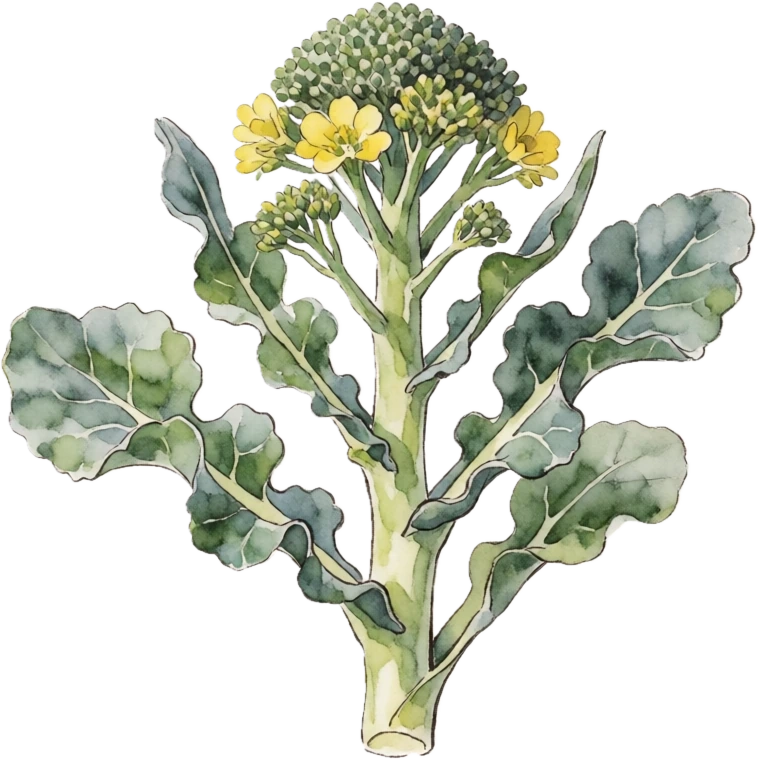
Botanical illustration of Broccoli
Annual · Brassica oleracea var. italica

Heat makes it bolt to yellow flowers overnight — spring crop needs an early start; fall crop (transplant late July) is more forgiving.

AnnualFull SunModerate waterModerate growthExcellent edibleAttracts beesAttracts butterfliesNone winter chill

☤ Juglone-sensitiveBroccoli is sensitive to juglone — the toxin exuded by black walnut, butternut, and their relatives. Keep it 50+ ft from any walnut or hickory, or its leaves will yellow, wilt, and die back for no obvious reason.

Where to buy the plant — 3 nurseries

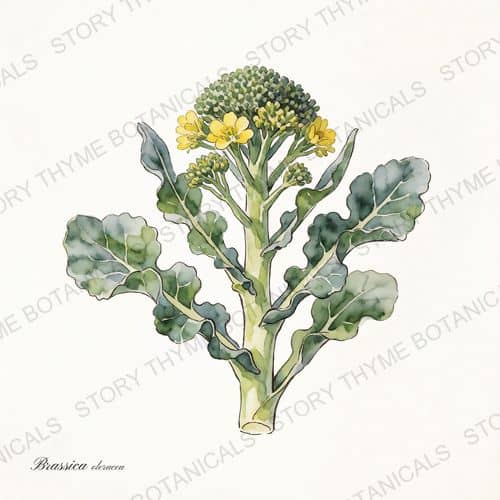
Broccoli Plant — a print from the Vegetables Vol. 2 - In the Garden collection

From the print shop

Growing broccoli? Hang it.

Our Vegetables Vol. 2 - In the Garden collection carries broccoliBrassica oleracea, print Nº 14, “Broccoli Plant.”

16 designsfrom $21.99white or black groundmatte poster, unframed

Shop Vegetables Vol. 2 - In the Garden botanical prints →

I

Overview

Will broccoli suit your garden, and what goes wrong.

Will it fruit where you are?

Enter your ZIP — we look up your USDA hardiness zone (2023 map) and check it against what broccoli actually needs.

Life cycleAnnual
Winter chillNone

Broccoli at a glance

Life cycleAnnual
Mature size2-3 ft
PollinationNone (harvested before bloom)
Chill requirementNone (not chill-dependent)
Bloom seasonHeads ARE flower buds
Harvest seasonJune, then side shoots; fall crop October
Growth rateModerate

Common broccoli problems

II

Growing

Light, water, soil, propagation and the season’s jobs.

How to grow broccoli: light, water & soil

LightFull Sun
WaterSteady, 1-1.5 inches/week
SoilRich, Firm · pH 6.0 - 7.0
FertilizerHeavy feeder. Nitrogen at transplant and 3 weeks later.
PruningNone (annual) — Cut central head at 45° — side shoots produce for weeks after.
Spacing18 inches

How to plant & propagate broccoli

Maturity60-90 days
From seedStart indoors 6 wks early or sow midsummer for fall; 45-75°F
PropagateFrom seed

When to spray broccoli

Growing season. Bt every 7-10 days from transplant. Soak harvested heads in salt water to evict hidden worms.

The broccoli growing playbook

Field-tested instructions for every job broccoli asks of you, compiled from university extension guidance — in the order the season brings them.

Sowing

Start seed indoors 6-7 weeks before you plant out

Sow seed a quarter to a half inch deep, 6 to 7 weeks before your intended planting-out date - and that date is 2 to 3 weeks before your average last frost, not after it. Aim to produce a plant with 4 to 6 mature leaves and a well-developed root system at set-out. Broccoli has to size its head while the weather is still cool, so the crop must already be well ahead of the heat before it ever reaches the ground. Six to seven weeks is what it takes to build a transplant big enough to grow away fast but not so old that it buttons.

Sow the fall crop by counting back from your first frost

For a fall crop, count your variety's days to maturity back from your average first fall frost and sow then; leave yourself some slack, since heads size slowly as the days shorten. Choose a longer-cycle variety of 60 to 85 days so the head forms in cooling weather. Seed can start indoors or go directly in the garden, since the soil is already warm. A fall crop matures into cooling weather, which is when broccoli makes its tightest heads, but it still has to finish before hard freezes arrive. Broccoli keeps growing through the first light frosts, so the deadline is the hard freeze, and the only portable way to hit it is to count backward from your own frost date rather than trust a calendar month.

Planting out

Set plants out 2-3 weeks before last frost, at 4-6 leaves

Harden plants off, then set them 12 to 18 inches apart in rows 2 to 3 feet apart, 2 to 3 weeks before your average last frost. Choose plants with 4 to 6 mature leaves and pass over the older, larger, root-bound ones. Broccoli takes frost, so going out early buys cool weather for heading. But an over-mature or stressed transplant buttons - it throws a tiny useless head instead of growing on - and plants set closer than 12 inches make smaller heads and far fewer side shoots.

Watering

Hold water steady at 1-2 inches a week as the head fills

Give 1 to 2 inches of water per week, watering deeply and infrequently rather than lightly and often. Drip irrigation is ideal. Do not let the plant dry down and rebound while the head is sizing. A drought check as the head forms is a direct cause of buttoning - the plant reads the stress as a cue to flower early and quits growing the head, and no amount of later watering undoes it. Deep infrequent water drives roots down and buffers the plant through the next hot spell.

Feeding

Split the nitrogen: four weeks out, then at quarter-sized head

Four weeks after transplanting, sidedress a half cup of 21-0-0 per 10 feet of row. Apply another quarter cup of nitrogen fertilizer once the head has reached the size of a quarter. Set phosphorus and potassium from a soil test rather than guessing. Broccoli builds nearly its whole head in one short window, and a nitrogen check during that stretch is one of the things that makes plants button or throw loose, uneven heads. Splitting the nitrogen keeps it available through head fill instead of flushing past the crop while the plant is still small.

Spraying

Cabbageworms: Bt at button stage, while the larvae are small

Check both sides of the leaves weekly from planting on, and more often as the season progresses. If you find two or more medium-sized larvae per 10 leaves at the button stage, spray Bacillus thuringiensis var. kurstaki, then follow with a clean-up spray 7 to 10 days before harvest. Get thorough leaf coverage - the caterpillars have to eat it for it to work. Imported cabbageworm, cabbage looper and diamondback moth larvae move into the developing head, where no spray can reach them and no washing gets them out afterward. Bt only kills caterpillars that ingest it and is far more effective on small larvae than large ones, which is why the button stage is the moment and not a week later.

Bt kurstaki kills only caterpillars that eat it and spares the parasitoids and other natural enemies that hold these pests down, unlike broad-spectrum permethrin, beta-cyfluthrin or lambda-cyhalothrin. Utah State times the final clean-up spray 7 to 10 days before harvest - treat that as your interval before cutting.

Protection

Row cover goes on the day you transplant, edges buried

Lay lightweight floating row cover over the bed at transplanting and bury the edges so no gap remains. Leave it on until harvest - broccoli is cut in bud and needs no insect pollination. Only use it on ground that did not grow a brassica crop or brassica cover crop last year. Cabbage maggot flies lay at the base of the plant and the maggots tunnel the roots, and once they are feeding there is nothing you can spray - the cover has to be in place before the flies are flying. The same cover stops cabbage butterflies and looper moths from ever laying an egg. But cover stretched over last year's brassica ground does the opposite: it traps the maggot flies emerging from that soil in with your crop.

Harvesting

Cut while the beads are tight, then feed for side shoots

Cut when the head is large and compact - 6 to 12 inches across on a full-size variety - and before any flower bud opens, taking about 6 inches of stem with it. Leave the plant standing. Sidedress nitrogen after cutting to push side shoots, and keep picking those smaller heads. The head IS the flower bud cluster, so once the beads loosen and show yellow the crop is past eating quality and the plant is committing to seed. Cutting the main head releases the lower buds to grow, and nitrogen right after harvest is what turns them into a second, much longer picking.

Broccoli companion plants

Good companions

Underlined names have their own growing guide in this library.

III

The year

What broccoli asks for, month by month.

The broccoli year, month by month

MonthJanFebMarAprMayJunJulAugSepOctNovDec
Harvest

What each band means

  • Harvestpicking time — check ripeness every few days.

The broccoli year as text

  • Jan quiet month
  • Feb quiet month
  • Mar quiet month
  • Apr quiet month
  • May quiet month
  • Jun harvest
  • Jul quiet month
  • Aug quiet month
  • Sep harvest
  • Oct harvest
  • Nov harvest
  • Dec quiet month

These are the species' typical months — expect them a few weeks earlier in warm zones and later in cold ones. Watch the plant, not just the calendar.

IV

Ecology & uses

What it does for the garden, and what it is grown for.

Broccoli in the garden system

  • Herbaceous layer annual
AttractsBees, Butterflies
MoistureFacultative / average
DeerBrowsed — protect young plants
OriginIntroduced

What broccoli is grown for

✓ Commonly eaten

UseFresh
UseFreezing
UseSide shoots
Edible value4/5

Harvesting & storing broccoli

June, then side shoots; fall crop October. About 60-90 days from planting.

Edibility, identification, and traditional-use notes here are general reference — not medical or veterinary advice, and not a claim that any plant treats or prevents anything. Medicinal ratings record how strongly a plant features in herbal tradition, nothing more. Never eat or dose a plant you have not positively identified. More on how to use this library.

V

Cultivars

Named varieties of broccoli, ruled as a catalogue.

Best broccoli varieties & cultivars

10 on file

Named varieties of broccoli differ in days to maturity, disease resistance, flavor, and habit — pick one that fits your season and space.

Flash

DiseaseDowny mildew

The strongest heat claim of any broccoli sourced, combined with 50 days - the pick where spring turns hot fast, since it can head up before the heat rather than fighting it. No bolt claim was found; heat resistance is the sourced trait.

Where to buy ‘Flash

Story Thyme Farms may earn a small commission from these links, at no cost to you — it never changes what we recommend.
Green Magic

DiseaseDowny mildew

Heat tolerance plus 57 days is what lets it hold a head through a warm spell that would make other broccoli button or go loose - the default for a southern spring or a summer planting. Sourced for summer OR fall harvest, so it is the flexible slot in a succession.

Where to buy ‘Green Magic

Story Thyme Farms may earn a small commission from these links, at no cost to you — it never changes what we recommend.

Belstar

DiseaseBlack rot, downy mildew, fusarium yellows and wilt, white rust

Tolerant at both temperature extremes and of stress generally - the widest-latitude pick, usable spring and fall on the same site without swapping varieties. Broadest disease package here, which matters in a wet spring. Heads are smaller (5-6 in), so plant more for the same yield.

Where to buy ‘Belstarverified

Story Thyme Farms may earn a small commission from these links, at no cost to you — it never changes what we recommend.

Arcadia

DiseaseBrown bead, black rot, downy mildew, head rot

Best disease package plus tolerance at both extremes, but Cornell directs it to late summer or fall - treat it as a fall crop despite the heat tolerance. Cornell lists a wide 63-94 days; do not trust the low end in a short season. Head rot resistance is why to choose it where autumn is wet.

Where to buy ‘Arcadia

Story Thyme Farms may earn a small commission from these links, at no cost to you — it never changes what we recommend.

Marathon

DiseaseBrown bead, downy mildew, black rot

A FALL variety, not a spring one - sourced as late and cool-weather, so plant it to MATURE into cold rather than out of it. At 68 days a northern grower must count back from frost and transplant, not direct-sow. Brown bead resistance is why it holds head quality in a cold wet fall.

Where to buy ‘Marathon

Story Thyme Farms may earn a small commission from these links, at no cost to you — it never changes what we recommend.

Packman

The care consequence here is a WARNING, not a virtue: it buttons - throws tiny useless heads - under stress, so it must not be checked by drought, transplant shock, or a cold snap. Keep water and fertility steady or the crop simply fails. Good side shoots extend one planting. Cornell lists 50-73 days.

Where to buy ‘Packman

Story Thyme Farms may earn a small commission from these links, at no cost to you — it never changes what we recommend.

De Cicco · Di Cicco

Grow it for cut-and-come-again side spears, not one big head - heads are only 3-4 inches, so cut the main head early and keep taking laterals. HONEST GAP: no heat, cold, or bolt claim found on any extension source, so none is asserted. Gardener reviews report slow maturity in short-season regions, so 48 days may not hold in the north.

Where to buy ‘De Ciccoverified

Story Thyme Farms may earn a small commission from these links, at no cost to you — it never changes what we recommend.

Waltham 29 · Waltham Italian Green Sprouting

HONEST GAP: no heat-tolerance, cold-tolerance or bolt-resistance claim could be sourced from any university page - the widely repeated 'fall variety, heat-sensitive' framing traces only to seed vendors and is deliberately omitted here. Cornell's maturity is a very wide 60-95 days; do NOT plan a short season around the low end.

Where to buy ‘Waltham 29verified

Story Thyme Farms may earn a small commission from these links, at no cost to you — it never changes what we recommend.

Diplomat · Diplomat F1

DiseaseDowny mildewSizeMedium-large heads with small beads

Cornell sources it as both cold and heat tolerant, but points it at northern areas with moderately warm temperatures for summer and early fall harvest - so it is a northern variety that shrugs off a hot spell, not a southern one. At 68 days it is late enough that a short-season grower must transplant rather than direct-sow.

Where to buy ‘Diplomat

Story Thyme Farms may earn a small commission from these links, at no cost to you — it never changes what we recommend.
Emerald Jewel · Emerald Jewel F1

DiseaseClub root, downy mildew

The reason to pick this: it is one of the few clubroot-resistant broccolis on Cornell's disease-resistance list, which also carries downy mildew resistance. Clubroot resting spores persist in soil for many years, so on ground with a known history no rotation you can realistically wait out will clear it - resistance is the practical answer. Monclano is the other clubroot-resistant variety Cornell lists, so compare the two before committing. HONEST GAP: Cornell's disease list gives the resistances but no maturity, heat or cold figure, so none is asserted here.

Where to buy ‘Emerald Jewel

Story Thyme Farms may earn a small commission from these links, at no cost to you — it never changes what we recommend.

VI

Sources & plant ID

Where the care distinctions come from, and how the plant is filed.

Research basis

Sources behind this profile

No extension citations are attached to broccoliyet. The care figures below come from the library's own catalogue rather than a traced primary source.

Plant ID

BinomialBrassica oleracea var. italica
FamilyBrassicaceae
TypeAnnual
USDA symbolBROL
OriginIntroduced
Invasive riskLow

VII

Where to buy

Third-party nurseries — not Story Thyme Farms.

Third-party nurseries, not Story Thyme Farms. Prices are theirs.

Story Thyme Farms may earn a small commission from these links, at no cost to you — it never changes what we recommend.

VIII

Questions

Broccoli questions, answered straight.

Is broccoli safe for kids and pets?

Broccoli is commonly eaten and isn't considered toxic, but "commonly eaten" isn't a guarantee for any particular person or animal — allergies, quantity, and which part you eat all matter. Never eat a plant you haven't positively identified, and check with a vet before letting pets or livestock graze anything new.

When do you harvest broccoli?

June, then side shoots; fall crop October. From planting, expect about 60-90 days to maturity.

What grows well with broccoli?

Proven companions include aromatic herbs, onions, nasturtium — the full companion list, and what to keep away, is in the Growing tab above.

How do you propagate broccoli?

From seed.

IX

Elsewhere

Where broccoli sits in the library.

Where broccoli sits in the library

Grows in the same world